
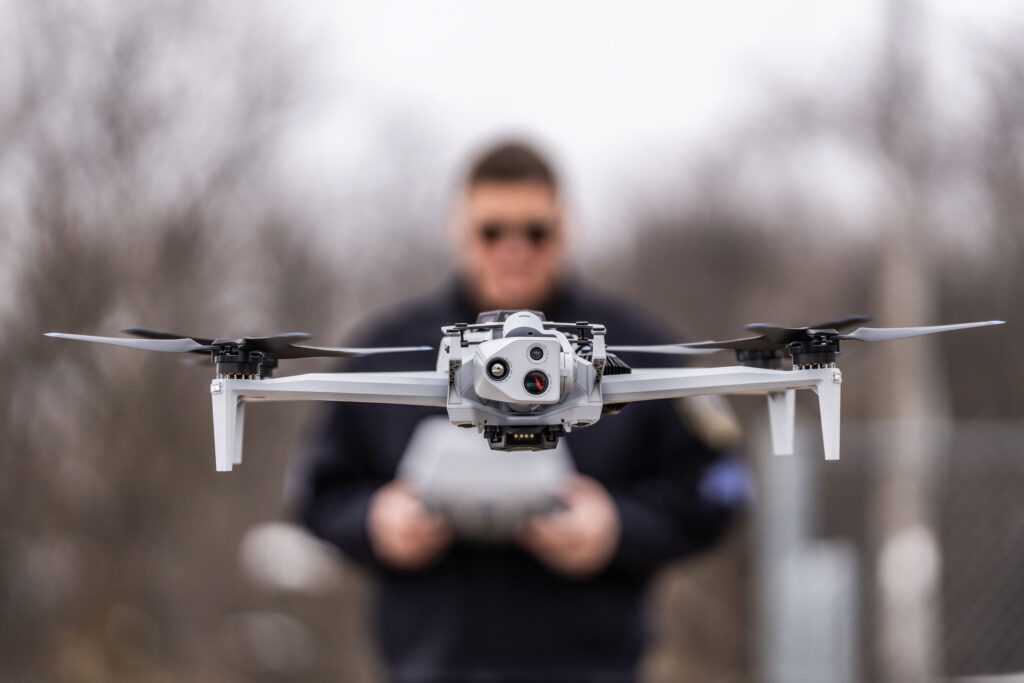
Americans’ protection against unreasonable search was codified in 1791 via the Constitution’s Fourth Amendment. But the founding fathers could not have imagined the future we now live in: easy-to-fly quadcopters, capable of cruising at 45 mph, carrying high-definition cameras and infrared imaging.
Now the Milwaukee Police Department has 11 of these drones, each costing about $16,500. They’re piloted using keyboards or off-the-shelf Xbox controllers and can be launched from squad cars or from police station roofs. What MPD calls the “Drone as First Responder” program can unquestionably be a boon to public safety, particularly in high-risk situations. A drone can be an eye in the sky capable of scouting a shooting scene, provide a lookout during a domestic violence response, or use thermal imaging to find a lost hiker or swimmer.

Know somebody making an impact in Milwaukee?
On his first DFR flight in January, Sgt. Christopher Boss used a drone to quickly find a shooting victim soon before the first squad car could arrive. “We were able to help route the officer. And then we were also able to cover the officer, who was there by himself, rendering lifesaving aid to this person with a crowd around him. We could monitor the crowd and make sure there was nobody there tampering with evidence,” Boss recalls. That was just one of the 100-plus calls that Milwaukee’s police drones responded to in their first week of regular action.
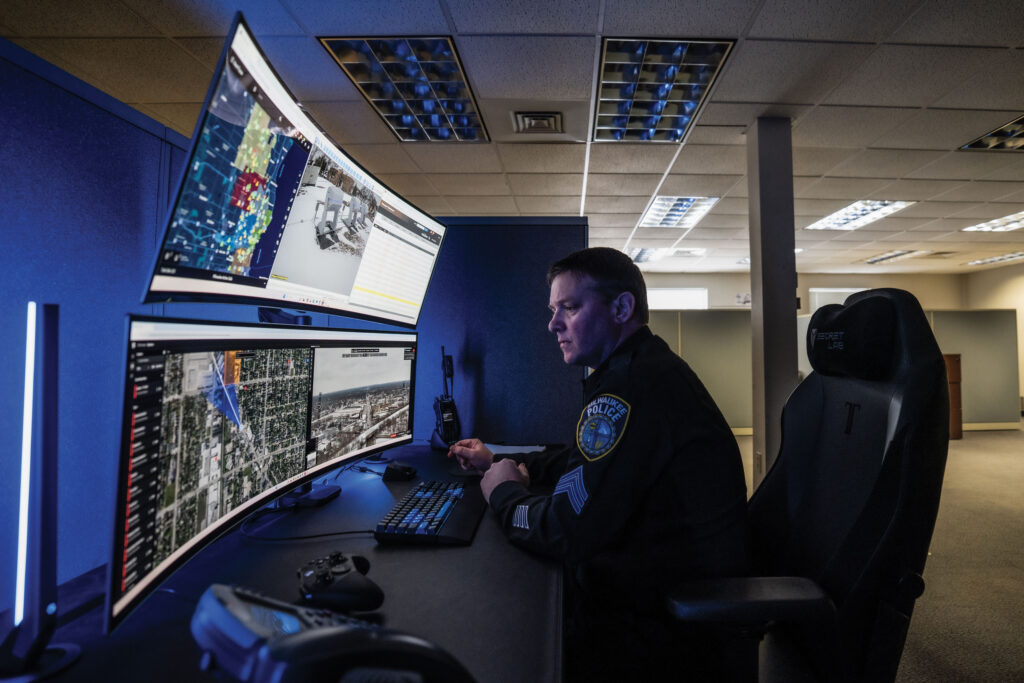
MPD does not need a warrant to launch its eyes in the sky. Like a recreational craft with a sightseeing camera, police drones can be flown just about anywhere at any time with a license. MPD has presented the Fire and Police Commission and Common Council with “standard operating instructions” for drone use, which are not public, and says they continue to work with both governing bodies.
While the idea of airborne motorized eyes of government circling above us had largely been the stuff of dystopian science fiction, local, state and federal legislators have all been reticent about putting limits on drone units. The guiding principle for warrantless aircraft reconnaissance by law enforcement was set out in the 1989 Florida v. Riley U.S. Supreme Court decision. In that case, a police helicopter was used to confirm that a greenhouse was being used to grow marijuana. That flight was deemed to have not violated the grower’s privacy because airspace is considered “public space.”
With Florida v. Riley in mind: “The question becomes whether this [drone] technology is so advanced – and so intrusive – that it violates the reasonable expectation of privacy protected by the Fourth Amendment,” former Waukesha County District Attorney Paul Bucher, now a defense attorney, wrote in an October blog post. “What has never been settled is whether low-altitude hovering over private backyards or fenced areas constitutes a ‘search.’”
In an interview, Bucher says he has always advised cops, “When in doubt, get a search warrant.” But, “in most of these [drone] cases, you don’t need a search warrant.” He doesn’t expect legislators to take on regulation of warrantless drone usage, because of the prevailing politics of the day and the legal complexities of the issue.
The last time the state Legislature weighed in on this was more than a decade ago. The 2013 law states that police cannot use drones “to gather evidence … in a criminal investigation from or at a place or location where an individual has a reasonable expectation of privacy without first obtaining a search warrant.”
Because the American Civil Liberties Union also doesn’t expect meaningful legislative action, it’s pressuring municipalities to erect some guardrails. “There are credible reasons why law enforcement wants to use drones,” says Jon McCray Jones, an ACLU of Wisconsin policy analyst. “The problem is that drones are often being used to surveil protests and people expressing their First Amendment rights, and being used in non-emergency situations and situations like crowd control.”
The ACLU is particularly concerned about AI-powered facial recognition being used to identify and surveil protesters long after demonstrations wrap up. “Even if you don’t have live facial recognition technology, if you have cameras and that data is being recorded, you can, after the protest, run a facial recognition software through that camera footage, and identify and target the people who are involved in a protest,” McCray Jones worries. “Imagine if J. Edgar Hoover was able to deploy facial recognition of who went to the Selma March.”