
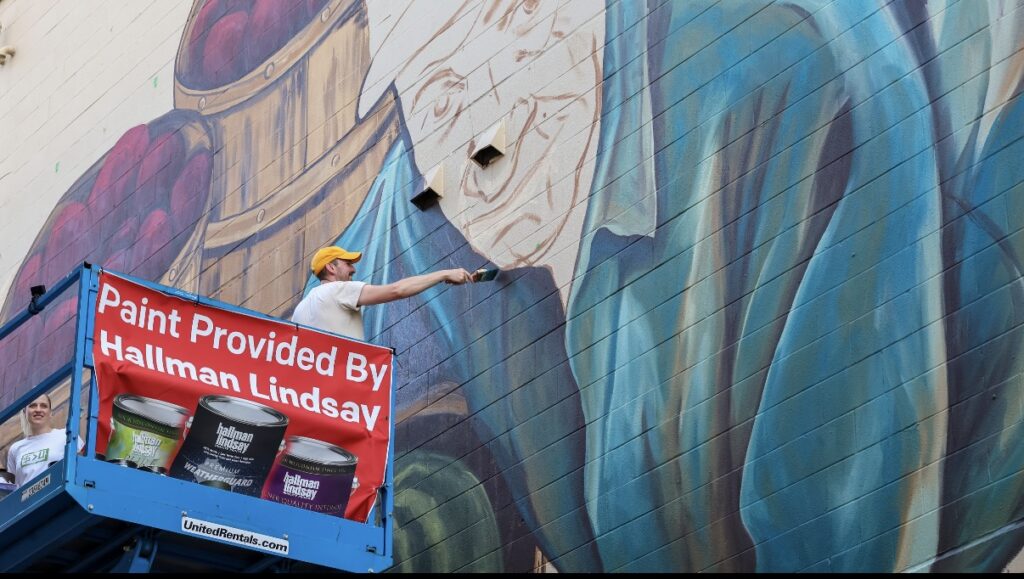
Since early August, Milwaukee artist John Kowalczyk, who also teaches at UW-Milwaukee’s School of Architecture & Urban Planning, has spent his days creating a massive mural named “Portal to the Past,” which aims to translate more than a century of neighborhood history into a single visual work on the north-facing façade of the Commission House condominium development (400 N. Broadway St.).
A Chicago native who graduated from the Milwaukee Institute of Art & Design, Kowalczyk has spent the past two decades creating murals, sculptures and public art installations in Milwaukee. His first public-facing mural was on a garage at Mitchell Park and his work can also be found in the East Side’s Black Cat Alley. Other recent public work includes “Archaea,” a collaborative installation on Milwaukee’s lakefront, presented by Joy Engine and Fuzz Pop Workshop, along with his “Foxes and Friends” mural on the south wall of the Broadway Theatre Center, (158 N. Broadway St.).
Known for his signature layering techniques, vibrant patterns and structural symmetry, Kowalczyk’s design for “Portal to the Past” features a striking dual perspective, offering distinct visual experiences whether viewed by pedestrians up close on the sidewalk or by commuters taking in the full sweeping mural from a distance.

Celebrate this year’s winners of the Betty Awards!
Two other Milwaukee artists, Sara Bott and Drew York, are assisting Kowalczyk in creating the mural that will adorn a building that has stood since 1911 and once served as a wholesale produce warehouse for E.R. Godfrey & Sons, a company credited with bringing the first shipment of bananas to Milwaukee and also the first in the city to enter the frozen food business.
The building, which features brown and glazed yellow brick and terra cotta trim, later housed Bruce Publishing Co., a printer of Bibles and other liturgical materials, following Godfrey’s departure from the site in 1949.
LoDuca Brothers converted the building in the 1970s to distribute accordions and wine. A major renovation in the early 2000s transformed the property into a 30-unit condominium complex. A ghost sign from the company will remain.
The size and scope of the project have created a bit of stress for Kowalczyk and his fellow artists.
“It’s definitely the size, but I think it’s also dealing with what it means to me and what it means to the city of Milwaukee,” Kowalczyk said on a recent morning as rain fell, forcing a break in the painting. “This is my most public-facing project and hopefully the most permanent mural I’ll put up; you can see it from Downtown and the freeway.”
The project has presented some challenges, mostly due to its scope and location immediately adjacent to an I-794 ramp that passes within feet of the building. Saying he was both “terrified and excited” to start work on what he referred to as a “behemoth of a mural.”

Kowalczyk is designing the mural using almost all 15,000 square feet of space available to him, working with the ramp obstruction to create the intended dual perspective. Drones have been used to scan the building and assist in the mural’s design, as have virtual reality goggles.
The lower portion of the mural is designed to bring back to life the Commission Row fruit and vegetable market from the 1900s and features horse-drawn wagons, a vine of oversized grapes, produce-filled crates and a whimsical 20-foot cat.
The upper part will feature a large-scale accordion, more grapes, as an ode to the building’s use as a distributor of wine, as well as banana leaves.
“It is truly an honor to leave my mark on Milwaukee’s skyline,” said Kowalczyk.
The $153,000 project reached its funding goal through a coalition of community backers, anchored by an anonymous lead donor and a donation of paint from Sun Prairie-based Hallman Lindsay Paints.
The mural “ensures that the story of the makers, merchants and music that built Milwaukee remains an indelible part of our skyline for generations to come,” Mary Schanning, a member of the Commission House Mural Committee, said in a statement.
The committee selected Kowalczyk following an extensive search. Out of more than a dozen artists interviewed, four finalists submitted concept renderings, with Kowalczyk’s vision unanimously rising to the top.
While his immediate attention is focused almost entirely on “Portal to the Past,” Kowalczyk already has lined up a future project, which will be a colorful painting of flora and fauna on two faces of the BBC Lighting building, (2015 W. St. Paul Ave.) in the Menomonee Valley.
“Portal to the Past” is expected to be completed by November. The public is invited to follow the daily progress on Instagram.
“Murals are one of the easiest things to do to brighten up an area. They make such an impact,” Kowalczyk said.