
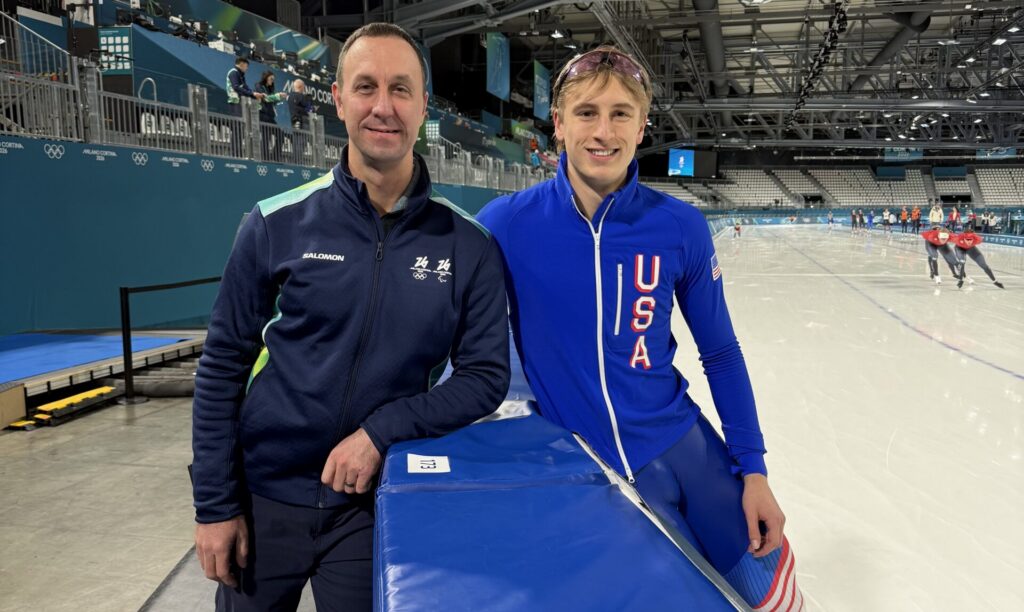
Jordan Stolz has emerged as the most decorated American athlete in the Milan Cortina Winter Olympics. Winning three medals, including a pair of golds, the 21-year-old Kewaskum speedskater has established a name for himself as a phenom in the sport – and behind the scenes of those races was Paul Golomski, the general manager of Milwaukee’s Pettit National Ice Center.
Stolz has skated and trained at the Pettit Center since early childhood, has set records on the center’s 400-meter oval, and always has high praise for the team, led by Golomski, that meticulously creates and maintains the ice conditions at the facility, which serves as an official training site for U.S. Speedskating.
Golomski’s work led to him being selected to serve as part of the ice crew at the Milano Speed Skating Stadium for the run of the Milan Cortina Olympic Games after handling a similar role for the 2018 Winter Games in Pyeongchang, South Korea. He served as one of four ice technicians who worked under the direction of ice master Mark Messer, director of the Olympic Oval in Calgary, Canada.
“Both Games were life-changing opportunities for me,” says Golomski, who spent a month in Milan leading up to and during the Olympics, in addition to a 10-day stint there in November during a trial run. “I have great memories and I’ll never forget a single day.”
His responsibilities in Milan included readying and maintaining the ice for training and competition, monitoring ice temperatures and making sure ice resurfacing equipment was in proper working order. “We’re looking at ice thickness, plotting 50 or 60 points of ice thickness every day,” Golomski says. “We’re also checking water quality and water temperature and purification systems.”
During breaks in his busy schedule, Golomski got to witness, from a trackside vantage point, Stolz’s exhilarating medal-winning performances. When Stolz captured a gold medal in his first race in Milan, an Olympic record-breaking performance in the 1,000 meters, he found himself battling a wave of emotions.
“I was really having trouble keeping my composure and staying focused,” says Golomski. “He’s one of the hardest working kids in the whole sport and he’s been that way from a very young age. To become an Olympic champion isn’t an easy thing to do.”
Golomski described it as “a dream come true” to be part of the crew that made and maintained the ice for Stolz’s medal-winning moments. “To have Jordan skate and win medals on ice that I was able to make with the team, it was awesome,” Golomski says.
At the Olympic Trials, Golomski had a cheering section of his own that consisted of his wife, Ashley, and son, Benjamin, who held up a sign with the words “My Dad is the Icemeister.” Ashley and Benjamin, along with Golomski’s father, got to spend a week taking in the action in Milan, making the Olympic experience even more special.

Golomski Has a Long History Working With Ice
Golomski has spent more than two decades developing and honing his ice-making skills. Stolz and a bevy of other skaters have been quick to express their appreciation and respect.
During the International Skating Union World Cup event in January 2025, skaters were effusive in their praise for Golomski after track records were set in every race over the first two days of competition.
“The ice is always great at the Pettit. Paul does a really good job here,” said Erin Jackson, a gold medalist in the 500 meters at the 2022 Winter Olympics in Beijing. “This is my favorite place to race and it definitely delivered.”
Stolz flashed a smile when comparing the Pettit Center track that weekend to the oval at Heerenveen, in the Northern Netherlands, a regular stop on the ISU World Cup renowned for turning out top times. “Heerenveen is supposed to be the fastest ice, right?” Stolz said. “And now they’re in Milwaukee and everyone is going faster.”
Skaters competing at the U.S. Olympic Long Track Speedskating Trials held at the Pettit Center in January again had high praise for the ice conditions. “The ice here is one of, if not the best, in the world. It always feels fantastic and the ice crew here does an amazing job getting everything to be pristine every time we’re here,” said Cooper McCleod after earning a spot on his first Olympic team. “Everybody, universally across the globe, agrees with that after having the World Cup here last year.”
The comments mean a lot to Golomski and his team.
“I have a great team of ice technicians and maintenance technicians. There is no way one person can deliver all of this,” he says. “It feels great to hear those comments. We’ve dedicated our lives to this craft and trying to perfect the science of ice and making skaters go fast. At the end of the day, we’re hoping to get really good feedback and that skaters like the ice.
“The athletes are the reason for our success but it’s a feather in our cap to hear them compliment the work we have done,” Golomski continues. “Keeping the ice in top condition isn’t an easy job. There’s a lot of work behind it and it makes all the work worthwhile when we get that type of feedback.”

Celebrate this year’s winners of the Betty Awards!
What Goes into Making the Perfect Speedskating Ice?
Many factors go into making the “fast” ice desired by skaters, Golomski notes.
“First, you have to have good water, so we purify the water and we back blend minerals into it to get to a really precise parts per million of solids in the water,” he says. “The water is critical. We heat the water to about 160 degrees to remove gas from it and lower the surface tension of the water. Once we do that, ice temperature becomes super critical for getting good glide. There were all these different variables that we had to take into account to try and find that really precise Goldilocks zone where everything is really good and the skating is fast.”
Speedskating blades are designed to slide and glide but not penetrate the surface of the ice like hockey and figure skating blades, which can dig into the ice, he says.
“If we get the ice too warm, skaters lose glide and speed and they’ll call the ice soft, which is a slap in the face to a speedskating icemaker,” Golomski says. “One of the big challenges we had in this building is we didn’t know how it would react when 7,000 to 9,000 fans came in. During the first event, the air temperature rose about four or five degrees and we weren’t really expecting that. There was a lot of adapting during the first few days.”
Challenges abounded in Milan, Golomski says, especially since the speedskating oval was a temporary track built inside adjacent trade fair halls.

“I’ve never worked on a temporary track before. It was a bit of a learning curve for us,” he says. “The biggest challenge for a floor like that is that the ice isn’t bonded into the concrete. When we make ice on a concrete floor, the first layer actually bonds into the pores of the concrete and you have a rigid bond, almost like glue. With this, there was insulation on top of the concrete floor and a big plastic liner that they put a flexible piping system on and the ice sitting on top of the piping system. So, when we drive a 6- or 7-ton machine onto the ice, we had to be very careful.”
Stolz’s rise to becoming one of the world’s most dominant speedskaters extends far beyond his intense training regimen. He often turns to Golomski and his team to pick their brains about ice and other topics, anything that could give him an edge on the track.
“Jordan has learned a lot about the science of ice,” Golomski says. “He’s a student of the sport in almost every aspect, from boot and blade technology to building technology to how different water conditions and altitude at different venues might impact his performance. He really wants to understand how he can perform well in every building. He studies video and talks to people like me and others that are really in tune with the science behind ice and what it takes to do well.”
The knowledge exchange goes in both directions, as it did in Milan. “Jordan provided our crew with feedback, too,” he says. “His feedback, while being one of the best skaters in the world, really helps us dial in the ice conditions a bit better. In the first week of training there, he gave us some really good feedback.”
After all of the excitement surrounding the Olympics and all the attention paid to Stolz, Golomski was back on the job at the Pettit Center this week.
“It’s kind of right back into the day-to-day duties,” he says. “I wear a lot of hats here administratively, overseeing the whole building and everything ice related. When you go to the Olympics for 28 days and come back, there are a lot of people that want to congratulate you. But it’s not quite as much fun sitting as a desk as it was being at the Olympics.”
Golomski says he’d certainly accept an invitation, if asked, to be on the ice crew for the 2030 Winter Olympics in France. But he’s also got the 2034 Games in Salt Lake City on his mind and he’s hoping Stolz’s performance in Milan will spark more interest in speedskating.
“We’re hoping we use Jordan’s success as a launching pad to inspire other kids to get into the sport, like how Jordan was inspired by [short-track speedskater] Apolo Ohno,” Golomski says. “It would be really cool for the U.S. to perform well on home soil in eight years and it will take that long to develop a youth athlete into an Olympic athlete.”
As a nonprofit, the Pettit Center is constantly in search of the next generation of skaters to keep the facility viable, Golomski says. “Jordan’s really a great mentor for kids who are skating here already,” he says. “For them to know that they can skate on the same ice as an Olympic champion, that’s a pretty cool thing. Hopefully, parents will see that Jordan started out just like any other kid.”
Golomski offered a final reflection of his time in Milan.
“The situation was much more complex and there were a lot of people that had big-time doubts about our ability to deliver a high-performing sheet of ice,” he says. “To come out with seven Olympic records was something that nobody was expecting. Skaters hit times that were even low-land world records and that seemed as though it wouldn’t be possible. We’re really satisfied with how it went.”
Something else from Milan is also sticking with Golomski.
“The food in Italy was amazing,” he says. “I didn’t have a bad meal there. I’m missing that.”