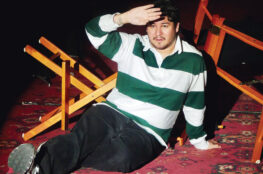
Michael Cerda is a modern-day sign-painter, freshening up facades with a distinct retro-inspired touch through his business Cerda Design Co. (@cerdasignco).
You’ve likely seen his work without knowing it – on the windows, doors and walls of 414loral, Lilliput Records and more local spots. He sometimes designs the logos he paints, like that of Ruby’s Bagels. Otherwise, he tailors existing branding by adding drop shadows or using gold leaf on glass – his favorite method.
“I feel like people really latch onto the story-telling element of sign-painting … the fact that it’s done by hand,” he says. “There’s just something more special about it.”
MilMag spoke to Cerda about how he’s become the go-to guy in this throwback trade.

If someone has inspired you through their service, leadership or dedication, the Unity Awards are your opportunity to recognize them!
I wanted to start with your background in graphic design. What sparked your interest?
I grew up loving to draw and paint. As a kid, making money wasn’t really the goal – I just did it because I loved it and it was fun. As I got older, I realized that I needed to find a way to make money off of it. And I got into airbrushing at the same time I was in high school, so I was doing graffiti here in Milwaukee. It’s not a great way for spending time; I got busted for that. I immediately let that go, and I found graphic design as another way to express myself while making money and still doing something creative.
What do you think drew you to letters?
Honestly, looking at album covers. When I was younger, my brother used to collect house music. Back in the ’90s, they made these cassette tapes of Latin house, and a lot of the artwork that was on these cassette tape cases were hand-drawn illustrations. Instead of typing out the title, a lot of the letters were hand-drawn. That caught my attention. Also, looking at Lowrider magazine – it’s a magazine that would highlight lowrider culture out in the West Coast or pretty much all over the country. And if you notice on the lowriders, a lot of the cars would have really intricate script letters or Old English letters. Going back to the whole graffiti lifestyle, looking at people’s sketchbooks and the art that was on the walls. I didn’t really understand it back then. I felt like it just caught my attention, and it was just slowly programming in my brain that one day all this information that I’m collecting is going to become useful.
How did sign-painting become a practice for you?
A lot of sign-painters started sharing their work on Instagram, and I started following these accounts and not really understanding what they were doing. It just looked cool. And then I started analyzing the signage that was in Milwaukee, along with ghost signs, the old faded signs of buildings all throughout the city. All that started to register, like, oh my God, these signs were done by hand. Someone with a brush is actually laying this stuff down. There wasn’t much online about sign-painting and tutorials, so I had to rely on just trial and error.
What was the first business you did signs for?
Jesus Gonzalez is a good friend of mine. He owns Mazorca Tacos, which used to be parked on First and Pittsburgh. It’s this metal food cart, and when he first opened, he had hit me up to first do his logo and then to hand-paint his sign for his menu. I fabricated this huge wooden panel with a frame and a way to hang it. I laid out the menu items by hand, and then I painted it, and I made a video documenting the whole process. It’s literally a video documentation of me not knowing what the hell I was doing. If I were to do that sign today, I would do it completely differently because I’m just making a ton of mistakes. I was learning in real time what sign-painting was without looking anything up. At the same time, I was doing lettering on Pete’s Pops carts.
How long does the painting process take?
It depends. The most common signs I do are branding signage for businesses. A lot of the times they’re on the front windows of their business, and that’s probably my favorite type of project – working on glass. Sometimes they just want their logo, or they want the services that they provide. Sometimes I’ll be at a job for four hours, and another one will take three days. It’s about patience. It’s about understanding how the paint reacts on the glass, how many coats of paint you need, the colors that work well together, the colors that are best visible from the street, if the glass is double-paned or not. Whether they want to go fancy and they want to use gold leaf, which is another old-school way of doing signage. In my honest opinion, gold leaf on glass is unmatched. It’s the coolest thing when it comes to signage.
You’ve also painted some murals around town, like El Paletero in Walker’s Point.
Yeah, that one was really exciting. That’s probably my proudest project because I was working with the Brewers, which is exciting alone, but also the message with the mural that we painted means a lot to me. Another one from last year was I did was a homage to the Tarahumara, a tribe of people in Mexico who are known for their long-distance running, and they run in sandals for 26 miles – like full marathons – across this rough terrain. (The mural) is a pair of legs that are a Tarahumara runner. It’s in the parking lot of Zócalo Food Park. Those two murals got me wanting to do more mural work, because it satisfies me in a different way than sign-painting. Even though I am able to express myself through sign-painting, with the murals I can paint different things and tell different stories. And it’s almost like instead of giving to a business to promote what they’re doing, it’s like giving back to the community.
What do you enjoy about sign-painting?
It’s incredible. I’m really in love with connecting with the community. Being able to meet these business owners and helping them with their signage keeps me grounded and connected with people that are doing things in the city. And feeling like I’m playing a role in bringing that dream to life is really fulfilling. I also feel like I’m keeping an old-school tradition alive. Sign-painting for a while was starting to fade away because it was being replaced by vinyl signs. With Instagram and social media, old-school sign-painters were able to share their work, thus inspiring the new generation of guys and girls to pick up the trade. Now there’s tons of sign-painters all over the world, and I’m one of those people here in the city that is trying to keep that tradition going.