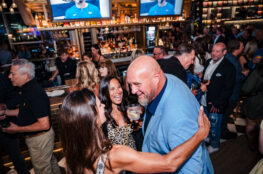


Bar owner John Dye lives in the shadow-splashed world of the perpetual cocktail hour. Mixing and serving stiff drinks, channeling nostalgic eras frozen in time – that whole aesthetic accompanied Dye through college and beyond, until he finally succumbed to its pull and made that world his career. Now he operates the city’s most historic, mystique-laden bars – Bryant’s, At Random, The Jazz Estate and, most recently, Von Trier.

Check It Out!
By his own account, the 50-year-old Dye isn’t interested in writing first chapters. He likes to pick up a story where it left off, adding more chapters without diverging from its original narrative. You’ll see that philosophy in action at Bryant’s, the 87-year-old South Side bar where there’s never been a printed menu and the bartenders customize a cocktail to anyone’s tastes. To him, it isn’t just about making drinks. It’s preserving a Milwaukee legacy.
THE THING IS, Dye isn’t from Milwaukee, or even Wisconsin. He moved here in 2000 for an architecture Ph.D. program at UW-Milwaukee. Montana is where he grew up – between Missoula and Helena. His first “cocktail” was a shot glass of Squirt poured by his grandfather.
“I remember going to his house as a kid and he’s like, ‘Boys, it’s time for a cocktail,’” says Dye. “I was enamored with that.” Even as a kid, he appreciated things with a pedigree. “There’s this great place outside my hometown called Frontier Town, which is this tourist attraction, but a very homemade one, and it was historic. I think I’ve always had a love of historic preservation and just how important old buildings are to cities, how they add to the uniqueness and, I guess I’d say now, the culture of a city.”
Dye’s first part-time job, at age 14, was helping out in a restaurant kitchen. Later, he turned to bartending to help put himself through college in Seattle and eventually Milwaukee. It was out West that he developed a fascination with the past and collecting pieces of it. “A lot of it was built around the old cocktail books I would find in thrift stores, and the cocktail shakers and those old cocktail-mixing containers with the recipes on them,” he laughs. At the time, Seattle had old cocktail lounges, but he didn’t think they held true to the originals.
When Dye moved to Milwaukee, he noticed the historic bars were very different. “Not only are these bars still here, they’re [run] like cocktail lounges. And it’s the original owners, or somebody much older than me, running them – and running them in this really distinct, classy way.”
John Dye doesn’t just like old bars. He’s fascinated by all kinds of objects, particularly from the 1950s to the ’70s. That includes signage, midcentury portraits, animatronic monkeys and lamps. “I actually have to, a lot of times, hold myself back like, ‘Oh no, you really don’t need to purchase this big, weird thing.’ I think it’s for the same reason [as the bars] – there’s just stories with all of the stuff, and anything that’s unique just really makes me smile.”
A lot of relics are in his personal collection, but there are at least two things he wants the public to experience again – the lunch and candy counters from Goldmann’s Department Store, which closed in 2007 after 111 years in business. The plan for how the counters would return is not fully formed. “It was supposed to come before [Von Trier],” he says. “But I don’t think we’re ready for that right now. Hopefully it will come down the line, because they need to
be out again. They’re really wonderful.”
In the early 2000s, Dye focused on his doctoral studies but still tended bar five nights a week at Hi Hat Lounge on Brady Street. What was trending then were flavored martinis, cosmos, Bellinis. Co-owner Leslie Montemurro describes Dye, who kept the gig for eight years, as a fixture during the bar’s “white shirt and tie days.” He showed a sharp eye for details, Montemurro says, and was a “big part of creating [Hi Hat’s] cocktail culture.”
Bartending outlasted his academic career, which ended when Dye decided teaching and research didn’t appeal to him. For a while he didn’t know what he wanted to do – get an MBA? Sell real estate? He briefly pursued each, unsuccessfully. But the attempt to sell homes would have an unexpected result. Looking at properties for sale, he noticed Bryant’s was on the market. He didn’t see himself as a bar owner – and yet, still.

“I was the first person to look at it,” he says. He met with Shirley Lafferty, Bryant’s manager of 45 years, and came home interested but conflicted. The schmoozy social aspects of bar ownership didn’t bother him, but another element gave him pause: “I couldn’t really picture myself [owning it]. It’s all very lovely, but it’s a lot of drinking.”
Dye says he figured the bar would sell quickly and that would be that. It didn’t. “I kept thinking, ‘Somebody’s gonna step forward and take over this absolutely wonderful historic space,’ [but] nobody’s doing it. So I came to this point of, I have to do this. If I want this place to survive, I’m going to have to be the one.”
His first year as owner was 2008, during the financial crisis. “I remember [thinking], ‘Oh, God. What have I done?’” he says. “I spent a lot of time there … doing all the ownership stuff and bartending five nights a week. I just respect when people step into these businesses and put so much of their life to them. Because it’s really all-encompassing.”
Maybe it takes an outsider’s perspective to appreciate the true value of a legacy business. Robert Simonson, the Milwaukee-born cocktail/drinks writer for The New York Times, visits Bryant’s and At Random “at least once” every time he comes home for a visit. Dye, he says, “really gets Milwaukee … understands what’s great about it and what it has.
And one of the things that Milwaukee has always been good at, or Wisconsin in general, is holding on to its old places. If it likes a restaurant or a bar, it stands by it, and it’s loyal to it, and it doesn’t understand why you would need to replace it or improve it. So you need people like John. … He just wants to dust them off, polish them and keep them going.”
Dye was interested in Bay View’s At Random, the local epicenter of boozy, retro ice cream drinks, well before its 2018 sale. Two years earlier, he’d taken ownership of The Jazz Estate, which had been an intimate haven for live jazz since 1977, after being approached by the owner. With At Random, Dye was doing the courting.
He talked to the bar’s founders, Ron and Shirley Zeller, “several times” but says they were never ready to sell. “And I don’t think [Ron] knew if he was ready to sell it to me in particular,” says Dye. “There was this level of competition between Bryant’s and At Random, but I think Ron [also] realized that we could run it – not exactly like he ran it – but we’re true to At Random and we’re true to his legacy.”
Since the pandemic, The Jazz Estate is the Dye venue that has struggled. After a rebranding in early 2023 to focus more on cocktails, less on music, The Estate, as it’s now called, ended that year by discontinuing regular operating hours. Dye cited as reasons the rising costs and business that “didn’t pick up as expected” post-pandemic. But as of February, the venue is back open, and live shows are booked through midsummer.
AHEAD OF THE NEWEST addition to the portfolio – the East Side’s Von Trier, the German landmark – Dye was thinking not just about expansion but, somewhere down the line, making an exit. “If I left this business, and the places that I’ve worked on were handed over to our employees, I would be so happy. That’s been a goal over the last few years. Some of the growth is my passion for saving these places and honoring the history and building them up. And some of it is realizing that in order to be around, we have to grow and make our workplaces more sustainable for our staff.”