
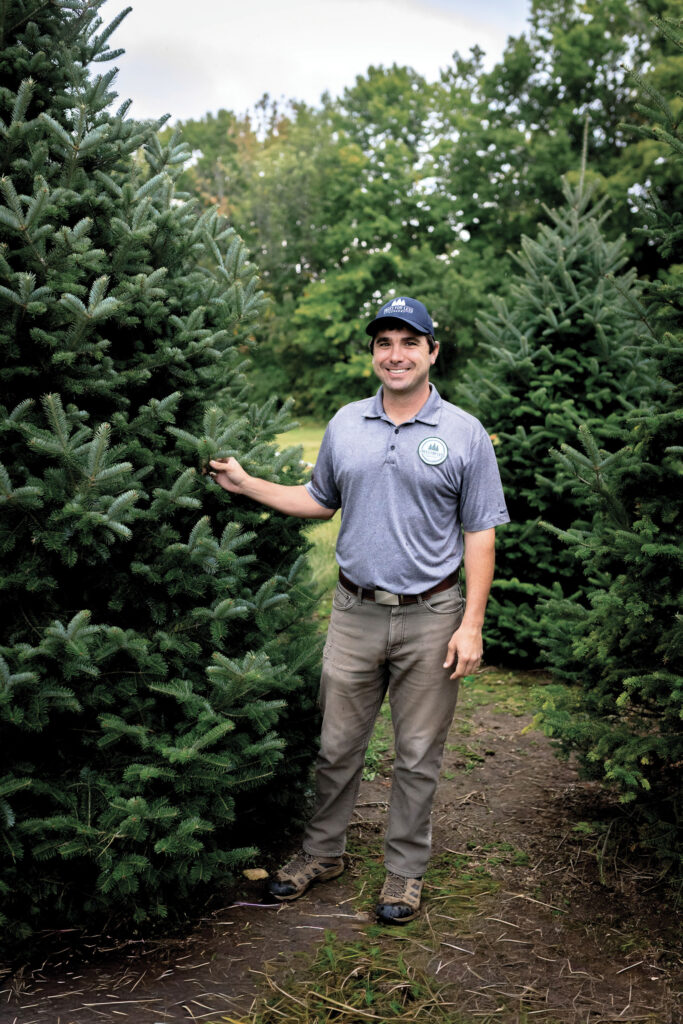
Around this time of year, Sam O’Malley is busier than Kris Kringle. From late summer through the fall, he’s been getting his sprawling 150-acre farm in Mequon ready for the hundreds of families and couples that visit every year.
The goal is to give them one of the most magical, memory-making experiences of the winter holiday season, only one aspect of which is picking out a Christmas tree.
“When people pull up, they’ll see the hot cocoa station and a big roaring fire pit,” says O’Malley, owner of Trees for Less Nursery in Mequon. “There’s a little hut where you can cook your own s’mores, and we’ve also got the hay ride through the farm where we do a scavenger hunt.

If someone has inspired you through their service, leadership or dedication, the Unity Awards are your opportunity to recognize them!
“And for the first time this year, we’ll even have reindeer – they’ll be right there by Santa and his sleigh for the kids and for photos,” he adds, pointing to a ring of full-grown balsam firs in the center of a large field just inside the farm’s entrance.
It’s a lot of work, O’Malley says, and he needs to hire a “small army of high school kids to help me out.”
And, he adds, these “agri-entertainment” touches are necessary. As one of only a few remaining Christmas tree grower/retailers in metro Milwaukee, O’Malley needs to make the drive worth it for customers by punching up the annual ritual of getting a tree – especially in this age of big-box stores, delivery-everything and, even worse, artificial tannenbaums.
“All of that is what keeps people coming back year after year – it’s the ambiance and the experience that makes it a tradition,” he continues. “I’d estimate that 90% of our customers have gotten their tree from us before. And with that and everything else we offer, we’ve been able to grow 10%-15% each year.”
O’Malley knows that part of his success is due to thinning competition. There are simply fewer Wisconsin farms growing Christmas trees, and those farms are growing fewer trees.
Wisconsin’s Christmas tree harvest has dropped more than 60% over the last 20 years, to 600,000 in 2022, the most recent year for which USDA data was available. That decline was roughly twice as steep as the national decline in the same time period, which was 30% to 14.5 million trees. The number of Wisconsin farms growing Christmas trees dropped more than 30%, from 916 farms in 2002 to just 611 in 2022.
“About a thousand Christmas trees fit on an acre. So if you have 40 acres, you should be able to sell 4,000 trees a year, if you rotate it in 10 years – instead of the eight, just to give yourself some buffer. So you should be planting 4,000 trees a year so that you have that 10-year rotation.”
– Greg Hann, Wisconsin Christmas Tree Producers Association
The 41-year-old O’Malley, who bought the business from his father about five years ago, feels this shift in the industry. To keep up with demand while he replenishes and expands his stock of slow-growing Christmas trees on the farm, O’Malley needs to buy pre-cut trees from other farms. But even that’s proven increasingly difficult lately.
“It’s been hard for me to find wholesalers to bring in enough trees to satisfy my customer base,” he says. “A lot of the ma-and-pa nurseries in Wisconsin and the Midwest have shut down. Sometimes, the next generation of farmers don’t want to take on the work or some have decided to sell the land, I guess.
“My local suppliers couldn’t give me the volume that I needed, so I had to get trees all the way from Nova Scotia last year,” continues O’Malley, adding that he still gets many pre-cut trees shipped from Central Wisconsin. “The farms that have survived know that the demand is there, so I think that they’re ramping up production on their end.”
THERE’S ONE BIG GRINCH behind Wisconsin Christmas tree farms’ decline: artificial trees. “We’ve lost market share to the fake-tree industry,” Greg Hann of the Wisconsin Christmas Tree Producers Association says flatly. “There’s been a lot of very good marketing and changes made to the way fake trees look.”
The technology of the fake trees has improved in recent years – more lifelike needles and branches, easier setup and integrated lights – adds Hann, who has owned and operated Hann’s Christmas Farm in the town of Oregon, just south of Madison, for 25 years.
Because of this, Hann says, many tree farms – like O’Malley’s and his own – have turned to seasonal activities that a plastic tree can’t provide.
“A lot of them have spaces for photos with Santa and Mrs. Claus because of social media,” he explains. “And there’s the hot cider and snacks, and some have horse-drawn sleigh rides if there’s snow. We even have a wood carver come out on one weekend.”
Running a tree farm is labor intensive. Planting usually begins in April, and Hann begins trimming trees in June. By August, he starts shearing and shaping the tree into the desired conical shape. (No, they don’t just grow that way.) All through the growing season, there’s mowing and more mowing to keep weeds down.
Know Your Native Tree
Just as there are different opinions about what makes the best kind of Christmas tree, there are also different regions – with different soil types – around the state that work best for growing different kinds of trees. Most common here are the firs and spruces.
“Wisconsin’s super lucky because we have a native balsam fir. It has a great smell as it aspirates and lets moisture out into your house,” explains Greg Hann of the Wisconsin Christmas Tree Producers Association. “Fraser firs have become the most popular tree for two reasons: good needle retention and a stiffer branch to hold larger ornaments.”
While the firs have shorter needles, those who like the “wispy, longer-needle tree will want to go with a white pine, which also has a great fragrance and is another native Wisconsin tree,” he adds.
Beyond the hard work, tree farming takes patience. “The first two years, they grow slowly, and then it’s about a foot a year after that,” Hann says. “So a full grown tree can take about eight years.”
Those long months of work come to a head with a maddeningly busy sprint beginning just before Black Friday and ending about three or four weeks later, when the trees sell out or Christmas Day arrives.
That’s when the money finally rolls in. O’Malley was still calculating his prices for this season, but last year, Trees for Less charged $15 per foot for cut-your-own trees and “anywhere from around $20 for the rough-looking, Charlie Brown-ish trees to about $200 for the 12-foot tall, nicest, largest trees we’ve got.” Hann says that statewide, a typical 7- or 8-foot tree – from a farm or a retail lot – ranges between $80 and $90.
NOT EVERY TREE FARM, though, puts on a big Santa-ready experience for buyers. Several years into retirement, Randy and Karen Cooper choose to keep things far simpler at their Poplar Creek Tree Farm in New Berlin. “We’ve got a netting-type tree baler, knee pads, saws and a porta-potty, but that’s about it,” says Randy.
“And we’ve got no shelter, so you take the weather as it comes,” Karen adds.
The Coopers grow about 15 acres of Christmas trees ranging in sizes for a small apartment to a large living room. Varieties include balsam and canaan firs and scotch and white pine.
And their cut-your-own tree costs match up to their no-frills system: “It doesn’t matter if you get a tabletop size or you get a 6- or a 10-foot tree, it’s the same price,” says Karen. “It’s either $55 for the pines or $65 for the short needle.”
And like others around the state, the Poplar Creek Tree Farm is very popular each winter.
“Cutting down a real tree is more work and it takes more time than just pulling a plastic one out from a box in the basement,” says Randy. “Plus, not only is a real Christmas tree less expensive than an artificial one, it’s recyclable, too – it eventually goes back to the earth.”