

By 1912, the last full year of William Howard Taft’s only term as president, Milwaukee’s population of Serbian immigrants had grown to around 3,000. The community founded a congregation that settled first into a house converted to a church near Third Street and National Avenue in Walker’s Point.
But with more immigrants arriving, the church, led by the Very Reverend Father Milan Brkich, began looking for land in the 1940s. Brkich found a good deal on a plot of 14 acres on 51st and Oklahoma Avenue, long before the latter was a main thoroughfare of the South Side.

If someone has inspired you through their service, leadership or dedication, the Unity Awards are your opportunity to recognize them!
“It was a huge discussion to buy this land, because at the time there was nothing – the buses didn’t run out here. People thought he was crazy for even suggesting it,” says Vlado Ninkovich, president of the board for American Serb Memorial Hall, which today shares those 14 acres with St. Sava Serbian Orthodox Cathedral. “A lot of people weren’t happy, but it turned out he had a vision.”
That vision came in stages. The first step was to build Serb Hall, which opened as an event venue in 1950. The business generated money to fund the cathedral, which was completed in 1958. A third building on the campus, the Serbian Cultural Center, was built in 1973.
Serb Hall, dedicated in memorial to Serbs who fought in the US military, quickly became not only the center of Milwaukee’s Serbian community, but a symbol of the South Side in general. At the end of a long week, it was a place for the neighborhood’s blue-collar workers to grab a fish fry and a beer or an old-fashioned, roll a game in the building’s 12-lane bowling alley, and sometimes catch a show; “America’s Polka King” Frankie Yankovic performed there regularly.
All of that also made Serb Hall a perfect target for politicians to stop by to shake hands and give speeches, and for 75 years it has attracted everyone from stumping alderpersons to presidential candidates. Campaigning guests at Serb Hall have included presidents Kennedy, Nixon, Reagan and Clinton, among others.
Longtime Wisconsin political observer Mordecai Lee, a professor emeritus at UW-Milwaukee’s political science department, says that Serb Hall evolved to become “a kind of political shorthand – ‘so-and-so campaigned at Serb Hall today,’ and then it’s almost like you didn’t need to get any other information because that person would have been campaigning to get South Side votes.”
These mostly white, working-class voters, Lee explains, were largely “conservative Democrats, blue-collar ethnics, union members – usually Polish, German, eastern European ancestry.” They anchored the political careers of a host of mostly moderate to conservative Democratic elected officials representing the area. And occasionally, Milwaukee’s racial division was targeted by candidates like presidential hopeful George Wallace, a segregationist from Alabama who campaigned to a receptive audience at Serb Hall.
More recently, the changing profile of the South Side has diminished Serb Hall’s political importance – even as Wisconsin seems poised to again be a key swing state in 2024. The business was dangerously close to shuttering for good in recent years, too, but Serb Hall has weathered through.
GOOD FRIDAY IS THE BUSIEST of the year at Serb Hall. Once touted as “the world’s largest weekly fish fry,” the Friday tradition dates to 1967. The fish fry takes place year-round but sees an enormous uptick during Lent, when many Catholics abstain from eating mammals or fowl on Fridays. In 2004, a Serb Hall manager said the kitchen served a ton of fish every Friday – and twice that on Good Friday, with 75 gallons of tartar sauce on the side.
Nowadays, a variation of the Friday night fish fry is found at a wide range of Wisconsin taverns and restaurants, but Serb Hall’s is one of the granddaddies. Business boomed so much that Serb Hall built an addition that included the Wisconsin Room and a drive-thru window station in 1987, doubling the size of the building.

On Jan 26, Milwaukee welcomed its seventh sister city: Kragujevac, Serbia. With a population of about 171,000, it’s Serbia’s fourth-largest city, an industrial center known for making firearms and automobiles.
The connection to Kragujevac came largely from the efforts of St. Sava parish and Milwaukee Ald. Marina Dimitrijevic, who is of Serbian descent. Kragujevac Mayor Nikola Dašić was among the dignitaries in attendance for a ceremony at City Hall, and a celebration afterward took place at Serb Hall.
The Sister Cities International program is intended to promote civic partnerships and people-to-people diplomacy; Milwaukee’s other sisters are Galway, Ireland; Zadar, Croatia; Abuja, Nigeria; Irpin, Ukraine; Bomet County, Kenya; and Tarime District, Tanzania.
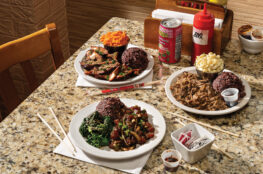
The fish fry is still popular today, and the kitchen staff spends the days leading up to Friday mixing a dressing of oil, vinegar, garlic and red pepper for Serbian-style potato salad, cutting cabbage for coleslaw and preparing hundreds of pounds of fish to be deep-fried.
This year’s Good Friday didn’t see the volume of customers the business has had in the past. After closing for over a year in 2021, Serb Hall is still trying to let people know that they’re open and fish is back on the menu. But as the 6 o’clock hour approached, the President’s Room began to fill up with a buzz of people chatting and the clatter of plates.
Waitstaff zipped across the hall’s terrazzo floor, delivering plates of fried cod and perch to the maze of tables, each decorated with a centerpiece vase featuring miniature American and Serbian flags and colored carnations nestled amongst the condiments. More people joined after the Good Friday liturgy concluded at St. Sava across the parking lot. Outside, cars lined up at the drive-thru.
Three of those plates of fish landed at Table 9, where Miroslav Jović, president of the St. Sava church board, was seated with his wife, Boki, and 11-year-old-son, Gabrilo. People waved and greeted Jović with “Živeli!” (jheev-eh-lee), as they walked by, a word that means “cheers” in Serbian. Jović immigrated here from Serbia 25 years ago with his parents and brother and was elected board president three years ago.
The St. Sava campus is still a critical center of the Serbian community. Jović says the church has about a thousand families as members, with services and Bible classes held in English and Serbian.

“There are no Serbian churches in northern Wisconsin. The next one going north is Duluth in Minnesota, so a lot of Serbs from the Appleton area, Green Bay, they’ll be here on Sunday for the liturgy,” Jović explains.
The cathedral, with its Byzantine-style architecture, is notable for its mosaic murals across the walls, ceilings and dome – some of which are replicas of those in St. George’s Church in Oplenac, Serbia. The project was started in 1969 and the murals were slowly created over a span of about 34 years by Italian artist Sirio Tonelli, using 2,000 tones and colors of Italian glass at a cost that eventually totaled $3 million.
Across a short walkway is the cultural center, which features a parochial school, Serbian language library, gym and soccer field. The center fosters cultural programs like a choir, folk dance ensemble, soccer and bocce clubs, the annual Serbian Days festival in August, a women’s group called the Circle of Serbian Sisters (founded in 1929), and even “Serbian Radio Hour” (broadcast Sunday mornings on Fonz-FM, 100.3). The campus also has a built-in community of Serbs – the church owns several homes along the perimeter of the property on 53rd Street.
While Jović digs into his perch, Ninkovich, a white-haired man with a friendly smile, is making his rounds, wandering from table to table greeting customers and making sure their dishes are satisfactory. When he stops by Table 9, he shakes Jović’s hand – and this is a handshake between church and state. St. Sava and Serb Hall have had a symbiotic relationship since the beginning, and this relationship was critical to Serb Hall’s survival in recent years.
“We don’t get involved with their affairs, but when they need our help with volunteer work, we send them,” Jović says. “We want them to be a successful tenant.”
SERB HALL DOES NOT HAVE A POLITICAL AFFILIATION, Ninkovich says, and the facilities have been used by both Democratic and Republican campaigns. (Libertarian candidate Gary Johnson campaigned there in 2016, too.) Since the early days, politicians have smelled something besides fried fish at Serb Hall – votes.
Lee knows firsthand Serb Hall’s political legacy; he spent the mid-1970s to the late ’80s as a Democrat in the Assembly and State Senate. In 1988, he endorsed Al Gore in the Democratic primary and stood with him during an appearance at the venue. Waiting backstage, Lee recalls being impressed by the candidate’s sense of humor, a contrast from his common depiction of being stuffy and robotic. “Here was this totally different person. I thought to myself, if only the real Al Gore would show himself to the voters, he could have gone a long way,” Lee says.
“Since the early days, politicians have smelled something besides fried fish at Serb Hall – votes.”
Lee cites Milwaukee’s longest-serving mayor, Henry Maier, as an example of the South Side’s political power. Maier, a Democrat, held the mayor’s office from 1960 to 1988, and his election night party in 1980 was held at Serb Hall. “His career was anchored in the conservative South Side votes,” Lee says. Although both parties campaigned at Serb Hall, it was long considered a “Democratic fortress” – though that began to change in the ’80s when many of the South Siders became “Reagan Democrats.”


“The talk about social values was appealing to those voters, so the South Side Democratic base turned into the South Side Republican base,” Lee says, noting that one of the last politicians to successfully tap into that base was former Gov. Scott Walker. “Walker knew these were conservative voters who had abandoned the Democratic Party and welcomed the wedge issues Republicans were talking about.”
In recent decades, the demographics of the South Side have changed. Many of the Reagan Democrats had already moved to the suburbs, while the population of young Latinx families has grown exponentially. That, Lee says, has led to Serb Hall’s star fading a bit, going from a “must stop” to a “maybe stop” for campaigns.
“Because of the demographic changes on the South Side, I don’t think Serb Hall is still the same political touchstone,” Lee says. He points to the 2022 mayoral race between Cavalier Johnson, then interim mayor, and longtime Ald. Bob Donovan to fill Tom Barrett’s vacated seat. Johnson won with 71.5% of the vote, more than doubling Donovan’s take.
“Donovan was the archetypal South Side politician: pro-police, law and order, conservative on social issues,” Lee explains. “The race was almost a referendum between Cavalier Johnson representing this new majority-minority city and Donovan representing the last gasp of the South Side.”
And while Donovan’s failed campaign might have shown how the old South Side’s political power had waned, at the end of 2020, it looked like Serb Hall itself was facing extinction.
LIKE SO MANY OTHER BUSINESSES, Serb Hall suffered from the pandemic shutdown. The South Side’s social hub sat empty. A chaotic pro-Donald Trump “Defend Your Vote” rally in Serb Hall’s parking lot 11 days after the November 2020 election drew fines from the city health department. A short time later, manager Nicholas Alioto, who had been mobbed by angry people at the rally, died.
Serb Hall closed its doors in January 2021, and it seemed likely it might be permanent. Church leaders thought it was time to sell the hall, but members like Ninkovich were adamant that the building remain property of the church.
Ninkovich says he grew up on the St. Sava campus; his parents were among the first few couples who got married in the church in the ’50s. Ninkovich was baptized in the church and married there; his children were baptized and married there; as we spoke, one of his grandchildren was a few weeks from being baptized there, too. Ninkovich recalls an early childhood memory: running through Serb Hall, what is now the President’s Room, watching traditional Serbian dance. “To think that the hall would be sold, it’s almost like a piece of you was being sold, and that’s how people took it when that discussion was being had,” Ninkovich says.
For decades, the President’s Room in Serb Hall displayed 5-foot-tall portraits of seven presidents who visited the venue – Dwight D. Eisenhower, John F. Kennedy, Richard Nixon, Gerald Ford, Jimmy Carter, Ronald Reagan and George H.W. Bush. (Bill Clinton visited after the commissions had been made in the late ’80s.)
“My understanding was that there was a concern because there wasn’t a portrait of President Obama,” Ninkovich says. When word got out, people bemoaned that the demands of the woke mob had struck again.
However, the late former Serb Hall general manager Nicholas Alioto said at the time that the reason for the removal wasn’t political but because of aesthetics with the hope of booking more weddings in the hall. A giant image of Nixon staring down the happy couple isn’t exactly romantic.
Ninkovich says he hopes to have the portraits rehung, especially so visitors to the twin Midwestern political conventions can visit Serb Hall and see them. “It’s part of our history,” he says.
At a passionate church meeting with hundreds of members in attendance, the congregation voted down the sale of Serb Hall. Ninkovich joined Serb Hall’s board in July 2021 and was elected president. The new board began the monumental task of reopening – the drive-thru was back up and running in time for Lent in 2022, and dine-in service reopened in February last year. But in between, an unexpected disaster: A fire sprinkler pipe burst in December 2022, badly flooding the building.
“We were talking about how the building needed to be remodeled, and that sped everything up. It was a disaster in one sense, but it also allowed us to fast-track remodeling,” Ninkovich says. Although the building’s two halls now have a fresh look, the bowling lanes were so badly water damaged that they’re probably beyond repair. Ninkovich says the board is currently weighing options of what to do with the space.
Serb Hall’s current struggle is to get the word out that they’re still open. The widespread reporting by local media that the venue had closed is hard to put back in a bottle. Ninkovich says that while this year’s Good Friday fish fry was “steady,” it wasn’t as busy as the venue’s glory days.
Key to helping the business in this rough time was the support of the church, whose members helped clean and work on the building. With staffing still a struggle, parishioners often volunteer to help out with the Friday fish fry and the business’s metaphorical bread and butter – renting event space for weddings, quinceañeras, holiday parties, memorial luncheons, union dinners.
“I’m really proud of the community,” Jović says of his fellow church members. “They’re just a text message away – ‘Hey, we need 20 people to get this done,’ and it gets done. This is ours and we’ll keep fighting for it. Whatever happens, we’re in it together.”
Ninkovich agrees and says that while things looked “dire,” he feels good about where Serb Hall stands now. “We’re in a strong position and getting stronger,” he says. “We’ve turned a corner.”
Oct. 1, 1956
In the venue’s first documented visit by a current or eventual president, Richard Nixon, then Dwight D. Eisenhower’s VP, capped a busy day on the campaign trail with a 9 p.m. speech at Serb Hall. By the time the event was over, Nixon had been awake and campaigning for 25 hours straight, 8 of those spent in Milwaukee.

April 3, 1960
Some 3,000 people flocked to Serb Hall for a campaign stop by John F. and Jacqueline Kennedy, who ran almost an hour late. Supporters sang Kennedy’s campaign song “High Hopes,” but the crowd in the overstuffed room grew hot and irritated. At one point, the audience was asked to take a break from smoking after a woman’s dress was ignited by a cigar. But a Milwaukee Journal reporter noted that the tensions melted when Jackie Kennedy gracefully took the stage and apologized for the wait. then, “in perfect Polish, she stated, ‘Poland will live forever,’” at which the largely Polish audience “burst into cheering and unashamed weeping.” The eventual president went on to captivate the crowd. Footage of his speech is featured in Robert Drew’s 1960 documentary Primary.

April 1, 1964
Serb Hall’s most controversial guest was probably Alabama Gov. George Wallace, a Dixiecrat segregationist who saw in Milwaukee an opportunity to bring his message north. Although negative press, protesters and hecklers followed him, he saw support on the South Side. At this Serb Hall appearance, a shouting match broke out between Wallace supporters and Black protesters, who refused to stand for the national anthem. Wallace drew a surprising 34% of the Wisconsin Democratic primary vote that year and afterwards said, “if I ever had to leave Alabama, I’d want to live on the South Side of Milwaukee.”

March 30, 1972
When Wallace again visited Serb Hall during his 1972 presidential bid, he was followed by Hunter S. Thompson, whose dispatches were collected into the gonzo journalism classic Fear and Loathing: On the Campaign Trail ’72. Thompson wrote that Wallace “jerked this crowd in Serb Hall around like he had them all on wires. They were laughing, shouting, whacking each other on the back. … It was a flat-out fire and brimstone performance.” The following day, four other Democratic candidates – Ed Muskie, Hubert Humphrey, John Lindsay and eventual nominee George McGovern – all stopped by Serb Hall for the Good Friday fish fry.

March 26, 1980
Ronald Reagan’s Serb Hall stop ahead of the Wisconsin primary was significant in the shift of political tides. The Milwaukee Sentinel wrote the Republican had successfully “invaded Democrat territory” with “a hooting, hollering campaign rally before a packed crowd.” As the Journal put it: “The South Side Democratic temple was ringing and rocking with praise for Ronald Reagan as he talked about whacking the fat out of the federal government.” Reagan visited again, as president, on Nov. 3, 1984, three days before the election. “I’m happy to be here with the sons and daughters of Wisconsin immigrants,” he said, “brave people who have followed their dreams to America, pushed back our frontiers and built strong and thriving cities like this one.”

April 11, 1984
George H.W. Bush, then Reagan’s veep, also stopped at Serb Hall, though his appearance had less gravitas and more gravity than Reagan’s. “Vice President George Bush got a taste of one of Milwaukee’s favorite sports Wednesday night, and a taste of the alley it is played on,” reported the Milwaukee Journal, showing photos of Bush, bowling arm outstretched, sailing through the air on Lane 3, then looking dazed as he sat up. A manager speculated that he biffed it because he wasn’t wearing proper shoes. His throw still managed to knock down nine pins.

April 6, 1992
The day before the Wisconsin primary, Bill and Hillary Clinton rallied at Serb Hall, with candidate Bill showing off a United Steelworkers of America jacket to display union support. “I want people to believe again that politics can be a noble profession,” he told the crowd. The 90-minute event marks the last time a successful presidential candidate rallied at Serb Hall – though Vice President Dick Cheney visited during winning campaigns in 2000 and 2004, and also-rans like Michael Dukakis, Howard Dean, John Edwards, John McCain and Mitt Romney have stopped by.

2010-12
In addition to presidential campaigns, Serb Hall has hosted myriad events related to city and state politics. Future Gov. Scott Walker celebrated winning the GOP primary over Mark Neumann there in 2010; months later, Democrat Tom Barrett’s campaign held an election night party at the venue, where Barrett conceded to Walker around 10:30 p.m. Serb Hall was visited by both sides in the 2012 recall election, including a town hall event on April 5 that featured Democratic contenders Barrett, Kathleen Vinehout, Doug La Follette and Kathleen Falk.

April 1, 2016
After Walker ended his short-lived presidential run in 2016, he attended a Republican Party fish fry dinner party at Serb Hall featuring candidates John Kasich and Ted Cruz. Walker had just endorsed Cruz and introduced him at the event. Sarah Palin, also in attendance, endorsed Donald Trump and spoke on his behalf, drawing a tepid response from the audience.
Nov. 14, 2020
Although Trump never visited Serb Hall, his presence was felt there at a chaotic “Defend Your Vote” rally amid the pandemic. The gathering in Serb Hall’s parking lot included former Sheriff David A. Clarke, hundreds of Trump supporters, and … the Milwaukee Health Department. When health inspectors told Serb Hall general manager Nicholas Alioto that he needed to get the attendees to sit down and socially distance, Alioto took a mic to reason with the crowd, but they turned on him, wrestling the mic from his hands, pushing him to the ground and kicking him while yelling insults, then breaking into a chant of “USA! USA!” Three days later, Alioto tested positive for COVID-19, and about two weeks after that he died at age 55, with the cause of death being listed as hypertensive cardiovascular disease. In late January 2021, Serb Hall announced it would close; it slowly reopened between 2022-23.
2024
At press time, no specific events tied to the Republican National Convention were in place, but Serb Hall board president Vlado Ninkovich says the venue is a registered vendor for the convention and hopes visitors to both the RNC and the Democratic National Convention in Chicago next month will come. In the fall, Serb Hall will be an early voting location, continuing its long history of being a place where South Siders engage with political decisions.