

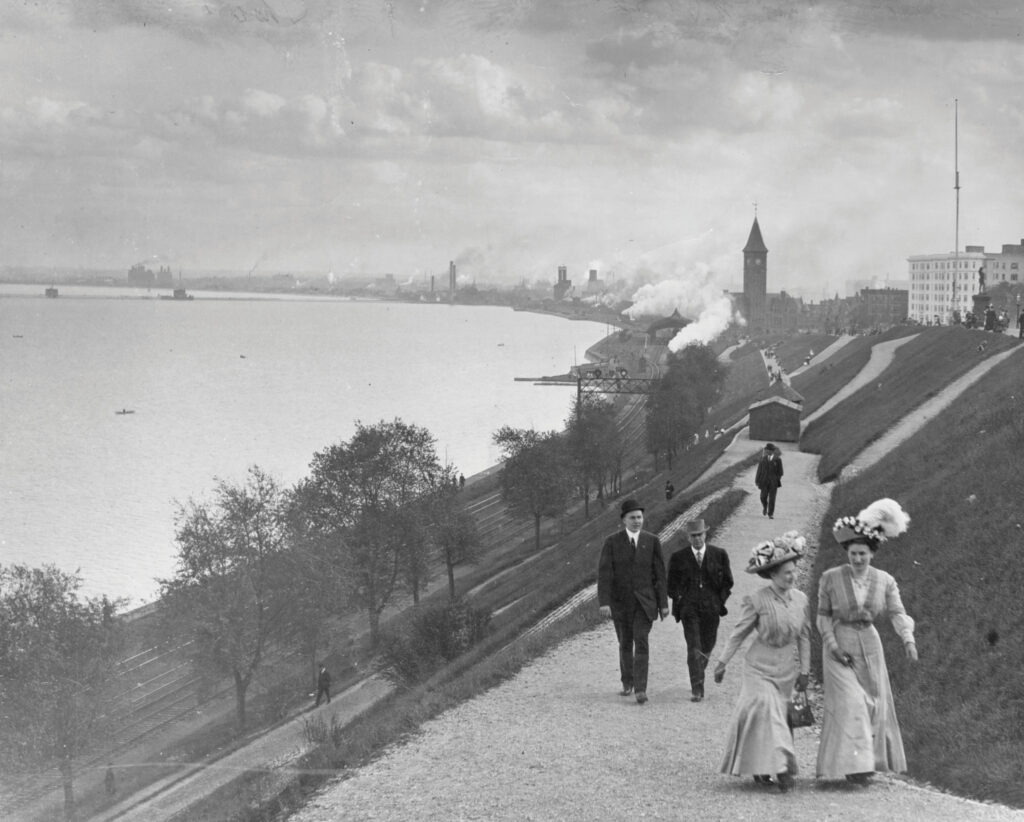
It was probably a Sunday afternoon when this dapper quartet neared the top of the bluff in what is now Juneau Park. Sunday, after all, was our ancestors’ only day off in the early 20th century. What better way to spend your one-day weekend than enjoying Milwaukee’s magnificent lakefront?
The lakefront was, in truth, a good deal less magnificent than it is today. Not only was the air thick with smoke from the city’s abundant factories, but access to the lake itself was severely limited. A broad ribbon of railroad tracks was stitched into the shoreline, and for many years the only public green space of any significance was the picturesque bluff shown here. It was photographed in 1912 by Sumner Matteson, a footloose photojournalist whose other subjects included Native American tribes in the West and the Cuban countryside.

Celebrate this year’s winners of the Betty Awards!
The park was the pride of the Seventh Ward, Milwaukee’s most affluent residential district. The same plutocrats who filled nearby Yankee Hill with mansions paid extra taxes to develop what is basically a picture window on the lakefront. Ready for visitors by 1889, Seventh Ward Park was described by one reporter as “a grand sweep of velvety lawn” that offered “ample opportunities for promenading.”
The verdant overlook was soon renamed for Solomon Juneau, the Milwaukee founding father whose statue still crowns the bluff. His park represented a down payment on one of the finest stretches of urban shoreline on the Great Lakes. The Socialists who swept into office in 1910 were convinced that access to nature was a human birthright, and they made park development one of their highest priorities. Perhaps their crowning achievement was Lincoln Memorial Drive, three magnificent miles of shoreline that remains Milwaukee’s most cherished green space nearly a century after it opened at the foot of this bluff in 1929.
Take a closer look:
- Many acres of lakebed were filled in to create Lincoln Memorial Drive.
- This lakebed is now the site of the War Memorial Center and the Art Museum.
- The North Western rail corridor is now a lakefront leg of the Oak Leaf Trail.
- Completed in 1889, the North Western railroad depot dominated the lakefront until it was razed in 1968.
- Milwaukee’s Norwegians erected a statue of Leif Erikson in 1887.
- The Cudahy Apartments opened in 1909. Two decades later, its tower was constructed.