
This story originally ran in the December 2001 issue of Milwaukee Magazine.
By Peter Robertson
Mayor John Norquist was ducking rumors of a sex scandal two weeks before election day, so columnists Cary Spivak and Dan Bice decided to pay a surprise visit to his then-lawyer, Anne Shindell. When the Milwaukee Journal Sentinel reporters stepped onto an elevator in her building, they found the mayor himself.
“It really was dumb luck,” Spivak recalls with a smile.
“Obviously, something was going on,” says Bice. “This was a very tense situation.”
Tucked under Norquist’s arm was a copy of their latest column, “Spivak & Bice,” which contained allegations of a possible sexual harassment complaint against him. After an awkward elevator ride, the mayor refused to answer any questions until he met with his attorney. Like a couple of gumshoes, Spivak and Bice went downstairs, checked for rear exits, watched the mayor’s bodyguard in a truck outside and bumped into – get this – the mayor’s wife, Susan Mudd. As Norquist emerged from Shindell’s office, Spivak asked him point-blank if he had had sex with a former aide, Marilyn Figueroa. Norquist, reading from a statement jotted on the Journal Sentinel, said, “It’s a legal matter and it’s in the hands of an attorney. I have nothing else to say.”
The reporters bolted back to the newsroom and wrote a column on the remarkable encounter and the mayor’s non-denial, casting a dark shadow of suspicion on him at this critical time. Many readers saw the column as old-school investigative journalism at its best, calling Spivak and Bice Milwaukee’s own Woodward and Bernstein. Critics argue the column was tabloid gossip, accusing the reporters of exaggerating the truth to feed their own egos.
Norquist insists Spivak and Bice didn’t even try to ask any questions and, says a close associate, the mayor had only a New York Times crossword puzzle in hand. “They think they’re the center of attention, but they’re not,” says the source.
Journal Sentinel editors wanted Spivak and Bice – known as the “Spice Boys” – to generate buzz, and they got it. Their chance meeting with Norquist is still talked about in media and political circles. “We got a huge reaction to it,” says Bice. “There are people who still don’t believe it actually happened.”
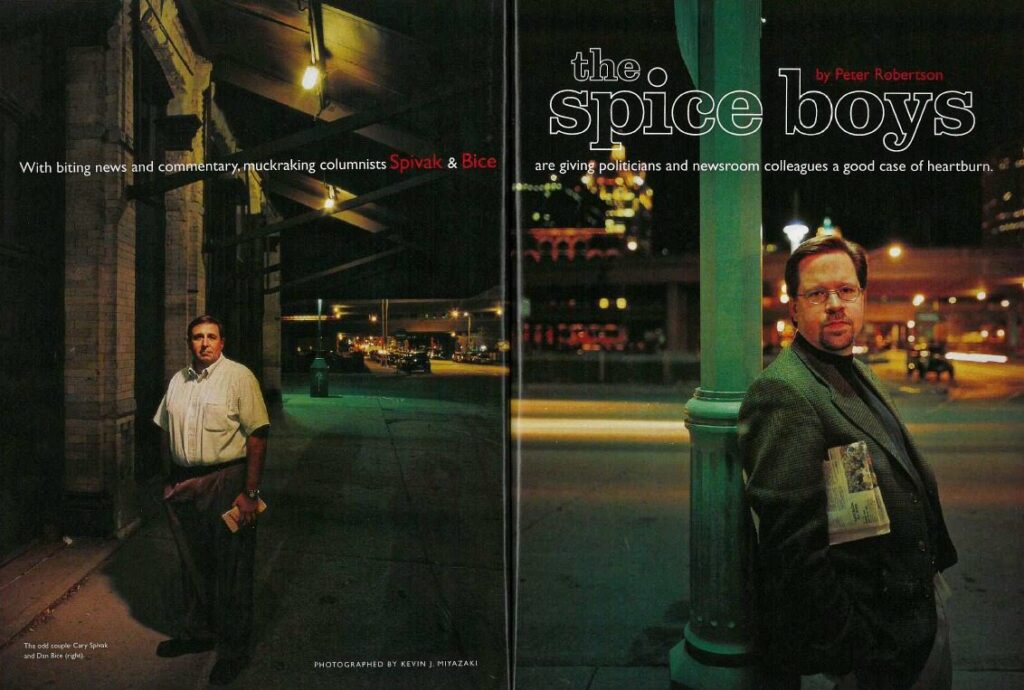
On Labor Day weekend, September 6, 1998, Milwaukee Journal Sentinel readers opened their morning newspaper and found “Spivak & Bice,” an ambitious new column with a blue-collar heart and white-collar soul. The muckraking column targeted the state’s powerbrokers, promising irreverent, in-your-face commentary rooted in button-down, fact-based reporting. That tall order went to Cary Spivak and Dan Bice, a genuine odd couple with very different backgrounds and personalities.
“I thought they understood the concept of what I was looking for and could take it beyond what I was talking about,” says Editor Marty Kaiser. Spivak, 46, a sloppy, glad-handing Chicago native, and Bice, 37, a dapper, quiet former West Virginian, promptly did just that.
“Spivak & Bice” regularly breaks news, shakes up movers and shakers and frequently appears on the front page. After just one year, the column won the prestigious National Headliner Award. “First-rate reporting with an attitude,” judges concluded.
Political, business and other opinion leaders say the column has had a big impact, and it’s a must-read at City Hall, the state capitol building, corporate offices, police stations, courthouses and School Board meetings. Not everyone thinks its impact has been positive, though, and some newsmakers say the reporters’ sassy mix of opinion and reporting has gone too far.
“They have a tabloid sensationalism flavor,” says state Sen. Mary Lazich. “It’s definitely not respected, hard-news journalism. It’s snoops and scoops.”
Who are the guys behind this provocative column? The affable Spivak is an honest-to-goodness Oscar Madison clone, complete with stained shirts, brash humor and a big-league passion for sports and reporting. Bice, meanwhile, resembles a rigid Felix, but his pinched intensity stems from very private life challenges and hasn’t hampered his reputation as a hatchet man. Together, their surprising chemistry fuels the column.
While newsroom colleagues applaud the thrice-weekly column for the edgy personality it gives the Journal Sentinel, others say the columnists’ freewheeling style has turned their newsroom into the “Wild, Wild West,” where they play by their own rules and poach stories from other reporters’ beats.
Kaiser is not at all concerned that Spivak and Bice may be shaking up his own workplace. “We’re here for the readers,” Kaiser says flatly. “We’re not here to be a Cub Scout troop and all get along.”
Three years after The Milwaukee Journal merged with the Milwaukee Sentinel, Kaiser decided his fledgling paper needed a column that broke news instead of just commented on it. The idea was to deliver hard news with a wink and a grin. The resulting talent search was less than typical, and the column faced its first controversy before it even appeared in the paper.
Formerly the managing editor at The Milwaukee Journal, Kaiser was well aware of the popularity of Journal reporter Meg Kissinger’s “Taking Names” column, a catty litter of gossipy blurbs that generated lots of talk around town from 1989-1995. Kissinger’s darts stung more than a few area leaders, but her deliberately lighthearted approach left no lasting scars. Kaiser wanted something more pointed.
“If I couldn’t find the right people or the right thing, it wasn’t going to happen,” says Kaiser. He thought it would take two seasoned reporters to produce an average of three stories per column and do it more than once each week, similar to the San Francisco Chronicle’s “Matier & Ross.”
“I thought it would give the column some real energy if they bounced ideas off each other,” says Kaiser. “I knew it would be different because there hadn’t been anything like it here.” Ignoring the standard procedure of posting the job, Kaiser and Managing Editor George Stanley set their sights first on Spivak, a wily, toothpick-chewing business and casino gaming reporter who knew how to get difficult people to talk.
Since joining the Sentinel in 1987, Spivak worked the business beat, then did news investigations until the 1995 merger, when he went back to business reporting for the Journal Sentinel. Colleagues say his desk is a landfill of notes and fast-food bags, his Rolodex is a scribbled mess, he wears rumpled clothes and keeps what he calls an “Emergency Business Writer’s Tie” in his desk drawer, and his shrewd friendliness reminds people of “Columbo.” Kissinger says that when they did a casino story together, she noticed an important document stained with coffee. “Oh, that just means it’s been ‘received,’ ” he chuckled. Stanley and Spivak once did a Sentinel gaming investigation that helped put a roughneck named Glenn Corrie in jail, but Corrie still liked Spivak and even gave him a tip on another scoundrel in court. “If you think I’m bad, you should check out this guy,” Corrie told Spivak.
“Cary would have been a great detective,” says Stanley.
Kaiser’s second choice – rumored to have been national affairs scribe Kathy Skiba – fell through in favor of Bice, an education reporter with a background in state government coverage. Reserved and scholarly in his tweed jackets and wire-rimmed glasses, Bice shuffles down the street with his face buried in books and takes vacations to obscure academic conferences. He is also regarded as an assassin with a pen.
Assigned to Madison for the Sentinel and Journal Sentinel from 1992-’97, Bice was labeled a “hit man” for doing merciless stories that infuriated political heavyweights. George Lightbourne, a cabinet secretary for Governors Tommy Thompson and Scott McCallum, says he quit taking Bice’s calls years ago. At a softball game between the press corps and governor’s office, Thompson winced when he met the reporter’s family. “He oohed and aahed over the babies and shook my hand,” says wife Sonya Bice of Thompson, who then soured after she told him her name. “He sort of recoiled and said, ‘I can’t believe these cute kids are Dan Bice’s family.’ Maybe he expected them to have forked tongues.” Bice’s transfer to the Milwaukee-based education beat in 1997 generated scuttlebutt that Thompson had banished him from Madison.
“That was frustrating. I just wanted to strengthen education reporting,” says Kaiser, adding that Bice’s experience made him a solid pick. Kaiser’s announcement that Spivak and Bice would pilot a new column irritated the newsroom’s union because the jobs were never posted. “People have a lot of respect for Cary and Dan, and that was never an issue,” says Bob Helbig, union president at the time. “We had to insist there be an open and fair process.”
In a bizarre twist, management agreed to reopen the search. Although there was little chance of Kaiser reversing his choices, then-reporter Jack Norman says he and others applied to show they were interested in doing columns. “There was never a time when I felt I was trying to take something away from them,” says Norman, now research director at the Institute for Wisconsin’s Future. “What they do is absolutely fabulous stuff.”
Newsmakers say “Spivak & Bice” is widely read in high places because it has proved a formidable watchdog column. Reader reaction has been wildly mixed, however, since newsmakers seem to be the column’s main audience and they don’t always like what they see.
Steve Baas, top spokesman for state Rep. Scott Jensen, says the column is a must-read in Madison. “There’s nothing more fascinating to us than ourselves,” snickers Baas. Milwaukee Ald. Fred Gordon reports strong readership at City Hall, but he doubts the column’s appeal to John Q. Public. “Any politician worth his or her salt reads ‘Spivak & Bice,’ ” says Gordon. “I don’t get a sense that anybody outside of the political community cares one way or another about what they write.”
He’s not alone. Government insiders say the column doesn’t provoke many letters or calls from the public to their offices, perhaps indicating a limited audience. Yet an audience of newsmakers is still important because of their power and influence. Kaiser is fond of saying that people like to read the column, but nobody wants to be in it. That’s certainly true for image-conscious politicos, concedes Sue Wendorff, chief spokesperson for Milwaukee County Executive F. Thomas Ament. “I think most people feel when they come into the office or call, it’s bad news,” she says. A look back at some of their memorable columns supports her contention.
In 1999, Spivak and Bice chided Norquist for falsely accusing a South Side woman of running a drug house after he saw an empty sandwich bag near her duplex. “The crime-busting mayor, interrupting his daily jog, immediately decided it was time to clean up his neighborhood,” they wrote. A few months later, they ridiculed public housing officials for misplacing 195 refrigerators, writing: “If you happen to find an extra refrigerator in your rec room, please call Ricardo Diaz at the Milwaukee Housing Authority.” They also poked fun at “Metal-fest” promoter Jack Koshick for booking the shock-rock bands “Anal Blast,” “Cradle of Filth” and “Internal Bleeding” to play at wholesome State Fair Park.
More recently, they mocked Ament for making taxpayers foot the bill for several political and social functions he attended: “County Executive F. Thomas Ament is a tightwad, especially with his campaign money. He’d rather use your tax dollars when he hits the party circuit.” Next, they hammered local artist Evelyn Terry for complaining that $75,000 wasn’t enough to complete her sculpture for Mitchell International Airport. “We have an artist whining about her fee and county officials wanting proof that she’s done something – anything – with money she’s already been paid,” they wrote. In a series of scathing front-page columns this summer, they again roasted Norquist, this time for being AWOL during a visit from Mexican President Vicente Fox and other big local events. “How does a 6-foot-7-inch mayor disappear in his own town?” they wrote, labeling him “our incredible shrinking mayor.”
Fans say “Spivak & Bice” is good for Wisconsin because the column has no sacred cows, tackles important issues with compelling flair and pushes the envelope without being unfair.
One legislative aide admits to being a tipster for the column and says he learned the hard way that even regular sources aren’t immune from attack. “We don’t get any special favors. They treat everybody the same,” the aide sighs. Adds media-savvy Milwaukee County Supervisor Roger Quindel: “We need someone to take potshots at people.”
“Fair” is how state Sen. Kim Plache describes Spivak and Bice. She got an unexpected phone call from them one night about loose talk that she was trying to funnel $1 million in state funds to a day-care center used by her daughter. “Once they learned all the facts, they said, ‘Thank you very much’ and didn’t write about it,” says Plache.
Others warn that the hit-and-run, short-item format of the column leaves little room for balanced stories, and some say it shows in their reporting. “They’re pretty humorous when you talk to them,” says Ament spokesperson Wendorff. “But they definitely already have their story written by the time they come to us. Their slant is decided.” A City Hall source insists it’s almost impossible to defend yourself when Spivak and Bice are on the prowl. “I really feel like they don’t even listen,” says the source. “As journalism, it’s unfair.” Bill Christofferson, Norquist’s top political adviser, says columns on the “incredible shrinking mayor” were clearly biased. “There are times when the outcome is predetermined. I think they took some extremely cheap shots,” he says.
State Rep. Sheryl Albers says it was “character assassination” when Spivak and Bice once implied that she submitted a resolution to protect her father’s farmland from being converted to a wildlife refuge. “I certainly didn’t see anything in the article that had a factual basis,” says Albers. “I find their column acidic.”
Says Managing Editor Stanley: “If we report the truth, it’s easy to defend. These are two guys you can trust.”
Though his life took him elsewhere, Cary Spivak is a Chicago guy and always will be. The gritty, breezy city stamped him early. In the end, Spivak brought Chicago-style journalism to Wisconsin because his career and family found a home here.
A native of Chicago’s “Old Town” section, Spivak saw many different sides of the metropolitan area growing up. As his Jewish, middle-class family moved to Albany Park and later Skokie on the city’s outskirts, he thrived in the urban neighborhoods and diverse schools. “He had a lot of friends,” says his older brother, Jeff.
Big baseball fans, Spivak and his friends took the el more than 20 times a year to see Cubs games at Wrigley Field, and they played “lineball” in the street. “It’s a Chicago version of stickball,” says Jeff, where three or four boys would take turns whacking a 16-inch softball with a wooden bat in the street. Explains Spivak: “If it gets to the Chevy, it’s a single, and the streetlamp is a double.”
Says his mother, Helen, who now lives in Arizona: “You could trust Cary. If he made a commitment, he’d keep it.” Spivak’s father, Mike, a bar and liquor store manager who died in 1990, was a big influence on him. “His father was his father, not his buddy. He taught him to be a man and stick up for himself,” she says. Spivak stocked cigarettes at his father’s skid-row bar off the Loop, where bums slept on the curb out front, and later worked at his father’s liquor store on the rough-and-tumble South Side.
After Spivak left home to study journalism at Northern Illinois University near Rockford, he continued working summers at the liquor store. “A couple of the delivery drivers would give me cases of beer to take back to school, so I’d be pretty popular when I got off the elevators at the dorm,” he says. While he developed a fondness for taverns near NIU, Spivak chose the school for its daily student newspaper, the reputable Northern Star. “I grew up reading the Chicago newspapers,” he says. His family subscribed to the Chicago Sun-Times, and Spivak says he used to pick up the now-defunct Chicago Daily News on the way home from school to follow Mike Royko, the Windy City giant and his all-time favorite writer. “I don’t style myself after Royko,” he says, “but of any people I’ve read, he was the best.”
Spivak’s investigative vein can be traced back to college, where he made quite a splash. After his probe into shocking lapses at the college health center, students began wearing T-shirts that read: “I went to NIU Health Service and survived.” And, with a gutsy story that would have made the hard-boiled Royko smile, he attracted even more attention as a senior by locking horns with NIU President Richard Nelson. Spivak exposed damning evidence that Nelson hit a bicycling girl with his car, left the accident scene and contributed to a widespread cover-up. “I was a 21-year-old kid playing with fire,” says Spivak. However, when Nelson was convicted and resigned from the school, Spivak won a national student journalism award and the awe of other reporters.
Charles Nicodemus, who also worked on the story as an investigative reporter for the Chicago Daily News, says Spivak convinced the jittery victim to show him her bike. Turns out it had paint residue linking the bike to Nelson’s car. “Cary can be a very persistent and persuasive guy, yet also sensitive and tactful,” says Nicodemus, now retired and living in Evanston, Illinois. “He was ready for metropolitan journalism already at that point. The simple fact is he was a student subject to all the pressures a school can put on you, and I never saw him show any trepidation.”
For Mark Brown, a fellow Northern Star reporter and current Sun-Times columnist, it showed the dead-serious side of an otherwise animated student known to sing, “If I Were a Rich Man” and “Hello Dolly.” Brown: “I do think Cary is a Chicago-style reporter. That means a straight-ahead, hit-’em-over-the-head kind of journalism.”
“Investigations just came kinda natural,” Spivak shrugs. “I don’t know if this is old or new school or what, but I’m very much a believer that this is an adversarial profession.”
His parents bought him a new suit for job hunting, but Spivak never got a chance to wear it. The Rockford Morning Star hired him right out of school, and he did investigations and political coverage there and at the merged Rockford Register Star from 1977-1985. “He’s not intimidated by anyone,” says Terry Koper, a Register Star editor who later worked with Spivak at the Milwaukee Sentinel.
Spivak met Liz Kudzma, who worked for the United States Census Bureau office in Rockford, while covering a story in 1980. She tried to fix him up with her friend, but Spivak instead asked Kudzma to an Italian restaurant. A year later, they were married. “He is what he writes,” says Kudzma. “He’s a very straightforward person.”
In 1985, Spivak left the Rockford paper for an ill-fated stint at United Press International, which went belly up after he arrived. He soon landed at Milwaukee’s Business Journal. “They asked if I could cover banking,” he says. “I said I’ve got a 2-year-old kid, so I’ll cover anything.”
Todd Bragstad, a communications specialist with the Milwaukee Metropolitan Sewerage District, worked with Spivak at the Business Journal. “He wouldn’t back down on tough stories,” says Bragstad. “He certainly had the reporting skills to make the leap to a bigger publication.” And leap he did, joining the Sentinel in 1987.
Spivak and his wife live in an old farmhouse in a Waukesha subdivision with their five kids (Michael, 4; Jenny, 6; Matt, 11; Stephanie, 15; and Sarah, 17). Still an avid sports fan, he goes to an occasional Brewers game or watches the Cubs and Bears on TV. Most of his free time is spent with his family, going to countless soccer games, driving lessons, band recitals and day trips to State Fair and Wisconsin Dells. Spivak is a practicing Jew, while his family is Catholic, so they compromise by honoring a wide array of holidays – from Christmas to Passover. “We celebrate everything here,” says Liz.
Bookish and introspective, Dan Bice comes across more like an absent-minded professor than a hit man. But don’t be fooled, caution people who know him best. Bice, who has battled withering personal hardships, has an intellectual curiosity and stoic toughness that make him a dogged journalist.
Born and raised in West Virginia’s capitol of Charleston, Bice was brainy and timid as a child, yet he was not at all bashful about questioning everything around him. Growing up as the middle kid with four siblings, Bice would rattle off impossibly detailed trivia while watching baseball games on television, according to his older sister, Penny. “He was generally shy and he kept his intelligence to himself,” says Penny, a legal assistant still living in Charleston. “But you would listen to him and wonder how he knew all this stuff when he was only 6 years old.”
Although his parents were fundamentalists, Bice investigated other churches during his high school years to see how their services differed from his family’s church. “I think Danny just has this inborn desire to learn,” says Penny. “Part of it was rebellion, but he just wants to learn.”
His father, David, an educator and author who was active in the state teachers’ union, says they once watched To Kill a Mockingbird together and his son asked him why society has rules if it doesn’t always follow them. “He always had a curiosity and a moral compass for doing right. He questioned things a great deal,” says David, a publisher of family history books in Alabama. “Justice is important to him.” During a fiery statewide debate over teaching evolution in textbooks, his father was ambushed with hostile questions in a live television news interview one night. “When I got home, Dan asked me about it,” says David, who explained to him that it’s a reporter’s job to catch people off guard. “He thought it was unfair, but he realized later that sometimes they have to ask tough questions.”
Bice went to Bryan College, a private Christian school located 30 miles north of Chattanooga, Tennessee. “My parents were fundamentalists, I grew up in a fundamentalist household and went to a fundamentalist college. Now I’m a recovering fundamentalist,” says Bice. His roommate for three years, Matt Eggert, says Bice had a wry sense of humor and wasn’t afraid to make waves. Eggert says they once teased a fellow student in their dorm by pretending to tear up a Bible and throw out the parts they didn’t believe. In reality, the Bible had already fallen apart. “The guy was just having a fit at the heresy of it,” laughs Eggert.
An English and ancient Greek major, Bice met his future wife, Sonya, while they both wrote for the college newspaper, The Triangle. “She was a recovering fundamentalist, too. It’s funny, we didn’t fit in very well,” says Bice. Sonya: “There were definitely faculty and students who thought negative reporting wasn’t Christian. In Dan’s mind, being a Christian journalist means reporting about things that are wrong, too.” He aggressively pursued thorny subjects, such as faculty salaries, and more than once published stories over the direct objections of school administrators. “It was a real rush to start breaking stories and challenge the administration. It was a very closed community where you didn’t challenge authority, but we had a lot of fun doing it,” says Bice.
He also faced some difficult challenges in his college years. First, his parents went through a nasty divorce and his father’s textbook publishing business failed, both at the same time. “It was ugly and a very sad time. Even though Danny didn’t have any support, he stuck with school and paid for it himself through loans and working,” says sister Penny. Moreover, as a junior, Dan started getting debilitating migraines, and he called his father to come and help. “We all thought he had a brain tumor,” says David Bice. After a flurry of brain scans, trips to the emergency room and shots of Demerol, the source of the headaches was never found and the pain persisted. Bice still gets migraines 10 to 15 days every month, although he carries shots of Immitrex (a blood thinner that relieves the pain) with him wherever he goes, and they help him to be functional. “It’s a tedious thing I have to deal with and it’s not something I like to talk about,” says Bice.
Upon graduating in 1986, Bice spent the summer at Florida’s respected Poynter Institute for Media Studies, and that winter he got a job at the Charleston Daily Mail, where he covered education, then state government. “He was this skinny, tall, stringy-looking kid who we knew nothing about. He proceeded to become one of the best reporters I’ve ever worked with,” says Nanya Friend, now editor of the Daily Mail. “He’s sneaky-smart, a lot smarter than he seems in person.” West Virginia politics are notorious for being a full-contact sport, and Bice became so obsessed with covering the corruption that he often parked illegally, ignored his parking tickets, forgot to eat and worked straight through his worsening migraines.
Dan and Sonya married in 1987 and made a pact when he decided to go back to school in 1991, agreeing to have children after he finished. Bice went to the University of Chicago and earned a master’s degree in social science while Sonya worked in the university’s publications office. As fate would have it, Sonya learned in 1993 that she was pregnant with their first child, Zachary (now 8), on the day Dan learned he got a job with the Sentinel’s Madison bureau. They have two other children, Sophie, 6, and Raney, 5. To hear Bice tell it, he’s a highly unlikely father. “I was never a fan of kids,” he confesses, “but I enjoy our kids a lot. I didn’t think I could.”
On June 24, 1999, his young family was turned upside down when Sonya was unexpectedly diagnosed with acute lymphocytic leukemia, an insidious form of blood cancer. Stunningly, 80 percent of adult patients die within five years of diagnosis, says Sonya.
Bice was out on a working lunch with Spivak, and they both got several urgent messages from Sonya. She was at Waukesha Memorial Hospital’s emergency room when she finally reached her husband. “I think something is terribly wrong,” she told him, giving him her white cell count but saying little else. “I didn’t use the word ‘leukemia.’ I found out later he wouldn’t wait until he got to the hospital to find out what it meant.” As he rushed out, Bice stopped at medical reporter Neil Rosenberg’s desk to ask what the symptoms indicated, so he knew the probable diagnosis before he left the newsroom.
Sonya began chemotherapy treatments at once, and the hellish side effects traumatized their family for months. She fought headaches, digestive paralysis, crippling fatigue, depression, paranoia and suicidal urges. “It was a near-catatonic state. At the lowest point, I told him, ‘If you really love me, you will help me die,’ ” says Sonya. “Danny’s reaction to all of this was to do exhaustive research.” He did Internet searches on leukemia, bought the same chemotherapy reference book that her doctors used and even did a background check on her oncologist. After he told her the oncologist had two speeding tickets on his record, he convinced her that the reactions she suffered were normal and temporary for her treatments. “This is solvable, don’t give up,” Bice told her.
“He really saved my life at that point,” says Sonya. “He never snapped. He never broke. I don’t know what would break him. He just dug in with the same stubbornness and blockheadedness that he’s always had.”
As a result of the illness, Bice says their kids have acted up and had trouble sleeping. When Sonya’s treatments end in January, they’ll wait to see if the cancer returns. “I think about what I would do if it was me alone with the kids and the column,” he says. “That would be hard.”
Through all of this, Bice says he missed very little work because the column was just 10 months old when Sonya was diagnosed and he didn’t want to abandon Spivak. Trying to keep his work and private lives separate, he told few newsroom colleagues about Sonya. “I didn’t want to be overwhelmed with everyone asking me what was going on,” he says. Word spread anyway, and reporters and editors took turns bringing his family meals for months.
Only once did his emotions spill over on the job. Bice and Spivak were talking to a local lawyer about a 1999 meeting where Summerfest Director Bo Black called the mayor a “Nazi,” and the attorney said it was a “tragedy” that Black’s comments were made public. “I got really mad. I said, ‘This isn’t a tragedy,’ ” Bice remembers, taking a long pause to compose himself. “A tragedy is a 33-year-old woman with cancer and three kids.” He quickly apologized to the lawyer and regrets the incident to this day.
There have been times when Bice leaves early or comes late to work, and he says Spivak has picked up the slack without any hesitation or complaints. They don’t socialize outside of work, but Bice considers him a friend. “For being as tough as nails as he is in his reporting, Spivak has been incredibly helpful,” says Bice. “It would have been very easy for him to get frustrated. He didn’t.”
Many reporting teams suffer feuds over interviews, writing, topics and angles. Not these guys. Despite their different personalities, Spivak and Bice enjoy an uncommon rapport that allows them to do nearly everything together with a unified purpose and voice, which is vital to the success and longevity of such a column.
“When journalists work together, egos start clashing and it can be a very sorry sight,” says Pulitzer Prize winner Margo Huston, who retired from the Journal Sentinel in 1999. “Dan and Cary have a unique ability among journalists to cooperate. They even do interviews together, and nobody does that.”
In fact, Spivak and Bice are renowned for their dual interviews, and people on the receiving end say their one-two punch can be entertaining, off-putting or both. They get on the same line in phone interviews and are often indistinguishable. They meet sources and subjects for lunches at restaurants like Jake’s Delicatessen, and they shoot off questions like a firing squad.
“They are the kind of guys who can lull you into thinking it’s just a casual conversation, but before you know it, you’ve said something you shouldn’t,” says one politico.
State Rep. Frank Lasee says his ears are still burning months after they “flippantly” questioned whether a Hitler quote on his official Web site was appropriate. “They were gleeful about it, like they had a good gotcha,” says Lasee. “I didn’t like it.”
Bice admits he can be reluctant to call somebody if he thinks they’ll be angry or won’t want to talk, but Spivak urges him on. “I’d rather do the aggressive interview and give the guy a shot to answer everything than to wimp out and put a story in the paper anyway. That’s unfair,” says Spivak.
Asked how they divide the writing responsibilities, they cackle and launch into a duet of self-mockery. “We don’t split up a whole lot,” says Spivak.
“We usually have one person writing and one official kibitzer, saying ‘try this’ or talking out the whole thing,” says Bice.
Spivak: “It’s whoever starts typing first.”
Bice: “There’s no division by topic.”
Spivak: “Whoever’s typing, the other guy is leaning over his shoulder.”
Bice: “It’s pretty laborious.”
“An efficiency expert would scream,” says Spivak. “We’ve been doing it for three years, so we do have a voice. Even if one of us isn’t there, we stay consistent with our style.”
As for topics, they’ve disagreed just once, on a story involving state Sen. Chuck Chvala and campaign donations, which they ultimately killed. “Journalistically, we’re not an odd couple,” says Bice. “The thing that makes us work pretty well together is nine times out of 10, we’ll agree on the stories we like.”
Spivak: “Bottom line is it’s our job to write an aggressive investigative column, and some people will come out looking good and some not so good. That’s our job and we do it.”
Award-winning media columnist Peter Robertson formerly wrote Milwaukee Magazine’s Pressroom Confidential.