


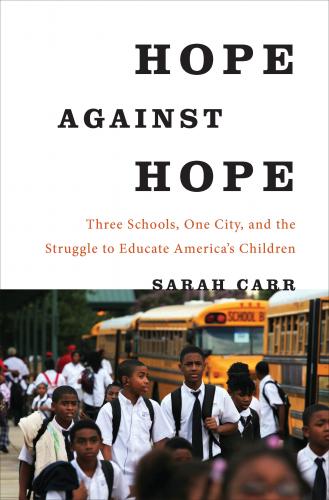
 Sarah Carr spent five years covering education for the Milwaukee Journal Sentinel before an
itch for change took her to New Orleans, where she covered the same beat for
the Times Picayune. It was a unique
opportunity. One result of the devastation of Hurricane Katrina on the fabric
of the city was a controversial decision that converted the entire New Orleans
school system into a massive experiment with charter schools and school choice.
Carr’s time in Milwaukee, a city on
the leading edge of the movement for private school vouchers and expanding
charter schools, turned out to be especially apt. She came here in 2002 after
getting a master’s degree at Columbia University, where she wrote about New
York City schools and fell in love with the subject. “I didn’t know at the time
what a fascinating place it would be to write about education,” Carr says of
Milwaukee.
A decade later, digging into the beat in New Orleans led her to
write Hope Against Hope (Bloomsbury, 316
pp.), which came out last month. Carr will be back in town March 19 and 20 to
discuss the book at 7 p.m. Tuesday night at Boswell Book Company, 2559 N.
Downer Ave, and Wednesday at Marquette University. Carr chronicles a year in
the lives of three very different actors in the New Orleans system: a 14-year-old
girl enrolled at a KIPP charter school, a
Harvard grad recruited for Teach for
America, and the principal of a re-opened school.
The approach gave her a degree
of intimacy not normally available. “It
was a lot more invasive into people’s lives than when you just go interview
them for an hour,” says Carr. “I was really grateful for how open the people I
followed were to letting me shadow them around.”
Watching outside media “parachute
in” to cover the New Orleans schools reinforced for her the importance of being
grounded in a community over time to get a fuller picture and reduce the risk
of being misled by actors with a vested interest. Carr says the book allowed
her to bring her own analysis to the topic, although she doesn’t make an
argument directly for or against charter schools or Teach for America, both of
which have vocal supporters as well as detractors.*
“When it comes to writing about
highly politicized education issues,” Carr says, “my time in Milwaukee made me
very suspicious of the extremes in the debate.”
Two diametrically opposed narratives
about school choice get the most attention, she says: One, that school choice
freed parents, children and even schools to excel; the other, that school
choice did nothing but hurt poor families. “Too much education journalism
focuses on quoting the extremes that perpetuated the two narratives,” instead
of exploring the more subtle and complex reality that lies somewhere between
them, Carr says.
The book took her much deeper than daily journalism usually
permits. “I often felt constrained by length and space in newspapers,” she
says. “Sometimes there really is only the space to get in the quote from either
extreme” – at the expense of the more nuanced, fleshed-out portrayal of an
issue. It also was a renewed lesson in the importance of getting into schools
and of seeking out and interviewing parents, teachers and school administrators
– not just superintendents, school board members or activists in the education
debate. “It’s hard because that kind of reporting takes more time,” she says –
time increasingly unavailable as staffs shrink and demands on reporters’ output
keep rising.
Indeed, it was that changing
newsroom culture that led Carr to leave the Times-Picayune
when the paper downsized and cut its print publication to three days a week
last year. She’s now a contributing editor at the Hechinger Report, a nonprofit journalism
organization specializing in education coverage.
Her years in Milwaukee brought home
the importance of ground-level reporting. Data is needed to ground stories, she
says, but by itself it tells little. “Data was relatively meaningless compared
to the story of one teenager who was profiled as part of the series, who had
assaulted her principal,” says Carr. “She had been shuttled around more than 25
foster homes and a dozen schools. It showed kids aren’t born troubled – they’re
made that way.”
*
 Our next journalists-turned-authors are two JS Madison bureau reporters, Patrick
Marley and Jason Stein. They are
out with a book looking back at the battle over Gov. Scott Walker’s Act 10, the law that stripped public employees
of most union rights and paved the way for nearly two years of protests, recall
races and polarization in this state.
Tuesday Marley and Stein took part
in a Q&A led by Public Policy Forum director Rob Henken about the book and the insights they gained while
working on it. (They’ll be at Boswell’s March 26.) More Than They Bargained For (University of Wisconsin Press, 350
pp.) reconstructs
the events before and after Walker introduced Act 10, its stormy passage
and the aftermath. It includes details and analysis not previously reported in
the heat of legislative and political battle.
“The human element – of who lawmakers are and what their
background is – is really important to what happens at the state Capitol, but
very often there’s no time or space to explore that in a newspaper article,”
Stein says in an email to Pressroom Buzz, written in consultation with Marley.
“This project gave us that chance.”
Word of Act 10’s reach leaked out
just one day before the bill was made public. “We knew it was a huge shift in
policy for Wisconsin,” Marley told Henken during Tuesday’s Q&A session. But
the press didn’t foresee the magnitude of the reaction, massive protests for
weeks on end inside and outside the state Capitol building and more, Marley
said.
I asked Stein and Marley whether
one reason for that surprise was that coverage of workers and unions has shrunk
so much from the news over the last several decades.
It may have to some degree, Marley
says, but he points out that even union leaders didn’t realize how big the
protests would be. While unions quickly rallied opposition and bused in members
to speak against it at a Joint Finance Committee hearing, “they were stunned by
the numbers that came to the Capitol.” The book quotes Marty Beil, executive
director of the Wisconsin State Employees Union: “Never did we think those
first two lobby days we’d see that many people.”
Henken asked whether the national
and even international attention to the bill, the protests, and the swift
departure of Wisconsin’s 14 Democratic senators for Illinois to block its
passage all helped to harden positions so that compromise was impossible.
“It was sort of like a couple
working out marriage difficulties with the extended family in the room,” Stein
told him – raising the stakes so that every move on either side immediately
would be framed in the most polarized and polarizing terms.
The book grew out of their proposal
to the UW Press in the summer of 2011, and it was produced mostly around their
regular jobs, with only a little time off and lots of weekends and evenings
spent writing.
The issue was distinctive and compelling for the moral
dimension participants brought to it – on both sides. “It’s rare when you’re
talking about budgets to have people so emotionally and morally invested in an
issue and in this case it was on both sides,” Stein tells me in his email
response with Marley. “It certainly complicated our reporting at times because
you had to work with sources and take feedback from readers who were very upset
about what was happening and had trouble understanding the other side’s point
of view. At the same time, it also enriched the reporting because it was great
to have so many people so interested in their government and what was being
reported on it.”
Did the emotion and moral fervor cramp their own
objectivity? No, they say. “The pressure that we felt was more from the
crushing deadlines, long hours and complicated issues,” Stein says. “Doing all
that amid the protests was daunting at times. But the urgency and the
importance of what was happening made us want to be more fair and more
accurate, not less.
“We don’t get too hung up on what we think about an issue,”
he continues. “We’re more interested in what we can find out about a story and
what other people’s emotional reaction to it is, not our own. The bottom line
is we saw Act 10 as a big deal and we wanted readers to know everything about
it.”
*Full disclosure: As a freelancer, I edit material for an
academic group that is deeply engaged in the school-reform debates and has
published critiques of various reform strategies. My writing on education
issues outside that work relies on my own research and analysis and neither
represents nor is controlled by my editing clients.
*
Comment
below, or write Pressroom at pressroom@milwaukeemagazine.com.
Follow Pressroom on Facebook or on Twitter.
(home page image from Shutterstock)


