Honey Creek is one of Milwaukee’s minor-league waterways. Rising in suburban Greenfield, it follows a concrete channel north, plunges underground for 2 miles, including the entire length of State Fair Park in West Allis, and then re-emerges along a wooded parkway to meet the Menomonee River near downtown Wauwatosa.

If someone has inspired you through their service, leadership or dedication, the Unity Awards are your opportunity to recognize them!
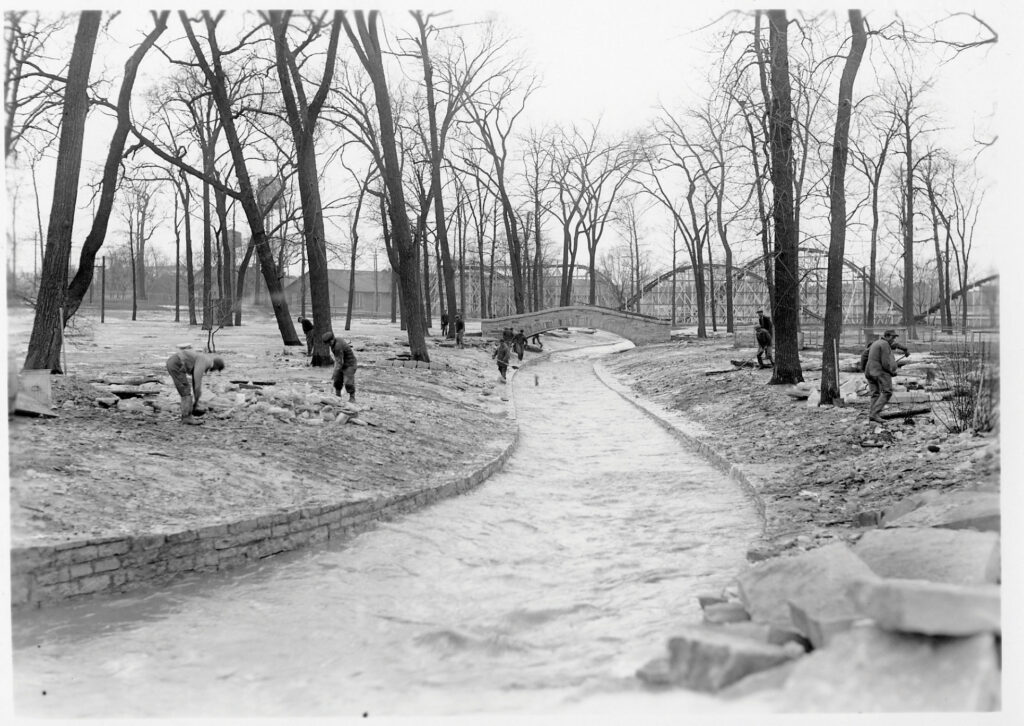
Although it lies buried today, the segment pictured here was once a prized amenity of State Fair Park. In 1892, after hopscotching around the state for 41 years, the fair’s leaders purchased a 160-acre farm at 84th and Greenfield for the event’s permanent home. The property included a remnant of the original hardwood forest that fair officials wisely chose to leave in a state of nature.
“The lawn and beautiful grove in the southwest section of the grounds,” reported the Milwaukee Journal, “will be placed at the disposal of the public for picnic purposes and general recreation.”
The one flaw in this idyllic picture was periodic flooding. Honey Creek jumped its banks whenever rain fell too hard or snow melted too fast, a problem that wasn’t addressed until the Depression of the 1930s.
Milwaukee County employed thousands of federally funded relief workers as the economic gloom deepened, and flood-proofing Honey Creek was one of their more ambitious projects. Civilian Conservation Corps crews streamlined the creek’s channel, added a rustic bridge, and built Lannon stone retaining walls. The relief workers shown here are clearing ice deposited during a late winter flood when the project was close to completion.
The grove remained a rustic respite from the State Fair’s carnival barkers and squealing pigs until the early 1960s, when Honey Creek was routed underground to open space for new development. The buried channel now lies squarely beneath the 200,000-square-foot bulk of the State Fair Park Exposition Center.
TAKE A CLOSER LOOK:
-
Water towers and smokestacks dominated the skyline of industrial West Allis.
-
To maximize employment, New Deal relief workers used picks and shovels rather than more efficient machinery.
-
This wooden roller coaster was built in 1924 for an amusement park that operated until 1961, when it was replaced by a traveling midway.
-
This jumbled pile of Lannon stone indicates that there was still work to be done. Most of the stone used in Milwaukee County’s work relief projects came from a quarry in Wauwatosa.
IN COLLABORATION WITH MILWAUKEE COUNTY HISTORICAL SOCIETY