
The honeymoon was over for Dennis Kuester. He had been chief executive
officer of M&I Bank for barely three months when an alarming phone call
broke the silence of his Florida retreat. The message: “We’d just been named the
worst place in the world for women to work,” Kuester ruefully recalls.
Kuester is exaggerating, but only slightly. In a survey of nearly 1,000 local
business leaders done by this magazine, M&I had received twice as many
negative votes as any other area employer for having the “worst workplaces…and
working climates for women.” Four other organizations were also ranked among the
worst: Wisconsin Energy Corp., Northwestern Mutual and the top two law firms,
Foley & Lardner and Quarles & Brady.
In the four years since our story (“Women and Power,” April 2002), some
companies have made great progress in their overall climate for women. Others
have done nothing.
Last November, a University of Wisconsin-Madison study commissioned by
Milwaukee Women Inc, an organization of professional women formed after our 2002
article, painted a mostly bleak picture of progress inside Wisconsin companies.
It found that one-third of the state’s largest public and private companies
still had no women directors on their boards in 2005. Among the state’s 50
largest public companies, the number of women board members was up slightly,
from 9.5 percent to 11 percent, but still below the national average of 14
percent. Meanwhile, the number of female executive officers at the top 50
companies had actually declined, dropping from 12 percent to 11 percent, well
below the national average of 16 percent.
But the five organizations tabbed in 2002 as the worst places for women to
work seemed to have improved the most. Today, Nancy Sennett is managing partner
for the local office of Foley & Lardner; Ann Murphy heads Quarles &
Brady’s local office.
Wisconsin Energy, now called WE Energies, has formalized procedures to make
sure that when it hires from outside, the pool of candidates includes qualified
women and minorities. Today, its top woman executive, Kristine Rappé, rates as
one of the most powerful women leaders in town.
At Northwestern Mutual, two women have been added as board members and four
more as senior vice presidents. Today, 27 percent of the company’s executive
officers are women. In December 2005, Fortune magazine ranked it among
the top national employers for women.
But perhaps no company has made greater strides than M&I. Even if a
negative survey result merely reflected a perception of outsiders, “perception
is reality,” Kuester figured, and it could hurt the company’s ability to hire
talented women and minorities. So he set out to change the company. Today,
M&I is among only a half-dozen of the state’s 50 largest publicly traded
companies to have three or more women executive officers and one of only five to
have added a woman to its board since 2002.
This is a big deal in a state woefully in need of corporate role models. “We
rank very, very poorly on females in management,” 44th among the states, says
Wisconsin Department of Workforce Development’s Terry Ludeman, the state’s top
labor economist.
Across the country, Bureau of Labor and Census Bureau statistics show,
college-educated women made just four-fifths of what men with a comparable
education earned in 2005 even though many of these women, 55 percent, are the
chief breadwinners, earning half or more of their household’s income.
Wisconsin also ranks 45th nationally in female-to-male pay equity for
full-time, year-round work, notes Ludeman. At our current rate of progress, it
will take more than 100 years before equity in pay is reached.
Perhaps that’s why college-educated women are leaving the state at twice the
rate of men, many for Minneapolis, which ranks 16th nationally in the percent of
management and supervisory jobs held by women (Milwaukee ranks 39th).
Aside from the issue of equity, Wisconsin’s ability to truly empower women
could affect our corporate profits and overall state economy. That’s the message
of the state’s first woman lieutenant governor, Barbara Lawton, as she
crisscrosses the state promoting her Wisconsin Women Equal Prosperity
initiative.
“If the goal is economic development…well, Chicago and Minneapolis have
already identified this as a critical issue…It will take a critical mass of
women and a cluster of companies to move into the 21st century,” says Lawton.
“Without a diversified workforce, you continue to give tacit approval to an
institution designed by men, for men, with the assumption that a full-time
caregiver would be at home. Well, none of that exists anymore.”
Though the statistics for Wisconsin suggest we have a long way to go, there
are clear signs of progress, starting with the companies mentioned above, but
also including Journal Communications, Manpower and even long-time male bastions
like the Metropolitan Milwaukee Association of Commerce and the elite business
leadership group, the Greater Milwaukee Committee.
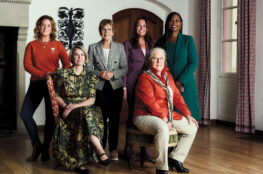
There are also signs of change among women themselves. High-powered women
executives in Milwaukee are doing more to help others move up the ladder than in
the past. They are getting more aggressive about publicizing the equity problem
through groups like Milwaukee Women Inc. They are finding ways to connect to top
male executives by working together on major civic projects.
“What I see is more women in attendance at the GMC, Boys & Girls Club
board, the United Performing Arts Fund board,” says WE Energies Rappé. “Women
are operating at a higher level in this community now than three or four years
ago.”
The city may be reaching a tipping point in terms of women and power. “Every
group in the community is after women, Hispanics, African Americans and young
professionals,” says Rappé. “I wasn’t aware of that three years ago, but now,
everywhere I go, it’s ‘How can I get these people involved?’”
A handful of Milwaukee companies are finding some answers.
Leading From the Top
Dennis Kuester doesn’t like to think of his
as a Horatio Alger story, but he certainly isn’t a Milwaukee blue blood. He is
the son of an Allis-Chalmers machinist with a third-grade education and a mother
who worked her way up from bakery clerk to supervising the Kohl’s grocery
chain’s bakeries.
Kuester himself is a public school graduate (Milwaukee’s Custer High School)
and former Kohl’s bagger (85 cents an hour) who earned a degree in accounting
and finance at the University of Wisconsin-Milwaukee, far from the world of Ivy
League elites. But when he joined M&I Bank after a 10-year stint at IBM,
Jack Puelicher, then the bank’s head, told Kuester his future didn’t depend on
his past but on his performance.
Kuester’s promotion 26 years later to CEO represented the triumph of someone
who didn’t – at least until then – belong to the old-boys club. Kuester’s
background and the fact that he had a grown daughter working in business may
have made him more concerned about the negative ranking his company received in
Milwaukee Magazine’s survey.
Kuester wondered whether his own workers considered M&I a poor place for
women workers. So in the spring of 2002, he hired an outside firm to find out
what his 14,000 employees were thinking. Twenty-one focus groups later, Kuester
knew “a lot of it was outside perception.” Internally, he adds, “We weren’t as
bad as people outside thought but certainly not as good as we could be.”
The company already had a diversity council, which Kuester chaired. He
re-energized it, particularly its mentoring program. In three years, M&I
increased the number of female senior managers by a remarkable 88 percent. They
now make up one-quarter of high-level managers. Much of the talent he found was
homegrown, like Kuester himself.
How did the management team change almost overnight? “It was just a matter of
focus,” says Kuester. “Once you focus a little bit more attention on this,
things change. Most firms need to bump it up a little.”
But leadership from the top is critical, experts say: The fact that the CEO
was sending a message that this was important meant everyone at M&I would
take this seriously.
Now, when management positions become available at M&I, Kuester says,
“Our first question is can this position be filled with a minority person or a
woman? But it still has to be a very qualified person; 14,000 people depend on
our leadership.”
Kuester actually talks more about fairness and righting old wrongs than the
women behind Milwaukee Women Inc. “It’s just the right thing to do,” he says.
“It’s right to give everyone an equal opportunity, especially groups that didn’t
have it in the past.”
But it’s unlikely the company would make such changes if it hurt the bottom
line. In fact, as The Economist reported last August, “A series of
studies from America, Britain and Scandinavia…show a strong correlation between
shareholder returns and the proportion of women in the higher executive
echelons…While this does not establish a causal relationship, it does suggest
that a corporate culture that fosters women’s careers can also foster
profitability.”
A 2004 study by Catalyst, a leading U.S. nonprofit advocate for professional
women, found that the return for Fortune 500 companies with the highest
representation of women in senior management was 34 percent higher than
companies with the fewest women. Increasingly, America’s businesses are learning
that diversity pays dividends.
Changing The Rules
The Greater Milwaukee Committee, founded in
1945, had always been dominated by male CEOs working quietly behind the scenes.
Since only CEOs were part of the club, that essentially excluded women. In later
years, female heads of area colleges and universities were allowed in and were
eventually joined by the town’s one woman CEO, Brady Corp. leader Katherine
Hudson, now retired.
By the late 1990s, the GMC had changed this rule to allow the city’s largest
companies to add a second executive from the corporate suite to the GMC’s
roster. There was a practical reason for this, since today’s CEOs often spent
much time on the road.
But it wasn’t until 2005, when Journal Communications Chairman and CEO Steve
Smith became GMC chairman and Robert W. Baird Managing Director and Chief
Investment Officer Mary Ellen Stanek became co-chair of the GMC membership
committee, that the rule began to have a major impact. Stanek helped bring in a
number of new women members, including Manpower Executive Vice President Barb
Beck, Time Warner Vice President Bev Greenberg, Aurora Health Care Senior VP Sue
Ela and Harley-Davidson VP, General Counsel and Secretary Gail Lione.
Julia Taylor, the first woman president in the group’s history, also had an
impact. Taking office in January 2003, Taylor pushed to create a new category of
emerging leader, and most of those chosen have been women. Since 2002, the
number of women and minorities on the GMC board has jumped from 12 percent to 21
percent.
“People come to the GMC and expect to find the old-boys network. But it’s not
anymore,” says Taylor.
The GMC had created a CEO Diversity Task Force in the late 1990s to help
businesses attract and retain African Americans, but it was expanded to advance
women as well. The task force was headed by Manpower CEO Jeff Joerres, who
declared it needed more prominence to have a true impact and pushed for it to
become one of four standing GMC committees, alongside economic development and
quality of life.
Under the guidance of Katherine Hudson, Harley-Davidson CEO Jeff Bleustein
and then University of Wisconsin-Milwaukee Chancellor Nancy Zimpher, the GMC
also created a diversity school for CEOs. The Institute for Diversity Education
& Leadership (IDEAL), located at UWM, began offering forums in 2004 on the
best practices for fostering diversity.
Sixty-five companies and organizations became IDEAL members. The group
included top management from Aurora, Journal Communications, Kohler Company,
Manpower, M&I, Marcus Corporation, The Blood Center and Children’s Hospital.
The intention is to “make Milwaukee a region of choice for diverse talent,”
says IDEAL Executive Director Amy Batiste, Ed.D. She believes local companies
have “moved beyond worrying about lawsuits to an awareness of diversity,” but
adds that most haven’t reached the point of valuing diversity, managing it and
leveraging its power.
Indeed, one CEO told Batiste he wouldn’t join IDEAL because then “we’d have
to do something.” But Batiste says she also has star pupils who “are making
diversity the center of their business plans, not just a program you do once or
twice a year.”
Measuring Results
While the GMC represents the region’s biggest
businesses, the Metropolitan Milwaukee Association of Commerce is more
wide-ranging, with a membership that includes many smaller businesses. Yet in
the summer of 2002, the group announced its roster of new appointees to the
board: Every one was a white male. That left the board with a membership that
was 96 percent male. The old-boys club, it seemed, was alive and well in 21st
century Milwaukee.
The city’s two professional-women’s groups, Professional Dimensions and
Tempo, immediately volunteered to help MMAC change its criteria for board
membership, remembers MMAC President Tim Sheehy.
But MMAC board chair Dick Abdoo and incoming chair Dennis Kuester didn’t want
to change the rules. They had a different approach.
“They were both big believers that what they measure is what you’re going to
do,” Sheehy recalls. “They said, ‘We’re not going to change the qualifications
for board membership, but we’re telling you, we’re going to measure your
performance by this and it will affect your bonus.”
Result: Within three years, MMAC’s board went from 4 percent women and
minorities to 17 percent.
“We always said the pond we fished in for members, business owners and CEOs
was more limited than the general population,” says Sheehy, “but we weren’t
looking at that pond with enough earnest.” Since Sheehy began searching the
waters’ small and mid-size companies, 43 percent of new board nominees have been
women and minorities.
MMAC’s transformation didn’t end there. For the past two years, it has helped
fund the Milwaukee Women Inc. study that measures progress in the boardrooms and
executive suites of the state’s largest companies to see whether, once again,
that which gets measured gets changed.
In November, MWI unveiled the findings of its new study at a joint meeting of
the GMC, MMAC, Tempo and Professional Dimensions.
The slide presentation had little progress to report. Of 43 companies that
remained from a 2002 list of the state’s 50 largest publicly traded firms (some
were sold, others moved), just five companies increased the number of women
executive officers, while 30 companies saw no change and eight saw a decrease.
At the bottom of the list was a kind of “Dirty Dozen” – 12 Wisconsin public
companies that still have no women executive officers and board members. Wags
dubbed it the “Zero-Zero Club.”
In deference to the male chief executives who might be present, the slide
presentation left out the list of Zero-Zero Club members. But how can you
measure results if you don’t fully report your findings?
Keynote speaker Charisse Lillie, a senior vice president of human relations
for Philadelphia-based Comcast, a Federal Reserve board member and accomplished
African-American attorney, seemed aware of this irony. “A lot of people worry,
‘How do you show the value of diversity without making it an attack on white
men?’ Well, I don’t have problems with it being an attack,” she said.
In fact, Lillie added, if the number of zero-zero companies doesn’t drop
significantly in a few years, she is willing to come back and lead the attack.
Lillie talked about the need for top-down leadership – the kind personified
by Kuester – about tying bonuses to achieving diversity, as the MMAC has done,
and about changing outmoded rules, as the GMC has done. But another, more subtle
way to achieve change is by creating a more collaborative culture. One local
company is leading the way.
Changing Corporate Culture
Northwestern Mutual has long prided
itself on being The Quiet Company, but that style may have hurt it when we did
our survey in 2002. The results ranked Northwestern Mutual as both among the
worst and the best in terms of promoting women. Was the company so quiet it
hadn’t communicated changes that were happening? Or did the sheer size of
Northwestern Mutual leave it divided upon itself, with departments that had very
different styles and results?
“In 2002, there were some departments where there weren’t any senior women,
but that has changed. I can’t think of one that doesn’t have a senior woman
now,” says Deborah Beck, executive vice president of planning and technology for
Northwestern Mutual.
Four years ago, the company had only one female senior vice president and now
it has four, says Beck, who joined the company as a Marquette University Law
School grad in 1975. Today, with nine of its 34 corporate officers, four of 24
board members and 53 percent of management made up of women, Northwestern Mutual
ranks with Xerox, long considered a corporate model for advancing women. More
than 20 percent of Northwestern Mutual employees who earn more than $200,000 are
women.
What accounts for the transformation? Beck points to the leadership of
retired CEO Jim Ericson and his successor, Ed Zore.
Like Kuester, Zore is another commoner, a working-class Milwaukee kid who
graduated from UWM and rose to the top without a degree from an East Coast
college. Zore, the father of two grown daughters, kept asking his corporate
colleagues, “How do we develop and encourage strong women?” says Beck.
One answer emerges in research showing that women find more career success in
co-operative, supportive, “feminine” firms than in aggressive, competitive,
“masculine” organizations.
“This is not a shark tank,” says Zore. “We don’t want people with real sharp
elbows.”
The fact that women may avoid a competitive culture doesn’t mean they’re not
good negotiators. In fact, business gurus now recommend adopting the
non-adversarial relationship-building techniques women tend to use. And there is
evidence that women are better at team building and communication, important
skills in a work environment.
“We can’t all think like white males,” says Zore. “That’s a minority of the
population.”
Also important is flexible work hours. Women tend to succeed where their need
to balance work and family doesn’t clash with organizational expectations and
values, say Stanford University researchers Charles O’Reilly and Olivia O’Neill,
who followed male and female MBA graduates years into their careers.
“All we’re doing is making sure it’s a level playing field,” says Zore. “If a
woman has a child, we do everything we can – time off, flexibility – to make
sure that person comes back. We say, ‘Why don’t we see if we can make the rules
adaptable to their needs?’”
In another Stanford study, economist Muriel Niederle found that even at a
task women clearly perform as well as men, they were more likely to underrate
their performance, while men consistently overrated theirs.
“You have to have the kind of environment that will attract the talent you
want and the process so that people who deserve jobs get them without any
biases, overt or covert,” notes Zore. “If I see a woman and a man at the same
level, I ask why is this man making X and the woman this?”
Finally, he says, the company has to provide mentoring. “You have to…look at
women and minorities and identify, grow and support them.”
Harley-Davidson adopted that kind of culture years ago. It’s not a
competitive or hierarchical place, says H-D Vice President, General Counsel and
Secretary Gail Lione. “We govern by circles, with a very flat structure with no
executive VPs…women play well when you have consensus management.”
Out of the 250 highest-paid executives at the state’s 50 largest public
companies, only 13 are women, and Harley-Davidson has two of them: Lione and
Donna Zarcone, president of its financial services arm. In addition, five of the
company’s senior vice presidents are women.
Because the company is flexible and collegial, Lione says, it can accommodate
women who have a baby: “We have part-time, flex-time and telecommuting policies.
And even if they leave, we stay in touch. Some women want a year off. Some four
or five. Some come back right away. It’s not for us to question that, it’s for
us to accommodate that. You want to maintain the relationships and stay in
contact so you’ll get that talent back. Forty years is a long work life. So what
is a four-year hiatus?”
At a hierarchical company, she says, “You have to show up and punch the clock
every day. We have freedom with fences. We’ll experiment with what you need to
get your job done. Where it’s done is irrelevant. That’s attractive for all
people, but particularly women.”
Using Civic Power
Last summer, the Medical College of Wisconsin
hosted a fundraising golf outing at Chenequa Country Club, with the proceeds
going to fund cardiovascular research. Given that women are over 12 times more
likely to die from heart disease than breast cancer, you might have expected
large numbers to attend.
But judging from the dinner turnout, it might have been 1970. There were 300
men in the room and only one woman – if you exclude those serving the dinner.
That’s significant because corporate leaders who make board appointments tend
to select people from their own personal and professional networks, networks
that historically have not included women.
MCW President and CEO T. Michael Bolger says the event was never meant to
exclude women, but that “it’s up to the people who buy the foursomes to decide
who they invite.”
However it happened, it is exclusion from informal networking like this that
women rated as “the biggest obstacle Milwaukee women face” in our 2002 survey.
In fact, women considered it twice as big a problem as did male respondents.
They felt “male stereotyping…of women” was the biggest obstacle.
But as Beck notes, it’s hard to get beyond the stereotypes until there’s
enough women in the room so they can be seen “as individuals with strengths and
weaknesses, just like men.” Informal networking also helps break down the
stereotypes.
People hire those they know and are comfortable with, so relationships are
key to advancement. “You don’t want to go on a blind date with someone you put
on your board” is how one CEO put it to Stanek.
Rather than waiting to be invited to networking opportunities, women are
increasingly doing an end run on male CEOs, meeting them by joining community
not-for-profit boards.
The Committee of 200, a national group of which Beck is a member, reports
annually on women’s progress in business. It found that on a 10-point scale,
where parity with men is a 10, women went from 0 in 2002 to 10.78 in 2005 in the
number being asked to serve as honorary chairperson or high-profile fund-raiser
of the top 10 national charities.
“To get exposure, you can’t be afraid to raise your hand for significant
community positions – like co-chairing UPAF and United Way campaigns – where you
get opportunities to work side by side with some of the top business leaders,”
says Stanek, who co-chaired an annual UPAF campaign with Journal Communications
CEO Steve Smith.
“Women ask me, ‘How do I get from here to there?’” Rappé says. “I tell them
to get involved in [civic] board work and you can see how an entire enterprise
runs and you get exposure and relationship opportunities that will be valuable.”
UWM Vice Chancellor Joan Prince, incoming chair of the City of Milwaukee’s
library board, says “you can show your stuff on a not-for-profit board, but
until we African Americans do that in great numbers, progress will be slow.”
Prince says that once she’s on a board, “I always say let them find their own
secretary. They tend to want to make the woman the secretary. You go for the
nominating committee or the audit committee, where you can make a difference.”
Co-chairing a big campaign can increase your visibility enormously, says
Stanek. “People are able to see these women in action, demonstrating leadership
and commitment. You work through challenges and start to see how the other
person behaves.”
After working closely with her, UPAF co-chair Smith invited Stanek to serve
on Journal Communications’ board of directors. Smith declined to be interviewed
for this story, but Stanek’s addition to the board quickly led to other women
rising up: Another woman board member followed (making it two out of eight),
four of the company’s executive officers are now women and two of the five
people who report directly to Smith are women.
Men still dominate most corporate nominating committees, says Stanek,
recalling how another director on a corporate board marveled, “You have a whole
set of names we just didn’t have.”
It used to be that women were asked to fill a token spot, and they didn’t
hold the door open for other women. “That’s changed,” says Linda Mellowes, the
first person invited to join the Greater Milwaukee Committee as a community
volunteer.
“I use a mental image of myself using my elbows to let other women and people
of color in,” says Stanek, “so they don’t have to go to another market.”
Prince says she never leaves a nonprofit board without “a succession plan”
that puts another African-American woman in her place.
When Manpower Inc. Chairman, CEO and President Jeff Joerres hired Barbara
Beck to be his second in command in 2002, Beck quickly got involved in nonprofit
work, chairing the Heart Ball and a major fundraiser for the Boys & Girls
Club.
Beck increased the profitability of Manpower’s North American operations by
140 percent in the three years she was here before being promoted last fall to
oversee the company’s European, Middle Eastern and African operations. But while
she was in Milwaukee, she “pushed the entire company into the community,” says
Senior Vice President Melanie Holmes, a 25-year Manpower veteran.
Beck required everyone who directly reported to her to get nonprofit board
experience. “We never had that requirement before,” says Holmes, who now
recommends such involvement as “the way to get ahead – in all aspects of your
life.”
Meanwhile, society is changing. Generation X and Y workers, both male and
female, are looking for more flexibility and a better work-life balance, the
kind of workplace where women have thrived.
“I know women are saying it’s taking too long, but it’s going to change
faster than people expect,” says Sheehy, pointing to the growth in the number of
college graduate women across all fields (last year, 57 percent of all U.S.
bachelor’s and 58 percent of all master’s degrees were earned by women).
“Companies can’t afford to have an old-boys club because in 10 years, when
you have huge numbers of people retiring, if you’re not seen as open to
diversity, you’re going to be at the back of the pack in your ability to recruit
talent,” says Sheehy.
Still, for baby boom women now on the front line of this battle, who earned
the degrees and followed the rules only to encounter frustration, the
transformation in Wisconsin’s corporate boardrooms is painfully slow. “It’s been
a couple hundred years,” says Lieutenant Gov. Lawton. “We’re plumb out of
patience.”
Mary Van de Kamp Nohl is a senior editor of Milwaukee Magazine.
Additional research by Amanda La Bonar. Photographed by Dan Bishop.