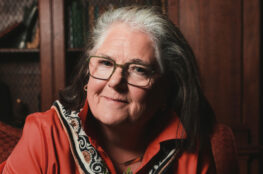

On a spring morning in 1998, Nancy Zimpher arrived early at the Downtown Wyndham Hotel wearing red – buckeye red, the colors of her alma mater and employer, Ohio State University.
She was interviewing for the job as chancellor of the University of Wisconsin-Milwaukee, the very first of 12 candidates to meet with the university’s search-and-screen committee.
As deans, professors, students and alumni filed into a dark conference room, Zimpher flipped on the overhead lights and flung open the drapes.
“She not only turned on the lights, but she lit up the room,” recalls Rene Gratz, a UWM professor of health sciences.
The “lady in red,” as she was remembered, was picked as a finalist for the job and went on to wow the UW Board of Regents’ own interview team.
“If Nancy wouldn’t have taken the job,” says Sheldon Lubar, former regent president and chair of the regents’ interview panel, “I would have suggested starting the search process all over again.”
To this day, nearly four years after those all-important first impressions, UWM Chancellor Nancy Zimpher continues to dazzle.
“She is everywhere, and she always has a way of contributing something positive,” says Bob Milbourne, executive director of the Greater Milwaukee Committee.
“She’s really put UWM on the map, not only in the state but in the nation as well,” says Talia Schank, president of UWM’s Student Association.
“She has a magnetic personality.… She’s kind of like a rock star,” says Charles O. Kroncke, outgoing dean of UWM’s School of Business Administration.
“She’s an irresistible force of nature,” says Bob Greenstreet, dean of the School of Architecture and Urban Planning.
Nancy Zimpher is, in a word, a seductress. With her winning smile, in her signature patterned stockings and St. John’s Knits suits – now of black and gold, her new school colors – she has turned a lot of heads in a lot of crowds. In a recent Milwaukee Journal Sentinel survey on leadership, it was even suggested that she’d make a good mayor.
Right out of the gate, Zimpher began a one-woman public relations campaign, working the campus, the city, the state, cultivating all of the right connections.
On her first official workday, Saturday, August 1, 1998, she attended African World Festival and a celebration sponsored by UWM’s African American Alumni Association, opening a door to the city’s black community. Days later, she met with the mayor and county executive. She made appointments with top business leaders, edu-cators and legislators. She addressed the Milwaukee Common Council, something no UWM chancellor had done in years. She spoke to an audience of 1,000 for the Women’s Fund annual fundraising lunch-eon, getting a standing ovation before she even opened her mouth when introduced as UWM’s first woman chancellor.
“Nancy knew the importance of getting out,” says Sandra Hoeh, former assistant chancellor for university relations. “She understood what it meant to be an urban university.”
Zimpher’s high-profile style took some getting used to at a campus whose inferiority complex rivals the city’s. Never in recent memory had UWM seen a chancellor so accessible, so out there beyond the ivory tower of the Kenwood Boulevard campus.
So it’s not surprising that this newcomer from Ohio engenders both fawning adoration and lingering skepticism. Her biggest critics – mostly faculty – are also among her biggest fans, an understandable contradiction in a milieu thick with opinions.
Skeptics are wary of her role as promoter, and charges are leveled of Zimpher egomania. (Every month, as the faculty/staff newsletter hits the racks, e-mails fly containing nothing but a single numeral – 10, for instance – the number of times the chancellor’s photograph is displayed in the newsletter.) The skeptics expect the seductress to woo and run, to pack her résumé and leave behind a jilted UWM for a more famous, sexier university, perhaps her beloved Ohio State.
A woman chancellor at a public university averages about four and a half years on the job, according to the American Council on Education. Zimpher has been at UWM three and a half. But she says she’s not going anywhere anytime soon. Yes, she has received “expressed interest” from other institutions, she says, but no, she’s not considering a move.
“Once you become a chancellor or president, you become more widely known, and so, like everybody else, you get calls and inquiries,” she says. “We’re just not doing anything with that. I am here and happy.…”
Her Milwaukee appointment is, of course, a handsome one. Her yearly salary is $185,000, raised to the salary cap last year by the regents. She has the use of a university car, a new Ford Taurus. She and her husband, Ken Howey, a professor in the School of Education, live rent-free in a state-owned lakeside English tutor in Shorewood. (Zimpher’s son by a previous marriage is a first-year student at Ohio University, a private school in Athens, Ohio.)
Supporters say they don’t see Zimpher leaving town before she completes her goals.
“We have a syndrome here in Milwaukee,” says Greenstreet. “People say, ‘She’s good. When is she leaving?’ But Nancy is not a hit-and-run chancellor. I don’t have any fear that she is looking to leave.”
“We don’t nail people’s feet to the ground,” adds UW System President Katharine Lyall, “but I think Nancy is the kind of leader who gets her satisfaction from accomplishing her agenda.”
And her agenda is hardly modest. Along with the image buffing and the never-ending networking, she is attempting something quite daring. Under the catch-all tag “the Milwaukee Idea,” Zimpher is trying to build “a new kind of university,” as the promotional brochures put it, a “premier urban research university” that’s an integral, active player in the life of the city.
Borrowing from the “Wisconsin Idea,” a credo dating back to the late 1800s that states “the boundaries of the University [of Wisconsin] are the boundaries of the state,” Zimpher reasons that UWM’s own focus should extend throughout metro Milwaukee. UWM, she declared, must be an “idea factory,” promoting “engagement” with industries, governments and nonprofits.
Zimpher has indeed put UWM on the map. It’s hard to miss the black and gold logo on campus, at the State Fair, atop the Plankinton building and in right field at Miller Park, pooh-poohed by some as a waste of $750,000 (a three-year partnership with the Milwaukee Brewers, funded from gifts and corporate sponsorship) but seen by Zimpher as a good opportunity for “branding.” Zimpher herself, with a wardrobe of black and gold, is a walking billboard.
Last year, the university opened a new high-rise dormitory and a new home for the Peck School of the Arts in the remodeled Temple Emanu-El B’ne Jeshurun on Kenwood Boulevard. Plans are under way to branch out even more, possibly to relocate entire departments and add classrooms to the Kenilworth building near Farwell and North or at Northridge Mall. A proposal was announced by Columbia and St. Mary’s hospitals late last year to replace the two East Side hospitals with a new facility, possibly freeing up the Columbia property for UWM expansion. “We’re looking at what Columbia will do,” says the chancellor.
On the national level, Zimpher has hitched UWM to her already rising star. She’s written or co-authored 15 books or monographs, mostly on teacher training, her longtime expertise. Last fiscal year, she and her husband wrote a grant proposal that brought in $638,000 for recruiting and preparing teachers for high-need urban schools.
“She’s very active, a national leader among urban university leaders,” says Luther Burse, of the National Association of State Universities and Land Grant Colleges.
If the cardinal rule of marketing is “know thy customer,” Zimpher has managed to keep most of them satisfied: students, faculty, regents, lawmakers, the governor, the business community. But whether her grand design will have a measurable effect on improving the quality of education at UWM is still an open question.
ven as a child, Zimpher’s life was a whirlwind of accomplishments. Born on October 29, 1946, Nancy Lusk was the youngest of three children, two girls and a boy. When she was 5, her parents, Aven and Elsie Lusk, bought a small farm in the western Appalachians near the town of Gallipolis, Ohio. An acre of corn grew outside the farmhouse, and the children belonged to the 4-H Club.
But their parents were educators, not farmers. Aven was a principal before taking a job as a salesman, while Elsie taught high school. Having a mother teaching high school raised certain expectations of the Lusk children. For instance, because Elsie was trained to teach Latin, her children were obligated to study Latin through all four years of high school.
Nancy was bright and active. She played snare drum, won the Daughters of the American Revolution Good Citizen Award, was yearbook editor and president of a youth group. As a senior, she was elected to the National Honor Society.
“I was inquisitive, but I don’t think I was particularly erudite as a child,” she says. “I didn’t hide away and read books.”
Still, it was forever a challenge to keep up with her overachieving siblings. “While I was good, I was never as good as my sister and brother,” she says. “They were 4-point students. They got in the honor society during their junior year.” Her sister went on to get a master’s degree in teaching from Harvard before going to law school; today, she practices law in Cleveland. Her brother became a physician and lives in St. Louis.
After graduating from high school in 1964, she made a beeline to Columbus and Ohio State University, her first and only choice for college, where she majored in English, with plans to teach.
It was the age of bell bottoms and love beads. She fit right in, groovin’ on Dylan and Hendrix, diggin’ Joseph Heller’s Catch-22 and Eldridge Cleaver’s Soul on Ice. Her hair long and blond, her fingers strumming an acoustic guitar, she resembled Mary Travers of Peter, Paul & Mary, with “the bangs but not the talent,” she says.
In her junior year, she joined a sorority, Kappa Alpha Theta. “That was a pretty rarefied environment,” she says, “with some extraordinary women.” Indeed, one of her sorority sisters would become the chief executive officer of Baldwin Piano; another, Judith Miller, a New York Times reporter and co-author of the bestseller Germs.
In 1968, she received her bachelor’s degree in English with a minor in speech, completing classes in oral interpretation, public speaking and theater and erasing all tangible traces of her Appalachian upbringing.
The year 1968 offered other influences. A roiling presidential campaign was in full swing. Martin Luther King Jr. was gunned down in Memphis. President Johnson had ratcheted up bombing in North Vietnam.
“My political awareness was being raised very quickly,” she says.
By the end of summer, she moved to Maryland to teach seventh-grade English. But before the end of the school year, she was back in Columbus, engaged to be married. That fall, after marrying Craig Zimpher, a graduate student she had met at a Robert Kennedy rally, she began a master’s program in English literature. The couple lived in a dorm, her new husband director of the residence hall.
It was a heady time to be a college student. “You didn’t dare go to a party if you hadn’t read the week’s installment of The New York Review of Books and The New Republic,” says Zimpher.
It also spurred her political activism. She helped organize a Columbus contingent to the March on Washington in 1969.
“I thought we were in a difficult and inappropriate war,” Zimpher says of her politics at the time. “I was worried about presidential leadership, I had lost some confidence in government. I was like a lot of people… frightened. My friends were going to war – I’d lost high school friends – and I had friends who served in the National Guard who were just as afraid as people on the other side of the line.”
The antiwar movement reached a sobering juncture on May 4, 1970, when Ohio National Guardsmen shot and killed four students and wounded nine others on the campus of Kent State University. One hundred miles away in Columbus, the university president shut down Ohio State and the governor ordered armed guardsmen to occupy the school to quell unrest.
Months after Kent State, Craig Zimpher, an ROTC student, reported for two years of military service. He was sent to rural Missouri. There, Nancy Zimpher finished her master’s thesis (on animal imagery in the works of Herman Melville), then taught grade school for a year in a two-room schoolhouse in the Ozarks. She led the school choir and learned to play the dulcimer. In some ways, it was a reprise of her Appalachian childhood. “I think I fit in pretty well,” she remembers.
In 1972, her husband’s military duty ended and Zimpher returned once again to Ohio State, this time to begin a doctorate. After just two years in the classroom, her aspirations shifted. Emerging was an interest in training future school teachers.
“My penchant for wanting to be in charge was beginning to emerge,” she says. “It wasn’t enough to manage my interests in the classroom. I wanted to manage lots of classrooms.” She added minors in political science and academic administration to a doctorate in teacher education.
It was unusual for a student to complete all three degrees at the same institution. “I was encouraged to go elsewhere, but I hadn’t exhausted the courses at Ohio State just because I had two degrees from there,” she says.
Zimpher gave birth to a son, Fletcher, in 1983. She and her husband divorced in 1986. A year later, she married Ken Howey, a professor of educational policy at OSU. Howey was a Wisconsinite, raised in Green Bay, with master’s and doctorate degrees from UW-Madison. With her husband as her professional and personal companion, Zimpher deftly climbed the ladder as an academic – from director of undergraduate programs to assistant professor to full professor, from associate dean to dean of education to executive dean of the professional colleges, one of four super deans at OSU.
“She was sort of an inside outsider,” recalls Scott Powers, a former education reporter at the Columbus Dispatch. “Because all of her academic training was at Ohio State, they didn’t accept her as having credentials. It was a struggle for her to move up through the ranks, and it made her a huge fighter. She was known in Columbus as a force to be reckoned with” – on and off the campus. “She was well known in the mayor’s office, she was well known in the school board office, the state board of education. Her name was always showing up on some task force.”
It was widely assumed that Zimpher would be a provost or chancellor someday, somewhere, says Powers. “And every time I saw her, she was in some ridiculous outfit,” he adds, “a quasi-military dress with big shoulders” – the same sort she wears today.
Indeed, Zimpher learned how to make big impressions, gaining much of her PR savvy from Gordon Gee, president of OSU from 1990-1998 and Zimpher’s mentor. With his signature bow ties, oversize eye glasses and expansive grin, Gee was a local celebrity. Though he frequently ticked off the powers that be, his enigmatic behavior made him an influential promoter – and fund-raiser – for OSU, helping to bring in almost a billion dollars during his presidency.
With her own gift of gab and head-turning fashion sense, Zimpher’s reputation also grew. But not without conflict. As dean of education, she was involved in a plan to revitalize a declining neighborhood adjacent to campus. Working with the Columbus Public Schools, Zimpher chaired Campus Collaborative, which targeted 12 public schools in the University District for improvements.
The plan made headlines when activist Bill Moss, the only African-American member on the Columbus school board, charged Zimpher and OSU with attempting to gentrify the neighborhood and resegregate the selected schools for the benefit of real estate developers and OSU professors – funding capital improvements and creaming off the best teachers while ignoring problems at other city schools.
To her advantage, Moss says, Zimpher had developed a cozy relationship with public school officials. The school board president, he notes, was director of the YWCA when Zimpher was awarded a YWCA Woman of Achievement Award. The same board president put Zimpher in control of the search committee to bring a new superintendent to the school district.
“She’s a political animal,” Moss says today. “She needed to make a name for herself and she needed to do so with urban education.”
Zimpher takes issue with Moss, pointing out that she worked for 25 years with the Columbus Public Schools on a host of projects. With Campus Collaborative, she says, she had gained the support of 60 different departments at OSU, which pledged to retain faculty home ownership. “It was not gentrification,” she insists. “It was neighborhood revitalization.”
The plan, however, was scuttled; soon afterward, Zimpher was hired to head UWM.
he English teacher-turned-chancellor no longer has time for literature. She now reads what she calls “make me better” books – books on leadership and business strategies. Her schedule is jammed. To get from appointment to appointment on campus, a staffer sometimes wheels Zimpher around in a golf cart. She once had a personal trainer, but she was so worn out trying to squeeze in workouts before her early-morning meetings that she had to drop the routine. Weekends are often devoted to entertaining at the chancellor’s residence. She estimates she has one night a week to herself, free to take long walks with her husband along Lake Drive.
As chancellor, Zimpher wears many hats, nearly all of them public. She can be a masterful public speaker, relaxed, personable. She’s earnest when she needs to be, yet playfully irreverent to break the ice.
She is a quick study, always up on her homework. Before her first job interview at the Wyndham Hotel, she wheedled a meeting with the head of the recruiting firm hired to find a new chancellor. And chatting with an alum shortly after arriving in Milwaukee, she knew precisely when UWM’s erstwhile football team played its final game, as well as the final score.
For much of last year, Zimpher wore the hat of political schmoozer. On August 30, Gov. Scott McCallum signed the state’s biennial budget, allocating $19.8 million for UWM, an amount likely to be reduced some during the special legislative session now under way, but not far off from the $24 million Zimpher had originally requested.
After months of lobbying, Zimpher had hit the jackpot. Never before had UWM received state funding of this magnitude.
Since its conception in 1956, UWM has lived in the shadow of Madison, relegated to the reputation of a junior college and the stature of a commuter school. While UW-Madison developed itself as a world leader in biotechnology, UWM faced a decline in enrollment and the loss of dozens of teaching positions. While Madison celebrated top national ratings, UWM rarely garnered a mention, languishing in the fourth tier of U.S. News & World Report’s controversial yet coveted rankings of national universities, where it remains today. Embarrassingly, UWM was not named in the 2001 edition of the Princeton Review’s “Best 331 Colleges,” though the guide included gratifying blurbs for UW-Madison, Marquette University, Beloit College, Ripon College and Lawrence University.
Madison continues to outfund – and outshine – UWM, due partly to its size and history. Established in 1848, UW-Madison today has an enrollment of 40,470 undergraduate and graduate students, compared to Milwaukee’s 24,686. Because of its larger enrollment and greater number of out-of-state students, who pay higher tuitions, Madison collects more tuition than UWM and receives more federal funding, grants and contracts. It also raises more gifts from private donors, largely because UW-Madison has more living alumni. In October, UW-Madison received a staggering gift of $21.7 million from two longtime UW deans to set up the Wisconsin Idea Endowment. By comparison, UWM raised a total of $13.2 million in gifts and pledges for the entire 2001 fiscal year.
“When the system was merged 30 years ago, UW-Milwaukee was given a doctoral mission that it didn’t have before,” says UW System President Lyall. “Madison was asked to kind of coach Milwaukee” – develop faculty, establish procedures. “As a result, UW-Milwaukee grew up in the UW System feeling like it was a little brother to Madison.
“But little brother is growing up,” says Lyall. And much of the credit, she says, should go to Zimpher.
Prior to Zimpher’s arrival, on-campus issues took priority. Then-Chancellor John Schroeder was very much “an inside guy,” say observers, a chancellor who couldn’t be dragged off campus to meet with community leaders. Quiet and reserved, the longtime history professor’s style was laid-back and behind-the-scenes. Though low-key, he was effective in-house, even when handling such thorny issues as the Ceil Pillsbury sexual discrimination case, which forced UWM to rewrite its hiring and tenure guidelines.
So when Zimpher arrived on campus, she had few fires to put out. “We had been in a state of stable leadership for many years,” says Greenstreet, dean of the architecture school. “That enabled Nancy to hit the ground running forward.…”
But little work had been done to raise UWM’s profile, he adds. “We had been the stealth bomber of the UW System for too long. Nancy removed the cloak of invisibility.”
Zimpher very deliberately tailored her approach to be an outside chancellor. By the summer of 2000, she had taken UWM’s message to 18 UW campuses around Wisconsin.
In Madison to meet UW administrators and regents, Zimpher heard about something called the Wisconsin Idea. Less than a month after her arrival, at a brainstorming session, she introduced the Milwaukee Idea. Two weeks later, at her first faculty speech, she invited 100 people to spend 100 days shaping the foundation of the Milwaukee Idea. The list of volunteers soon doubled, then tripled.
“I don’t go into a room and then come out and say, ‘I’ve got it, by golly, it’s on the tablets, here it is,’ ” says Zimpher. “There were a lot of conversations.…”
Zimpher’s inauguration was delayed at her request until March 1999, giving her time to package and sell the Milwaukee Idea to the faculty and the community. By the time she was officially sworn in, her vision of a “new kind of university” was formed. The Milwaukee Idea would be her strategy for stopping the years of mission drift that had reduced UWM to a near invisible entity.
n a Thursday morning in October, Nancy Zimpher hosted yet another party, this one to kick off UWM’s latest Milwaukee Idea initiative, “Age and Community: Improving the Quality of Life for Older Adults.” It was a splashy event held at the University Outreach offices on the sixth floor of the Plankinton building. A jazz band played, Zimpher mingled with deans and professors and community activists as they munched on cheese and croissants and designer desserts.
The cost of the gala came to more than $4,000. But the return was enormous. “Age and Community” cemented a new partnership between UWM’s School of Social Welfare and the Helen Bader Foundation. To support a gerontology chair and promote research on aging, the foundation donated $5 million, the largest endowment ever made to a UWM school or college.
“It has taken a long time to get here,” says Robin Maryl, vice president of the foundation, noting that the university began exploring outreach to the elderly 20 years ago. “Our time has finally come.” The Milwaukee Idea has given agencies like the Bader Foundation a “front porch” at the university, says Maryl. “It has provided a place for people to go, and we just never had that before.”
UWM has long been regarded by many as aloof, a leafy East Side campus that looked down its nose at the community as if the city were its laboratory and the residents its lab rats. Seldom did UWM offer access or concrete solutions to city problems. But that has changed, says Stephen Percy, the chancellor’s deputy overseeing the Milwaukee Idea. “We now get invited to the table more often.”
With a budget allocation of $4.46 million for the current fiscal year, the Milwaukee Idea remains a work in progress, says Zimpher. The definition itself seems to have shifted shape since its introduction three years ago, and in the process it has confounded many.
“What is her Milwaukee Idea all about?” asks one skeptic. “…It seems like a lot of rhetoric.”
Zimpher isn’t surprised that it’s confusing to some. “It’s a complex thing, it’s not just a simple slogan.”
In broadest terms, the Milwaukee Idea is an attitude, she says, “a sense of knowing who we are, feeling confident.…” It’s also the marketing tool Zimpher and company used when lobbying the state Legislature last year. Under the cover of the Milwaukee Idea, UWM presented its investment plan, drawn up jointly by the administration and faculty, laying out objectives for improving the university. For example, under the plan, UWM aims to boost enrollment from 24,000 to 30,000 in the next five years.
Thirdly, and most precisely, the Milwaukee Idea is a set of strategic activities, says the chancellor, 15 initiatives so far that link UWM through research and teaching to off-campus enterprises, particularly in education, the environment, public health and economic development.
Under one initiative, the School of Architecture partners with local design firms to develop and construct a prototype for energy-efficient housing. Another initiative brings experienced MPS teachers into UWM’s School of Education for a year to help mentor beginning teachers.
Zimpher, through the Milwaukee Idea, has turned skeptics into converts. Business leaders, for example, no longer complain that UWM has shirked its role as an urban university, says the GMC’s Milbourne, who sat on the Milwaukee Idea’s steering committee. “Nancy has as much support from the business community as any other chancellor we’ve had at UWM.… UWM is now invited into issues that heretofore it would’ve been forgotten about.”
Faculty members, too, see advancement. When Zimpher introduced the Milwaukee Idea, English professor Greg Jay worried out loud that scholarly research would take a backseat to community engagement, that scholarship on, say, 15th century Italian poetry would not attract the kind of outside funding that an inner city project might and thus would lose import. His comments found their way to the chancellor; shortly after, she stopped by his office unannounced to talk.
“She didn’t make any promises,” Jay says, but she pledged that the Milwaukee Idea would be open to all. And she suggested that Jay get onboard.
He took her up on the offer and helped draft the first initiative, “Culture and Communities,” proposing projects and classes that cross college and departmental lines. As Jay wrote in an article published in the journal Academe: “The walls dividing the campus from the world that surrounds it are falling fast, sometimes for good reason, sometimes for reasons that should alarm us. Community engagement for the purpose of enriching education is exciting; community engagement for the purpose of enriching corporations and endowment accounts is suspect.… Faculty had better draw [the] line before somebody else does it for them.”
History professor Marc Levine heads another Milwaukee Idea initiative, the Consortium for Economic Opportunity. With an office on Martin Luther King Drive, the consortium lends its expertise to nonprofits and small businesses in the Inner City.
The Milwaukee Idea has “provided a framework to do better what we’ve been trying to do in our scholarly careers,” says Levine. “The university is a big place. The faculty is diverse.” At its best, the Milwaukee Idea can bridge the gap between applied research and ivory tower scholarship.
For the most part, Zimpher also seems to have the acceptance of students, though she was heckled by one during a campus photo shoot for this magazine. “Are you getting paid to do this?” hollered the angry young man. “Why don’t you go back to work!”
The students generally regard the Milwaukee Idea positively, despite the fact that the administration went back on its promise not to fund the Milwaukee Idea from tuition payments when Gov. McCallum insisted on a tuition hike as part of the $19.8 million 2002-’03 budget expenditure.
“I do think the administration could’ve done more on behalf of students to have that tuition component removed,” says Student Association president Schank. “We wanted to make sure students targeted for the Milwaukee Idea were not priced out of an education.”
Nevertheless, Schank gives Zimpher high marks for her accessibility. “She genuinely wants the opinion of the students.”
For some, the Milwaukee Idea is old wine in a new bottle. “We’ve been doing this long before the Milwaukee Idea,” says the business school’s Kroncke. “Professors go out and work with professionals.” UWM had one of the first MBA programs in the country, long before UW-Madison or Marquette, he says. “We were engaged in the community long ago, but nobody called it anything. What we lacked was marketing, image, packaging, visibility.… Nancy has changed that.”
The professional schools traditionally work hand in hand with the community. For years, the nursing school has coupled with local hospitals to train student nurses, says Laurie K. Glass, a professor in the School of Nursing who has worked under five of UWM’s six chancellors. But it’s Zimpher’s high-impact leadership that has made a notable difference, says Glass, unifying the professional schools and liberal arts alike. “It makes you feel like you’re back in a university.”
While few people question Zimpher’s sincerity, not everyone salutes the Milwaukee Idea. Some faculty members view it as nothing less than a threat to the university’s mission. They’re suspicious of community engagement and how Milwaukee Idea funds will affect research and hiring practices.
“Engagement – that’s the new term,” says David Petering, chemistry professor and former chair of the faculty academic planning and budget committee, which helped draft UWM’s investment plan. “That’s good for outside consumption, and you have to sell [the Milwaukee Idea] that way.… But is engage-ment the heart of the university? That’s the way a number of people will describe it, and to me, that simply cannot be. If you take away the heart of the university – that is, teaching and research – all you have is the shell.”
“There is a sense that people feel there are two universities,” says philosophy professor Bob Schwartz. “Many of us are doing what we always did.” Others, he says, are doing public relations and attending Milwaukee Idea meetings.
“There is a sense that you don’t want your university to be too engaged,” says Schwartz. “You do want to step back and reflect.… We’re not a training school for jobs, we need to inspire learning. That’s why students are here.” Schwartz and others worry that the Milwaukee Idea will place so much significance on applied research that theoretical training will be devalued.
“You have to have a great humanities department at a university, and they don’t bring in any money,” says Dick Blau, a professor in the film department. “But the impulse is, if you have to raise money, you’ve got to go to a pragmatic course.”
George Davida, a computer science professor, is more blunt. Engagement, he says, “is nothing more than schmoozing.” The Milwaukee Idea serves to sustain an administration of “paper-pushing sycophants” who are enhancing their careers and padding their wallets.
Davida thinks too much emphasis on engagement will corrupt the criteria for faculty hiring. Job candidates potentially could be judged on their experience in community-based projects or their willingness to buy in to the Milwaukee Idea, rather than on their scholarly qualifications. “Should we spend our money on an Einstein or an idiot?” he asks.
Dissent is no stranger on a campus of 11 schools and colleges, 146 degree programs and more than 3,000 faculty and staff members. The debate itself is timely. The administration and faculty are just now figuring out how to spend the state money won by Zimpher. Will ongoing programs get a cut of the Milwaukee Idea pie? Will boosting the student population to justify the cost of hiring new faculty water down the quality of incoming students?
Some faculty members are already accusing the administration of reneging on early promises. In a campus e-mail, Jay Moore, a psychology professor who worked on the budget process for four years, lays out a “bait and switch” scenario he believes the Zimpher administration is carrying out:
The chancellor’s “enormous skill and leadership” was instrumental in securing state funding, he acknowledges, but after hitting the jackpot, Zimpher now wants to fund only a “select subset of elements from the investment plan,” says Moore. Other elements crucial to the faculty – fellowships for grad students, professional development, enhanc-ing scholarly activities – will be swept off the table as the Milwaukee Idea gets top priority.
“The chancellor said the investment plan was equivalent to the Milwaukee Idea,” he writes. “We get money for the Milwaukee Idea, but now the campus administration says that the money can’t be used for certain elements of the investment plan.”
The switch, says Moore, came when the faculty was told state funds would be used not to support ongoing programs but a variety of new ones designed by the administration – in other words, Milwaukee Idea programs.
“That is not correct,” says Zimpher. There’s room within the budget for growing existing programs while funding new areas, she says. “I think we’ve cast a pretty broad net.”
The formation of the Milwaukee Idea and the original investment plan were exceedingly open processes, she reminds. Hundreds weighed in and more than 50 participants drafted the investment plan, many of them faculty.
“We’re working on staying with the invest-ment plan as originally crafted,” says Zimpher. “We’re working on ‘talking the talk.’ ”
hange at a university moves about as fast as the add/drop lines on the first day of classes. But, as the chancellor says, it’s time to talk the talk.
“In three short years, we’ve got ourselves positioned with a set of ideas,” says Zimpher. “Most of [them] have been launched and people are out there working on them.… And now we’re going to begin to tell ya how we’re going to know that we’re making a difference. Will it happen by next year? No, but some areas might actually make some gains.”
To weigh the gains, administration and faculty leadership will keep tabs on specific measures, both internal and external. As an external measure, UWM will track the successes and failures of MPS, a partner in the Milwaukee Idea. Clearly, the university has a vested interest in the school district; more than half of all MPS teachers have UWM degrees, says Zimpher.
“MPS is subject to a number of measures,” she says. “For example, graduation rate, number of students testing on grade level on an annual basis.… I’m suggesting that [those] measures be made more visible and in part linked to the strategies of the Milwaukee Idea.” One significant goal, she says, is to ensure that each MPS student is learning on grade level in two years.
On the other side of the coin are internal measures – rankings, grants, admissions standards, retention levels, the caliber of hires, capital campaigns. Every 10 years, for instance, graduate programs are evaluated and ranked by several national academies. (The most recent evaluation gave high scores to UWM’s School of Architecture and School of Nursing.) The next ranking is now in the works.
“There are all kinds of indicators that eventually allow prestigious institutions to be admitted into the so-called club – the Association of American Universities,” 63 universities in the United States and Canada that are regarded as the best for their research, faculty and graduate programs. UW-Madison and Ohio State, for example, are members of “the club”; UWM is not.
“By any measure, we’ve got some work to do,” says Zimpher.
In attracting research dollars, UWM has done a decent job under Zimpher. For fiscal year 1998-’99, UWM was second from the bottom in increasing research expenditures among the Urban 13, a group of comparable urban universities including City College of New York, the University of Illinois-Chicago, Wayne State University in Detroit and Cleveland State University. Through the office of Bill Rayburn, associate provost for research, the administration jacked up its projected goals. Last fiscal year, it far exceeded its 10 percent goal above its base year 1998-’99, posting a 25 percent increase – $31.8 million – still a far cry from the $400 million mark met by the thousand-pound gorilla in Madison but a notable achievement nonetheless.
Levine, of the Consortium for Economic Opportunity, has high hopes. In fact, he’s so convinced that UWM is heading in the right direction that he steps out on a limb to say that it could become the premier urban research university in the country. “These things take time,” says Levine, “but in the next three to five years, you’ll see changes in the trend line.”
Zimpher has brought a number of new faces to her administration, mostly to fill vacancies due to retirements and career moves. Since her arrival, 10 deans have been hired and a search is under way for two more. In 2000, John Wanat was hired away from the University of Illinois-Chicago to serve as UWM provost, the number-two position.
After years of losing faculty, departments are beginning to replenish their ranks. For this academic year, UWM hired 87 tenure-tracked faculty members and, as Levine notes, “only a trivial portion have been linked to the Milwaukee Idea.” By next fall, as many as 160 more professors will be hired, says Wanat.
There have been some notable hires recently. Jeffery Smith, a University of Iowa professor regarded by many as a top First Amendment historian, was hired by the Department of Journalism and Mass Communication. Daniel Sherman, a French and history scholar from Houston’s Rice University who is currently completing a Guggenheim and a Fulbright scholarship, was hired as director of the Center for 21st Century Studies. To fill the Vilas Research Professor of English and Comparative Literature, UWM hired author Marianna Torgovnick from Duke University’s English department, considered one of the best in the nation.
Faculty salaries, though, continue to lag. A full professor at UWM makes $78,100, an associate professor $60,500 and an assistant professor $52,000. The salaries for full professors are $6,600 below median salaries of comparable-sized urban universities across the country, such as Rutgers, Georgia State and Temple, says Michael Rupp, director of business services. Salaries are now on the bargaining table as funding under the investment plan is finalized.
Zimpher’s next front, though, could be her most formidable. With the chancellor at the helm, UWM is about to begin a five-year capital campaign to raise at least $100 million in gifts from the community at large. A feasibility study has just been completed to test the waters in Milwaukee and beyond, and a search is under way to hire a vice chancellor to run the development office.
Not only is the five-year $100 million goal hugely ambitious – the UWM Foundation for years has averaged less than $10 million annually – but the campaign will be Zimpher’s biggest test in convincing the community that UWM is indeed “a different kind of university.”
“It’s absolutely essential,” says Gene Haberman, who quit in September as UWM’s fundraising director to return to his home state of Ohio. “This campaign is going to change a lot of people’s opinions about UWM and its programs. If the campaign is not successful, it will really hurt, no question.”
In a sluggish economy, Zimpher agrees that a lackluster fundraising campaign or an interruption in state funding “would slow us down.” Yet she reasons that investing in UWM – and in Milwaukee Idea initiatives – “are the kind of things we think will jump-start the economy.” And that will be her message to potential donors and lawmakers.
Zimpher herself, of course, has a lot at stake. The Milwaukee Idea is her blueprint for change at UWM, very real changes that must produce very real results in order to justify state funding allotments.
But along with UWM’s future, it is the Milwaukee Idea that will become her own legacy, for better or worse.
Zimpher is confident of the plan– she’s even chronicled the origin and progress of the Milwaukee Idea in a book to be published late this year, titled A Time for Boldness: A Case Story of Institutional Change.
At Zimpher’s 1999 inauguration, her friend and mentor, former Ohio State President Gordon Gee, told the crowd in the Klotsche Center not to underestimate the aim of the new chancellor.
“She will not be trapped by the ivory tower,” said Gee, who, as a member of the Kellogg Commission, was an architect of the concept of “engagement.” “With her ideas and with her leadership, she will change the accepted notion that an urban university must act as an oasis of knowledge.”
Zimpher’s Milwaukee Idea is nothing less than the tearing down of the ivory tower at UWM.
“This institution is really trying hard to put its best foot forward,” says the chancellor. “And I think in some respect, everybody’s holding their breath to see if we can make this happen. Even the naysayers. In their heart of hearts, I think they might wish that it’d really come out swell.”
Kurt Chandler is a Milwaukee Magazine senior editor.