
By Paul Kosidowski
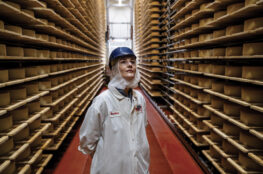
Photo by Jeff Sciortino
We’ve been hearing about the Era of Edo for so long that it seems a bit odd, some trick of time, that it’s only arriving now. But it’s welcome just the same. On Sept. 26, Edo de Waart assumes the podium for the first time as music director of the Milwaukee Symphony Orchestra.
It’s a watershed moment for the Milwaukee arts scene, yet de Waart is just one of many artists who will have a big impact on the 2009-’10 fine arts season. The accompanying profiles spotlight a wide-ranging group, some of whom operate quietly behind the scenes, that will help shape the shows and exhibitions you’ll see this season.
But Edo surely heads the list. After all, de Waart is truly world-class, arriving with a resume of associations and accomplishments with some of the top orchestras. But while the MSO has sounded great under de Waart’s guest baton – showing pristine clarity and dynamic precision in last year’s performance of Holst’s The Planets, for instance – de Waart knows that no conductor is a miracle worker.
“I’ve been music director in six different places,” de Waart says, “and I don’t go in with a mandate or wanting a certain thing. We work for a year and see how that goes. The orchestra and conductor have to learn a common language that is slightly different than the conductor who came before. Sometimes that takes two, three or four years.”
But de Waart ticks off the reasons his tenure here could be something quite special: “The orchestra is in very good shape, and I think we will get on very well,” he notes. “The audience is quite knowledgeable, which is inspiring to musicians. The people here are not just interested in tunes to hum along with or superstar soloists. There’s genuine interest in a lot of styles.”
This season, you can expect a good deal of Beethoven and Mahler from de Waart. He will conduct three major Beethoven pieces, and two of Mahler’s symphonies as well. (He chose a Beethoven concerto and Mahler’s Fourth for his last guest appearance with the MSO in November 2008.)
“No great symphony orchestra can excel without a serious portion of its work being devoted to those two composers,” de Waart says. Mahler, in particular, has a personal connection. His “home” orchestra, the Royal Concertgebouw Orchestra of Amsterdam (where de Waart began his career as oboist and, later, assistant conductor), is renowned for its Mahler tradition, starting when its music director, Willem Mengelberg, championed the composer during Mahler’s life and after his death.
“I was talking to George Szell once,” de Waart recalls, “and he remembered when Mengelberg brought the Concertgebouw to Berlin to perform Mahler. There were great conductors in Berlin at the time – Furtwängler and Klemperer – and Szell said they talked about Mahler for weeks afterward.
“Mahler is a pinnacle for a symphony orchestra,” de Waart says. “To really do an incredible job, you need to do one or two of his symphonies every year. And the audience needs to become familiar with them as well. Especially as you get into the Sixth or the Seventh, the layers get thicker and thicker.”
He also plans to program more contemporary composers, particularly John Adams, whom de Waart championed while leading the San Francisco Symphony in the 1980s. This season, the orchestra is playing Adams’ Doctor Atomic Symphony, drawn from his 2005 opera, under another conductor. But de Waart plans to conduct a major Adams symphonic piece in the following season.
But now the podium calls. “I’m extremely optimistic,” says de Waart. “It’s always hard to give a picture of what it will look like. We’ll just go to work.”
spanish-born Luz San Miguelhas been dancingsince she was 8 years old. Now a veteran with the Milwaukee Ballet, she has performed such roles as Lucy in Dracula, Odile in Swan Lake and Juliet in Romeo and Juliet. But today, she and fellow principal dancer Petr Zahradníceklook less then regal, dressed in street clothes. Zahradnícek started dancing at age 10 and is looking forward to his eighth season in Milwaukee, where he has choreographed new works and danced a wide variety of roles.
It’s a warm July day. Young girls in black and pink rehearsal regalia flock through the ballet headquarters. Though the upcoming season is on everyone’s mind – boxes of brochures are stacked in the front lobby – first rehearsals are still more than a month away. In fact, these two principal dancers are still not sure which roles they’ll play.
All the dancers have their guesses; Zahradnícek, for instance, is convinced San Miguel will dance the Cinderella lead. And he knows he’ll be represented on the ballet’s Pure Dance repertory program in March: He’s been commissioned to choreograph a piece for this concert. But apart from that, everything is still up in the air.
“In the summer, most dancers stay in shape at the gym or maybe take classes,” says Zahradnícek. Once the season starts, the pace is fairly brutal. “We have five weeks of rehearsal to prepare for our performances. That’s it.”
That’s true even for contemporary and world-premiere pieces, which aren’t as familiar to dancers as the classical repertoire. For a choreographer like Zahradnícek, video helps. “You think about the concept first,” he says, “listen to the music and think about steps. Then you can record them, and imagine them in a duet.” Some choreographers work with dancers “on the spot,” Zahradnícek says, but he prefers the prerehearsal work with video.
For a dancer like San Miguel, video is of no use: “I personally hate watching myself,” she laughs. “I’d rather have a teacher or choreographer direct me.” But she does thrill to new works. “When I was younger, I wanted to do all the classical roles,” she says. “Now, I like trying anything that will challenge my body and get me out of my comfort zone. I absolutely love the experience of new work.”
learning to be a classical singer is nosmall challenge. But ask Scott Stewart about the challenges of un-learning it. Stewart has prepared the choruses of the Florentine Opera for 32 years – that’s a lot of Mozart, Puccini and Verdi. But for this year’s production of Elmer Gantry (March 19 and 21), a contemporary work by Robert Aldrige and Herschel Garfein, Stewart needs to craft a sound that might have horrified Puccini.
“There’s a lot of Baptist choir-type singing,” Stewart says of Gantry, a satire of evangelism in rural America based on the Sinclair Lewis novel, “which is a challenge for a classically trained chorus.” Gantry requires that singers embrace some of the colors and vocabulary that define a particular heartland sound – which most trained singers would consider bad technique.
Of course, Stewart is used to shaping a chorus to the particular sound required by each opera. The Florentine keeps an active roster of 40-plus singers, but chooses from among them for each production according to the specific qualities of their voices. “Each piece is its own little animal,” says Stewart. “For Puccini, you look for certain kinds of strengths; for Mozart, you need voices with a little more flexibility.”
Still, Stewart has been thrilled to tackle pieces like Elmer Gantry and last season’s Baroque gem, Semele, which are not part of the standard repertoire. “It’s very exciting,” he says. “The Florentine is really revitalizing the art form here in Milwaukee.”
it’s hard to think of another ensemblein town that, year after year, has created more compelling original work than Wild Space Dance Company. Founded in 1986 by Debra Loewen, Wild Space goes its own way with an easy humility, but with a charged sense of creative restlessness.
When I caught up with Loewen, she was back in town after attending dance workshops on opposite coasts. In New York, she worked with choreographer Susan Marshall on creating new ways to collaborate with dancers and push for innovation. “Her approach helps you to let go of solving a problem so quickly,” Loewen notes.
In San Francisco, Loewen took the lead in a workshop on site-specific performances, which have come to define her work and her company (a fact recognized by an article in the April 2008 issue of Dance Magazine). Loewen has staged dances in a swimming pool, on the marsupial bridge by the Beerline, on the island at Lakeshore State Park, and in a variety of indoor spaces.
Loewen loves exploring different spaces and their histories, and getting out of the theater “box” to create new relationships between dancers and the audience.
“A theater is like a big TV,” she says. “But if you move the audience around, they feel they are ‘in it’ in a certain way. They are talking to each other.”
For her new work “Trace Elements” (Sept. 18-19), Loewen and Wild Space return to Turner Hall, where she paid tribute to 1930s dance marathons in “Physical Evidence.” This time, the work will reflect how the building is used today. There will be dancers on the gymnasium climbing wall, fencers, and movement that evokes “the ghosts of gymnasts past.” As the group’s name suggests, the building could become a very wild space.
it’s an intriguing trend in local theater. Facing a shortage of roles for women “of a certain age,” Angela Iannone, Laura Gordonand Mary MacDonald Kerr have all turned to directing, and have made a remarkable impact.
Iannone jokes that she’s spent much of the last few years playing men (she’s played King Henry at Milwaukee Shakespeare and other roles originally written for men). “Acting is still my first love,” she says. “But things change, and I’m not averse to exploring other opportunities.”
This season, Iannone will direct Milwaukee Chamber Theatre’s production of Moon Over the Brewery (Nov. 12-Dec.13), Bruce Graham’s romantic comedy about a single mother and her daughter in a Pennsylvania mining town. But this will also be a good season for her as an actress: She will play Katharine Hepburn in In Tandem’s one-woman Tea at Five (Oct. 8-25) and a modern-day Medea in Next Act’s Purgatorio (Jan. 28-Feb. 21).
Gordon is a company member at the Milwaukee Repertory Theater, where she will also tackle a one-woman show, playing advice columnist Ann Landers in The Lady with All the Answers (Nov. 24-Dec. 20). And she’ll have major roles in other Rep shows. But she’ll also direct The Rep’s Almost, Maine (Jan. 13-Feb. 7), a bittersweet romantic comedy that’s worlds away from her summer directing project, Harold Pinter’s Old Times at American Players Theatre. Even so, she’ll bring her signature intelligence and suspicion of sentimentality to Maine: “It’s the kind of thing that could be sickeningly sweet, but the playwright keeps it from going too far.”
MacDonald Kerrhas directed Gordon (in last year’s fine Going to St. Ives at Next Act), and this year she’ll direct Iannone in Purgatorio. Her approach to directing mirrors her acting, which is notable for its subtle detail and quiet emotional truth. Even with the classical-scaled emotions of Purgatorio, MacDonald Kerr prefers to think small: “Some directors have a big vision about what they want to accomplish,” she explains. “I tend to look at small moments that offer a sense of humanity the audience can relate to.”
She’ll surely bring that quality to her major acting project this season, Milwaukee Chamber Theatre’s The Sweetest Swing in Baseball (April 15-May 2), playing an artist in crisis who extends her stay at a mental health facility by assuming the identity of Darryl Strawberry. “It’s a great play about the value of art and artists,” she says.
clarinetist Todd Levyspends his summers with the Santa Fe Opera and the Santa Fe Chamber Music Festival. But when I talked to him in June, his mind was definitely on Milwaukee.
Levy will play the world premiere of Marc Neikrug’s Clarinet Concerto with the Milwaukee Symphony Orchestra (March 12-13), and helped push the composer to complete it. After Levy saw sketches of Neikrug’s dormant project a few years back, he offered encouragement: “ ‘Wow, this looks really promising,’ I told him. ‘I’d like to try to play it.’ ”
Neikrug is director of the Santa Fe Festival, and is mainly known as a chamber musician. But his career as a composer goes back decades. “His writing is hard to categorize,” Levy says, “but he creates very beautiful atmospheres when he writes for orchestra.”
Levy also has a new gig as co-director of Chamber Music Milwaukee, UW-Milwaukee’s four-concert showcase. “I’ve never really programmed a whole series,” he says. Among the works he’s chosen for this season: a rarely heard trio for clarinet, French horn and piano by Carl Reinecke, and several pieces by the prolific Libby Larsen, who will be in residence at UWM in the spring.
“Our goal,” Levy says, “is to present the best people and pick some pieces that people haven’t heard before – but really good stuff, not just novelty items.”
it’s a new era at the MilwaukeeArt Museum. After a couple changes in leadership, the museum now has no less than a trinity of experts to take it into the future. Assembled around a round table in Director Dan Keegan’s office are Keegan, Director of Exhibitions Laurie Wintersand Chief Curator Brady Roberts, and the mood is one of both relief – a 15 percent budget cut has helped the museum weather the economic crisis – and optimism about the future.
It’s a new leadership model for the museum, says Keegan. Roberts will focus on the museum’s permanent collection. In the near future, honoring both the 10th anniversary of the Calatrava addition (2011) and the 150th anniversary of the museum itself (2013), Roberts will oversee a complete reinstallation of the museum’s collection.
Winters, a 12-year veteran of the museum, will focus her attention on developing and booking new shows. “This is an increasingly common model for museum leadership,” says Keegan. “The complexity of organizing and presenting exhibitions has just gone through the roof. Not only the costs, but the logistics as well.”
The upcoming exhibitions look intriguing. “We’re just not rehashing topics and subjects,” says Winters. “We’re really working off the charts with new approaches to the material.” The season’s major exhibit, “Andy Warhol: The Last Decade” (Sept. 26-Jan. 3), is the first major museum exhibit devoted to the end of Warhol’s career, which was characterized by a return to “hands-on” painting and collaborations with Warholites, such as Jean-Michel Basquiat and Francesco Clemente.
But other shows suggest even more original approaches. “Raphael’s La Donna Velata” (March 26-June 6) will build an entire show around Raphael’s famous 16th-century portrait. And “Resurrecting Dave the Potter” (April 15-Aug. 1, 2010) is a collaboration of sorts between Chicago artist Theaster Gates and a 19th-century pottery builder named Dave. The show will include pieces made by laid-off Kohler employees and feature local church choirs performing music based on couplets found on the finished pots. Now that’s off the charts.
for his final seasonas artistic director at the Milwaukee Rep, Joe Hanreddymight have directed a theatrical swan song: “Maybe a new interpretation of Goethe’s Faust that would change theater as we know it?” he jokes. But the logistics of programming plays at the Rep – keeping three spaces and 10 company actors busy – made that impossible. So instead, Hanreddy focused on one of his favorite things: working with the resident actors, most of whom have been with him for his entire 16-year tenure.
The goal, he told me by phone from the Utah Shakespearean Festival, where he’s directing Private Lives, “is to create something where we could have a lot of fun.” To that end, he’s adapting the 1913 George M. Cohan play Seven Keys to Baldpate (March 23-April 18) for the Rep ensemble. Hanreddy will direct that show, as well as the annual production of A Christmas Carol (Nov. 27-Dec. 27) and the season-opener, The Government Inspector (Sept. 8-Oct. 4), Gogol’s comedy about greed and corruption. That play was adapted, with the Rep’s company in mind, by longtime collaborator Jeffrey Hatcher.
As for the future, Hanreddy wants to continue directing and writing. His adaptation of Jane Austen’s Pride and Prejudice, a huge Rep hit last season, will be performed by the prestigious Oregon Shakespeare Festival in 2010. And his early work on Baldpate has generated interest at other theaters.
luc Vanierthinks a lot about the future of dance, and not just about bodies in motion. He thinks technologically. “Lights are standard in theaters,” says Vanier, an assistant professor of dance at UWM’s Peck School of the Arts. “Soon they’ll be bright LEDs projecting images or video. And the dancers will be interacting with them. It’s an unavoidable development.”
At least it is for Vanier. His blending of technology and dance started when he was a student at the University of Illinois, and since then, the simple idea of a video delay has evolved into complex combinations of motion capture and video projections. His previous works in town have been striking for both their technology and musicality.
The Milwaukee Ballet has commissioned Vanier to create a work for its Innovative Motion concert (Feb. 11-14). Fake It ’Til You Make It features interactive projections and specially designed “shoe-stilts” that Vanier calls a variation on the toe-shoe. The work, he says, is “about pushing yourself to experience something until it makes sense.”
Another Vanier work, 2 x 2 (June 25-27, 2010) will feature two real-life couples: Vanier and choreographer Elizabeth Johnson, and filmmakers Heather and Seth Warren-Crowe. They will use several spaces in the Peck School’s Kenilworth Building to explore the ties between video technologies and human relationships. You might say it’s unavoidable.
given the breadth of artistsit’s presented over the years, picking a season to mark the 50th anniversary of Alverno Presents might seem a daunting project. But for David Ravel,it was a no-brainer. The Bill T. Jones/Arnie Zane Dance Company has a long history with Alverno, visiting several times since its Milwaukee debut in 1990. That adds a nostalgic reason to book Jones’ Serenade: The Proposition (Feb. 28), but the show is anything but backward-looking.
“This is what it looks like when a master is at the top of his game,” says Ravel, who has run Alverno Presents since 2003. “Jones is one of the few contemporary artists who adheres to the Wagnerian idea of gesamtkunstwerk, making every single element on par with the others in a piece. There’s video, live music, text, and his dancers are as practiced and expressive as actors as they are dancers.”
It’s the highlight of what looks like a great 50th season. Under Ravel, Alverno continues to present an amazing range of artists in world music, jazz and particularly dance. “There’s so much good work out there,” says Ravel. “I never feel like I’m lacking in choices.”
Jim Medvedis staring downat a 2-inch figure surrounded by sheets of painted red cardboard. It’s a tiny scale model of the set for The Inspector General, to be staged at the Milwaukee Rep. Set designer neil patel envisions a red floor, red boards framing the proscenium, and a sloping hill of brown earth against the very back of the stage.
Medved, who has run the Rep’s paint shop for 12 years, is charged with bringing Patel’s vision to life. “The first step is finding out exactly what the designer wants,” he explains. “There’s a texture on these boards. Can we achieve this through paint? Or does he want rough barn wood?”
Medved has to answer many questions like this and do lots of number-crunching. How much time will his staff of four scenic artists have? Is there room in the paint and carpentry shops for the work, given the other sets that must be constructed? (The Rep stages 15 shows each season.) What’s the best way to give Patel what he wants, yet stay within the ever-slimming budget?
One of the reasons Rep shows look so good is because Medved makes smart decisions – not to mention his creative skill, which enables him to create dozens of variations of a plain wood floor with only basic plywood and a brush – so that designers get exactly what they want.
“I’d say my work here fulfills my urge to paint,” Medved says. “If I do paint on my own, it tends to be watercolors that are very small. Postcard size.”
filmmakerIverson Whiteis a calm presence in the eye of a hurricane. Sitting in his immaculate living room, his speech is thoughtful and deliberate, even though a storm is approaching. White is waiting for footage from his latest film, The Funeral, to come back from the developing lab, and wondering whether he’ll have to reshoot a crucial scene that didn’t go as planned (some extras left early). And he’s getting ready to showcase his work in new Milwaukee venues – the Milwaukee Short Film Festival (Sept. 11-13) and the showcase for Mary L. Nohl Fund Fellowship winners (opening in October).
White’s recent films are quiet and well-crafted. The Funeral is about a woman who discovers her husband’s longtime affair after his death. Self-Determination, completed in 2008, portrays a woman who struggles to assert herself amidst her husband’s infidelity.
White describes The Funeral as “not about the fireworks” involved in its dramatic revelation. And like Self-Determination, its dialogue is sparse. “I’ve been making films for about 30 years now,” White says, “and I’m in this period where I’m starting to get impatient with a lot of exposition. I’m just fed up with people in movies telling us things. For me, both movies are reminiscent of silent films.”
White grew up in Detroit and started acting in high school. He continued in theater as he studied filmmaking in New Orleans and then at UCLA, where he made his first major film, Dark Exodus, which has won a number of awards. He joined the UWM faculty in 1987. Today, he modestly says he’s a better writer than filmmaker, but continues to make films “so I can actually see the stories I imagine.
“I’ve seen films where I’ve said, ‘I wish I would have made that,’ ” White explains, noting a recent German feature, The Lives of Others, as an example. “But I’ve never seen anybody else make the same film that I would have made. So in order to see that film, I have to make it.”
sharon Hansenknows her way around a world premiere. The music director of Milwaukee Choral Artists has coached her singers through several. “When composers are not familiar with the voice and are not singers themselves, world premieres can be a challenge,” she says. “The voice is quite a different instrument.”
But Hansen doesn’t expect this challenge with the major premiere she’s conducting this season, a setting of a Navajo prayer by Alexandra du Bois. “Alexandra knows the voice and is a singer herself,” Hansen says. “She writes music suited to the way voices move.”
The piece by du Bois is part of MCA’s appearance at Present Music’s annual St. John’s Cathedral concert (it was commissioned by PM). But it won’t be the only contemporary piece MCA performs this season. In February, the group will sing several works by composer Libby Larsen. And in April, the group will showcase the winner of its young composers competition.
charles Q. Sullivan has spent a lifetime in the arts: from chamber orchestras to liturgical drama to children’s choirs. Now in his eighth season as executive and artistic director of Early Music Now, we wondered what attracts him to music of the past – in the case of EMN, the distant past. All those blasting sackbuts and skittering soprano recorders are hardly familiar to today’s ears.
“The ear-opening sounds, forms and rhythms of music from past centuries is uniquely interesting precisely because its scale and freshness seems new to the modern ear,” Sullivan says.
This season’s freshest? Sullivan points to Lipzodes (Feb. 13), an ensemble that does 16th-century music from Guatemala. Also of note, a grande dame of early music, soprano Emma Kirkby (Oct. 27), whom the BBC named one of the best sopranos in the history of recorded music.
Paul Kosidowski is Milwaukee Magazine’s regular arts critic. Write to him at letters@milwaukeemagazine.com.
In Brief
More of the season’s best bets.
Frankly Music
Frank Almond’s terrific chamber music series scores a coup with the appearance of legendary cellist Lynn Harrell (Oct. 5), who will join MSO principal cellist Joseph Johnson and new MSO associate concertmaster Ilana Setapan for a concert of music by Alexander Glazunov and Brahms.
Spring Awakening
As unlikely a Broadway hit as we’ve seen, based on a German Expressionist saga about blossoming teen sexuality. This 2007 multiple Tony winner, at the Marcus Center Oct. 6-11, is a great example of a new breed of Broadway, moving past hyper-romantic blockbusters and embracing an alt-music aesthetic. Duncan Sheik wrote the music, and the terrific choreography is by Bill T. Jones.
A Night at the Movies
The often inventive and cross-genre-pollinating Theatre Gigante will create a theater piece (Nov. 5-7) from moments in classic films, such as Kurosawa’s The Seven Samurai and Marcel Carne’s beautiful Children of Paradise. You can bet that Gigante mime expert David Gaines will offer his tribute to Paradise’s great Jean-Louis Barrault.
Turtle Island Quartet
Slightly overshadowed by the media-worshipped Kronos Quartet, this ensemble has also pushed chamber music limits, playing jazz, folk and rock on instruments once reserved for Haydn and Debussy. This concert (Nov. 13) finds them at their most audacious, performing a string version of a sacred text of modern jazz, John Coltrane’s half-hour 1965 suite, “A Love Supreme.” There’s also music by Thelonious Monk and Miles Davis, and best of all, Brookfield’s Wilson Center has booked the concert in its intimate studio theater.
The Marriage of Bette & Boo
In both spirit and programming, the Boulevard Ensemble specializes in the madcap and outrageous – like this acclaimed 1985 comedy by Christopher Durang, rife with his signature blend of buoyancy and tragedy. There’s plenty of death, stillbirths, psychosis and … song and dance. Hotcha! (Nov.-Dec.)
Skylight Opera Theatre
The drama has been more offstage than on for the past few months, given the controversy over the firing of Artistic Director Bill Theisen. But we’ve got our fingers crossed that the Skylight will still be able to bring off its 50th anniversary season, including its ingeniously programmed Beaumarchais double header. The French playwright wrote a trilogy of plays about Figaro and his exploits, and the Skylight will present the best-known opera versions of the first two (the third, La Mere Coupable, has been opera-cized by Darius Milhaud and John Corigliano, but is rarely performed). Rossini’s The Barber of Seville opens the season (Sept. 18-Oct.4), and Mozart’s The Marriage of Figaro follows (Jan. 29-Feb. 14).
Picnic
Staging shows from a bygone era isn’t easy in these days of tight budgets. But Milwaukee Chamber Theatre decided to continue its tribute to Pulitzer Prize winners anyway, staging William Inge’s classic 1953 play (Oct. 15-Nov.1). To make it happen, MCT will partner with UW-Milwaukee’s theater department, enabling seasoned students and faculty to work side-by-side with professionals.
Present Music
The ensemble seems to have found a home of sorts in Turner Hall Ballroom, staging four of its six concerts there. And it’s bringing more eclectic guest performers to town, including practitioners of Iraqi jazz, experimental pop from Burkina Faso, and Chinese electronica. But the standout concert is Omnivorous Furniture (March 27), featuring Mason Bates, otherwise known as DJ Masonica. Bates is known for art installations, a “YouTube Symphony” and a recent premiere with Michael Tilson Thomas and the San Francisco Symphony.
Blackbird
As theaters try to economize, several have turned to powerful and soul-stripping dramatic duets. One of the season’s most promising is this winner of London’s 2007 Olivier Award for best play, by David Harrower. American Players Theatre regulars Brian Mani and Carrie Coon star in Renaissance Theaterworks’ production (Jan. 15-Feb. 7) about two people revisiting a relationship long after it is over.
Stuck
In Tandem Theatre gets into the world premiere mood with a new comedy (Feb. 26-March 14) by UW-Whitewater graduate Neil Haven. Always drawn to screwball material, In Tandem seems a perfect fit for Stuck: It’s about an unlikely group of people trapped in an elevator. Nick Harazin, Alison Mary Forbes and Doug Jarecki are among the cast.
The Wiz
First Stage Children’s Theater scheduled this musical (March 5-28) long before the death of Michael Jackson, but it will be hard to avoid thinking of one of his rare screen appearances in this ’70s classic. As Geoffrey Holder showed in the original production, it’s a great chance for inventive stagecraft. And if your tween doesn’t know that ubiquitous coming-of-age anthem “Greatest Love of All,” it’s time they discovered it.
Danceworks Performance Company
Its spring concert (April 16-18) brings back two of its most playful pieces from the past: “Wild Things,” inspired by Where the Wild Things Are, and “Frogs,” based on The Frog Prince. Add to that the new “Pot Luck,” inspired by the country sass of a church picnic, and you’ve got a level of whimsy that might be illegal in most states.
Milwaukee Chamber Orchestra
It’s modernism, European vs. American, at this concert (April 17). In this corner, Aaron Copland’s jazzy Clarinet Concerto (written for Benny Goodman). In that corner, Béla Bartók’s plucky, jangly Music for Strings, Percussion and Celesta. Imaginative programming by Music Director Richard Hynson. Should be fun.