
 First, a confession: I’m not sure I really “get” Andy Warhol. I’m suspicious of the one-sentence explanations of his art, as everyone should be: “Oh, he’s showing us that a soup can is an aesthetic object.” Or: “Look, he’s showing us that art is a commodity just like something you buy at the grocery store.” Arthur Danto used to make the case that art has become a sort of “illustrated philosophy.” And that’s hard to relate to Warhol because he’s a sort of anti-philosopher—he just doesn’t have the gravitas that we’ve come to associate with folks like Joseph Beuys or Marcel Duchamp.
Given that, I expected the new show at the Milwaukee Art Museum, “Warhol: The Last Decades,” to help me “get” Andy a little better. After a couple of visits, I’m not sure. But I also think that it might prove the ultimate meaning of Warhol—that he’s a near empty vessel into which any number of meanings might be poured.
It’s a good time for this show. In a few weeks, the art world will be buzzing with news from London’s Tate Museum’s show, “Pop Life,” which will explore Warhol’s legacy, particularly the part that relates to one of his mantras: “Good business is the best art.” The Milwaukee show has already attracted some national media anticipation.
“The Last Decades” doesn’t seem a part of that Warhol legacy. Partly because the art is generally unfamiliar. There are silk screens, sure, but also painterly collaborations (most notably with Jean-Michel Basquiat), huge Rorschach-style inkblots, “abstractions” of a sort, and lots of religious imagery.
 Yes, religious imagery. And we’re not talking Marilyn Monroe or Mao. One of curator Joe Ketner’s ideas here is depicting Warhol’s increasing engagement with his mortality, and the presence of his Catholicism in his work. One of the most haunting images in the exhibit, in fact, is Warhol’s 1986 self portrait (one of a series). There’s a double exposure effect that gives the image a haunted quality, a glimpse of the ghost in the Warhol machine.
But the most compelling dialogue here is not between life and death, but between “pop” and art. Another conceit of the show is that the ’80s marked Warhol’s return to painting. And so it did. There are striking and substantial collaborations, like “Alba’s Breakfast"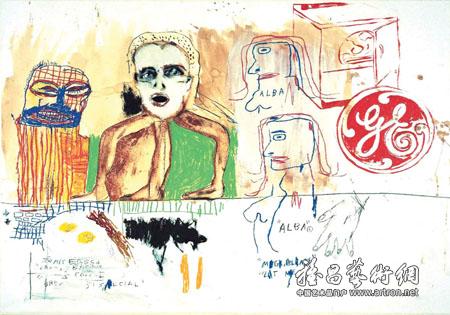 or “Arm and Hammer II,” that showcase Warhol’s handwork. But much of the work here seems an attempt to engage a dialogue between Warhol’s sense of “readymade” and the ‘80s resurgence of craft and technique.
Jackson Pollack, Duchamp’s “urinal,” and Viennese action art come together in a series of works in which he urinated onto metal, creating patterns of corrosion. Pollack’s drips and swirls are commodified in a series of pieces that coolly depict tangles of yarn on a pure white background. And an iconic painting like Da Vinci’s “Last Supper” becomes as pop as Marilyn, with commercial logos for Dove soap and GE light bulbs standing in for the Holy Spirit. Then the whole thing is stamped with a 59 cent price tag, as if it was a decorative placemat for sale at The Dollar Store.
So this show may or may note help you “get” Warhol more than you do already. But perhaps that’s the point. Even under the scrutiny of scholars and the artists who worked with him, Warhol remains as elusive and cool as ever. I have a feeling he’d be just fine with that.
********
He’s not th e most talkative fellow, so it was kind of a surprise when Edo De Waart picked up a microphone at the beginning of his concert debut as the Milwaukee Symphony Orchestra’s Music Director. It was simple enough. He wanted to play something American for his inaugural concert. Leonard Bernstein’s “Jeremiah” Symphony fit the bill. And he offered it as a sort of tribute to Bernstein. Early in his career, De Waart served as Bernstein’s assistant at the New York Philharmonic.
He didn’t mention that Bernstein conducted the Adagietto from Mahler’s Fifth Symphony—the other piece on the program—at the 1968 funeral of Robert F. Kennedy. Still in the shadow of death of the last Kennedy brother, the combination of Mahler and Bernstein seemed right, even if the occasion was the celebration of a new era rather than a lament for one passed.
And a celebration it was. De Waart’s Mahler was vigorous, stirring and gorgeously shaped. William Barnewitz (horn) and Mark Niehaus (trumpet) handled their daunting soli passages well, and the ensemble as a whole seemed to embrace the music with new energy.
Mahler’s Fifth is sprawling and eclectic, and it’s a daunting choice for an early collaboration between conductor and orchestra. De Waart had great command, but also inspired true joy in the orchestra’s playing. The “village band” passages were often rollicking and slippery. But the more lyrical, extended melodic sections were phrased with great sensitivity and drama.
The opening section of the Adagietto, for example, seemed rather cool and driven—De Waart avoided the legato excesses that other conductors would indulge. But that reticence was in the interest of the movement’s broader architecture. De Waart built the emotions layer by layer, working toward a potent climax by the movement’s end.
The “Jeremiah,” true to De Waart’s desires, was as American as a New York subway. Bernstein’s vigorous rhythms in the second movement drove the piece forward to the lamentation, beautifully sung by Sasha Cooke.