Make it to Milwaukee, and there is Paula’s sofa. It is the first-night sofa. For some, it may be the first-week or even the first-month sofa, a place of refuge until a first apartment can be rented, until room can be made somewhere for one more. Paula doesn’t know how many people have slept on that sofa after making the perilous 2,000-mile journey from her home town of Suchilapan Del Rio, a small town in Southern Mexico. She would have to go back 14 years to count them.
Paula’s husband, Lencho, came first. For starters, he tried his luck in Joliet, Ill. But Milwaukee’s foundries and factories and 24-hour diners turned out to be the Promised Land.
Paula followed some eight years later, after Lencho sent for her, after he had saved enough to pay the smuggler to get all of them across the border – Paula and the three children. Back when Lencho arrived, in the early 1980s, there were maybe 30 people from Suchilapan in Milwaukee. Now, there are perhaps 2,000. That’s 2,000 people from a Mexican town with an official 2005 population of just 1,923. And falling.
“A friend, a brother, an uncle – everyone brings someone else, and that’s how it happens, that’s how they come,” says Lencho. A network of sofas, a huge extended web of family and neighbors, all transplanted to “Suchilapan Dos,” as townspeople call Milwaukee. Another Suchilapan.
Milwaukee has dozens of sister cities like Suchilapan, all but invisible communities transplanted to this city. Those sister cities surface in the names of Milwaukee storefronts, businesses, taquerias and soccer teams. Luvianos. El Refugio. Ojo Caliente. Palos Altos. Suchilapan.
The immigrants from Suchilapan man Cudahy factories, fill up apartment buildings on Lapham Boulevard and shop at the Mitchell Street Mall. They baptize their babies at St. Anthony’s Parish on the South Side. Their soccer stars play indoors at the Milwaukee County Sports Complex; in the summer they play in weekend leagues at Meaux Park, Estabrook Park and Menomonee River Parkway. So many Suchilapan natives bus dishes and chop onions for omelets at Milwaukee’s all-night Greek-owned diners that the restaurants would have difficulty operating without them.
Most of these immigrants are illegal (and to protect their anonymity, we have not disclosed the last names of Paula and Lencho). Many send as much of their earnings home as possible. Their dollars join billions more in a rush of money south. In 2006, immigrants sent back an estimated $23 billion to Mexico in remittances, a flow that’s been dubbed “the new foreign aid.”
Increasingly, many immigrants to Milwaukee are coming from the state of Veracruz on the east coast of Mexico, where Suchilapan is located.
Between 1998 and 2002, Veracruz native Hugo Loyo ran a money transfer business that operated in four Midwestern states and sent $2 million south every month. Checking the numbers, he found the biggest share of money from Milwaukee was going to the state of Veracruz. And the biggest share of that money was heading to Suchilapan – millions of dollars in remittances flowing annually from Milwaukee.
Suchilapan natives and other immigrants from Veracruz are beginning to make their mark on Milwaukee, are beginning to change and enrich the local culture.
Seen from the other side of the border, Milwaukee has already had a profound effect on Suchilapan. The town’s economy and way of life now revolve around the migration to “the other Suchilapan.”
Looking at a map of the western half of Lake Michigan, you might imagine it a replica of the Veracruz coast. A long line of land holds back an expanse of blue; the curve around the coast of Chicago and Gary, Ind., echoes the gentle bow of the Veracruz shore around the Gulf of Mexico.
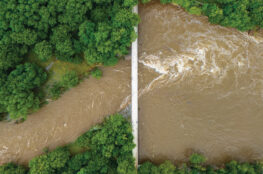
Suchilapan Del Rio is a scrappy cattle town buried in what used to be thick, semi-tropical forests of southern Veracruz, a few miles from the Oaxaca state border. Like Milwaukee, it is a town built on a river, the wide Coatzacoalcos River flowing by on its way to the Gulf.
A generation ago, this was a town that itself attracted immigrants. Town boosters and the Veracruz government enticed families from other states, offering land and the promise that anything planted would grow like crazy – two harvests a year, no fertilizer needed. Today, thick cedar, ceiba and oak forests have been felled, replaced by pastureland dotted with cattle, now the economic mainstay here. If it weren’t for the banana and palm trees, these could be the green rolling hills of Wisconsin in June.
Fittingly for an unofficial Milwaukee sister city, the first thing one encounters on the road to Suchilapan is a rusting, abandoned factory. For 30 years, three shifts a day, this factory converted the surrounding forests into neat sheets of plywood. In 2000, it became a victim of its own appetite, a plywood factory with no trees left to eat. The day it closed, 150 workers lost jobs in a town of around 500 households. Many are now in Milwaukee.
For a three-block stretch, Suchilapan is a bustling river town. It has bars and tortillerias, various stores selling veterinary supplies, shoes and seed. There are dentists and doctors, pharmacies and even Internet cafes. Buried in the hills nearby are dozens of other little communities, each with fewer than 100 residents, some accessible only by river. Long wooden boats with outboard motors taxi people from the hamlets to buy supplies, use the telephone, see a doctor, and of course, pick up Milwaukee-made money at the remittance window.
Former short-order cook Maximimo Flores spent 11 years in the United States (five in Milwaukee), earning enough money to build his own eight-table restaurant with a thatched roof on the main road into town. His two kids will go to college if they want to.
Up and down Suchilapan’s main drag, it’s a similar story. Restaurants that opened, stores that expanded, carpenters or mechanics that purchased equipment, customers buying things – all with money earned in Milwaukee.
Twenty-two years and counting in the United States (the last 18 in Milwaukee) has earned Ausencio Reyes enough money to buy 50 acres of pastureland and 20 head of cattle – about half of what he’d need to support his family without going north again. It’s also built a house for his wife and six children and another house for his parents. Reyes always told his wife he’d work in the U.S. until he turned 40. “But now that he’s 40 he says he’s still strong, so why shouldn’t he keep going?” says Magdalena Martinez. Ausencio hasn’t spent a full year in Suchilapan since he was 20 years old.
Clara is the mother of Paula, whose couch has welcomed so many in Milwaukee. The family’s history is a series of trips to Milwaukee.
“The first to go was Pedro,” Clara recalls. “That was 30 years ago. He’s never returned … After that, Elena went. After that, Yolanda. After that Paula, Juan, Pati, Dimas.”
Eight children, seven in Milwaukee.
Twice Clara made the trip herself, crossed the desert and braved the danger of capture by border authorities, to be with her children. Both times she brought along Mani, the grandson she’s raised since he was a baby. His father, who lives in Milwaukee, had remarried and Mani ended up with his grandmother.
The first time she crossed the border, Clara had Mani knocked out with sleeping pills, a common way to cross with kids, who can talk or cry at precisely the wrong moment. Mani was 4 at the time. When Clara arrived in Milwaukee, there was daughter Paula’s welcoming sofa and daughter Yolanda’s extra room. Mani went to nursery school in Milwaukee, but by first grade he and his grandmother were back in Suchilapan.
When Mani was in fifth grade, Clara took him again. He attended Kosciusko Middle School for nearly three years, but just before he was to graduate, his grandmother decided it was time to go. She’d gathered about $1,000 selling tamales and empanadas to Veracruz natives in Milwaukee, enough to buy a little lot in the port city of Veracruz. She planned to take Mani there and make a living by selling cut fruits and vegetables. But the plan flopped. Clara and Mani returned to Suchilapan.
“She missed the animals,” says Mani quietly, kicking the dirt with his knee-high rubber boot. “She likes life in Mexico.”
At 68, his grandma is spry and feisty. She wears her curly gray hair in two tight schoolgirl braids. She raises chickens and chats with them as they peck around her feet. “Otra vez con hambre?” You’re hungry again?
Clara can clean a river turtle. She can make soup from snails that cling to rocks in nearby creeks. (“That’s what we used to eat when there was no food,” remembers one of Paula’s sons.) She wraps homemade tortillas around salted minnows toasted crisp on the griddle.
At night, if a fox threatens one of her hens, she grabs a machete, runs into the rain in her nightgown, and finishes off the fox. In the morning, Mani buries the predator in the yard. If the fox gets the better of the hen before Clara scares it off, there’s chicken for lunch.
But the portions are small. Not like in Milwaukee. The chicken is eaten reluctantly, memories of the screaming hen still fresh in everyone’s mind.
El Campesino Grocery is 7,000 square feet of Mexico recreated on Milwaukee’s South Side at Sixth and Greenfield. Gummy worms, glow worms, tiny cellophane packets of pepper-seasoned peanuts, pumpkin seeds (for grinding into stews or eating plain), tamarind suckers, Pico-Tico candies (ingredients: sugar, salt, chile) – everything is here. Piñatas compete with Mexican soccer jerseys for ceiling space – the effect is the signature color overload of Mexican supermarkets. Squat boxes of tortillas form a low bunker in front of the meat counter, which runs the length of the store. Most of the tortillas come from Chicago factories that grind corn three shifts per day in Mexican neighborhoods there.
At a counter behind bulletproof glass, Lazaro Alvarez handles the money transfers. Friday is payday, and on Saturday they start lining up. It’s not a long line – often two or three people, stretching just about to the wall of dried chilies. But it’s steady – a couple hundred people come every weekend. Before banks got into this business – before everyone got into this business, from travel agencies to music stores – between 800 and 900 people per week would send money to Mexico from this supermarket, one of the first in Milwaukee to offer the service.
Most send between $150 and $250. Sometimes they send as much as $1,000 or $2,000. The smaller sums pay for basic needs back home – food and medicine, clothing and transportation to school. The larger amounts build houses and pay debts.
The lines get long before Christmas and Mother’s Day.
El Campesino moves the money to Mexico – $50,000 a week – using a wire-transfer service called Giros RealMex, which operates out of 10 locations in supermarkets and storefronts on Milwaukee’s South Side and advertises “money shipments in minutes.” At RealMex’s “U.S. headquarters,” an austere storefront on 17th and Forest Home, migrants are greeted with enlarged photos of towns in Mexico, often picturing the pharmacy or video store where their relatives will pick up the pesos.
Most of the money sent from El Campesino goes to Veracruz, says Alvarez. A sign above the payment window announces 10 places to send money. Of the 10, four are in the state of Veracruz, including a public phone business in the state capital whose name, interestingly, is “Telefonia Milwaukee.” Another option is Ferreteria Murga, a hardware store that handles transfer payments in Suchilapan.
In central western Mexican states like Jalisco, Guanajuato, Zacatecas and Michoacán, migration to the U.S. is three and four generations old. The first migrants to the U.S. – and to Milwaukee – came largely from these states, which were recruiting grounds for U.S. railroad companies and later for the Bracero programs – government-sponsored temporary-worker programs.
Veracruz, by contrast, had always been a destination, both for Mexicans from other states as well as for Central Americans. But between 1996 and 2002, the price of coffee – a key cash crop in the state – plummeted by more than 65 percent on the international market. Disease hit the crop of 2001. Cattle and citrus prices fell. Port jobs along the Veracruz coast were privatized and cut in the 1990s as part of Mexico’s painful push to a free-market economy. Petroleum exploration jobs dried up or moved out of state. And so Veracruzanos began to look north, to the U.S., for work.
When Milwaukee Area Technical College instructor Rosa Maria Zamora started teaching English as a second language back in the early 1980s, she rarely saw students from southern Mexico. Not anymore. “All of a sudden we have a lot more people from Oaxaca and Veracruz,” says Zamora, who sees the composition of her classes change with shifting geopolitical conditions. “If there’s famine in Africa, we’ll see it in our ESL department.” Of the 100 students she teaches in a semester, she estimates 20 now come from either Veracruz or neighboring Oaxaca – more than from any other single location.
Five years ago, Milwaukee’s Mexican Fiesta began including a Veracruz booth in its Cultural Village. Teresa Mercado, deputy director of the festival, says she’s seen a steady increase in attendance at the booth: “The flyers run out every year.” Last summer, the Folkloric Ballet of the University of Veracruz performed at the lakefront festival.
Veracruzanos listen to Afro-Caribbean-influenced music – cumbias and salsa – rather than the banda and norteños popular among immigrants from central and northern Mexico. Veracruz dances and use of instruments like the harp are unique in Mexico. Gradually these styles will diversify Milwaukee’s Latino culture.
But immigrants from Veracruz say they can’t get black beans, fried plantains, Veracruz-style empanadas or seafood anywhere in Milwaukee. Paula sometimes sells traditional Veracruz cuisine to her countrymen – she makes a round of calls to get the word out that she’s cooking, and people stop by to purchase a little taste of home.
Economically, the immigrants from Suchilapan found an early niche by working 12-hour night shifts in Greek-owned diners. Cheap housing made Milwaukee a good deal, even if its climate was a strange fit for people accustomed to much warmer temperatures. “[Cold and snow] are manageable if you think about it in context,” says Olegario
Ledesma, who arrived from the town of Oluta, Veracruz, 10 years ago. “It was cold versus poverty and hunger, and we all decided to deal with the cold.”
Ledesma, who works in a metal stamping factory, has seen the surge in his fellow immigrants. “You can go to any job in Milwaukee – factories, cleaning jobs, restaurants – and you’ll find someone from Veracruz working there,” says Ledesma. Certain industries in Milwaukee – asbestos removal, for instance – are dominated by Veracruz workers.
But immigration from Veracruz is still an overwhelmingly new and largely illegal venture. Patricia Zamudio Grave is a sociologist who earned her doctorate at Northwestern University. She’s also an investigator and immigration expert at a research institute in Xalapa, the capital of Veracruz, and has tracked the migration. “In the beginning it is difficult. Social networks are weak. There is a lack of information, a lack of support.”
But a growing network of family and friends journeying north will make it easier for migrants from Veracruz, Zamudio notes, and their numbers will multiply. “Veracruz is Mexico’s third most populous state,” she says. “In a very short time [Milwaukee] could be full of Veracruzanos.”
The tension and disagreements in the U.S. over the issue of immigration are well-known. But Mexico is far more conflicted, emotionally torn over the exodus it is experiencing. The migrants are Mexico’s most productive citizens, and their labor has been lost. By one recent estimate, 20 percent of Mexicans between the ages of 25 and 35 live outside of Mexico. These are sons and daughters and fathers and mothers in a culture where family is still everything. The separation and the longing for their return is intense. In some towns, women left behind manage with antidepressants and tranquilizers. For those who’ve gone illegally, there is no coming back for a visit, no vacation – not without high risk and cost. Some 2,000 died on the U.S. border in the last five years and the current going rate to cross the desert with a coyote, or migrant smuggler, is $2,500.
On the one hand, the migrants are heroes – that’s what former Mexican president Vicente Fox called them – keeping entire towns from starvation and pulling their extended families out of poverty. On the other hand, they are a reminder of Mexico’s failures, of a government that can’t make the economy work, despite the country’s vast natural resources and wealth, despite being next door to the world’s largest consumer market. Five million people left Mexico during Fox’s term in office, 2000 through 2006. They are part of a massive human migration – 200 million people on the move from poor countries to rich ones, from south to north – caused by the changing world economy.
“Migration is a solution and it is a problem,” says the Rev. Felipe Mata, Suchilapan’s priest. It has torn Suchilapan families apart, left children without fathers. In some cases, women and children are abandoned and are worse off economically. But the migrants are leaving “to try to meet a basic human need – to eat,” says Mata. “To have enough to live a dignified life.”
Remittances are by far the biggest form of aid in Mexico – bigger than direct foreign investment, government welfare payouts or foreign aid. There are four places to receive money in Suchilapan (by comparison, there are two places to buy tortillas). The place doing the swiftest business, Lubricantes Murga, receives 1,200 payment orders per month. Average payments are about $150, meaning more than $2 million annually flows through just one store.
Every Monday morning people from Suchilapan and neighboring villages line up to collect the money that their migrant relatives sent over the weekend from places like El Campesino Grocery. Mario Zuñiga Rojas, a priest who grew up in Suchilapan and authored a 2004 book about the town, estimates that Suchilapan receives $500,000 per month in remittances. Most of the money comes from Milwaukee, but North Carolina and Chicago’s metro area are also destinations for migrants.
According to an estimate by the Inter-American Development Bank, immigrants living in Wisconsin sent home $335 million to their families in Latin America and the Caribbean in 2006.
That means more business for Suchilapan peddler Saul Aguirre. Every Monday, he drives slowly over the town’s potholes, honking the horn to announce his arrival. He sells mattresses, fans, stoves, washing machines, televisions, blenders – all out of the back of his truck, all on payment plans. It’s a sure bet for him. Suchilapan is a boom town. There’s the cattle business and there are all the workers up north. “There’s money coming in here,” he says.
But Leobardo Benitez, a retired Suchilapan schoolteacher and principal who served as the regional mayor from 1998 to 2000, is distressed by the situation. “Mexico builds hospitals for women to have babies,” he says. “The Mexican government pays to educate those children. And at the moment in which they become productive and the country can begin to get something back from them – boom. They leave.”
An ironic example is Benitez’s son, who lives in Milwaukee. He studied law for two years before dropping out of college. In Milwaukee, he has a job in asbestos removal.
Migration is contagious, says the former mayor. His son saw friends go, saw the money and cars they brought back, and left. A local junior high school teacher says that kids who leave take portraits of themselves holding hundred-dollar bills. Those photos always make it back to Suchilapan.
Gonzalo Murga shares the ex-mayor’s concerns. Probably the most successful businessman in Suchilapan, Murga owns the anchor business in town – Ferreteria Murga, a huge hardware store located directly in front of Constructora Murga, his huge construction supply company. Migrants saving for homes in Suchilapan send remittances directly to Murga to pay him for cement mix and other materials. His hardware store also processes $80,000 in remittances a month, and Murga takes a cut.
Yet he questions how the migration helps Suchilapan. “Of 10 people who leave, two send money back,” he asserts.
In other Mexican cities, migrants to the U.S. have used the money they’ve earned to help pay for civic projects. The money paves roads, builds plazas and improves schools in their hometowns through a program by which federal, state and local governments in Mexico provide matching funds for emigrant-initiated projects.
But there have been no such public works in Suchilapan – no tangible, community benefits from so much migration to Milwaukee. Except for the main street, all streets in Suchilapan are unpaved. The town’s “potable” water system is a pump that pulls untreated water from the river.
Murga pulls out a photo of an employee Christmas party he threw one year. “Norte, norte, norte, norte, norte, norte, norte,” he says, pointing one by one to the workers who have gone to the U.S. Once men send for their wives or girlfriends or get married in Milwaukee, they send little back to the town, says Murga. Not all of them had to go, he claims. It’s possible to make it in Mexico, says Murga, who pays his 12 employees between $12 and $15 per day.
It all depends on what you have to start with, argues Clara, who doesn’t buy Murga’s spiel. His family wasn’t going hungry. He got a university education. How do you pull yourself up by your bootstraps if you have no boots, if you have nothing at all?
In 1998, Suchilapan merchant Fernando Haro and his wife were captured three times trying to sneak into the United States. If you get caught again, you’ll be looking at jail time, a U.S. border agent warned them.
It was enough to make Haro cry: the threat of jail, the hours they’d already suffered marching through the desert, the money they’d lose because they couldn’t cross and begin working to pay off the coyote. How would Haro support the baby son he left behind?
But Haro and his wife eventually made it to Milwaukee, where he worked for three years. Now he stands in his general store on Suchilapan’s main drag. The shop is packed to overflowing with staples and snacks, juice and soda, Coca-Cola and Gerber and Kleenex and Bimbo bread. “Thanks be to God,” says Haro. “This store was made in the United States.”
Before Haro headed north, “it wasn’t going poorly for me, but it wasn’t going well, either,” he says. “I despaired. I already had a family – I wanted my own things, my own business. All my friends told me, ‘Come to the U.S. We’ll get work for you.’”
There was no question about where to go. “Everyone heads for Milwaukee,” says Haro. “That’s where all of Suchilapan is.”
It was 1998 when the smuggler left Haro and his wife at Eighth and Mitchell. “We didn’t have anyone’s phone number,” says Haro. “We had no idea where we were.”
A stranger asked the couple what they were doing on the street. “The coyote left us here,” Haro told him. The man brought Haro and his wife to a basement apartment nearby and told them, “My sister just returned to Mexico – this was the apartment she rented. If you can make use of these things, go ahead.”
“There was a stove, dishes, sofa, TV – everything,” says Haro. What’s more, the apartment was in front of a factory that was hiring. That same afternoon, he worked the second shift and lined up a first-shift job for his wife, $7 per hour.
“I have great memories of that factory,” says Haro. “That factory allowed me to progress. If you see owner, if you see all my old co-workers, tell them I’m well. I’m here in Mexico. I’m still alive!”
Mani is watching a dubbed American horror film on his grandmother’s small television set, paid in installments with money sent from one of her daughters in Milwaukee. Clara glances over as a giant iguana starts on a rampage. “He’s in a place like Mitchell Mall,” Mani explains to his grandmother. She nods. Overhead, rain beats on the tin roof.
Sometimes, Clara can’t help chuckling at these cultural differences. In Milwaukee, her children took her on a picnic to Grant Park; at dusk, raccoons came out that were so large Clara couldn’t believe it. She wanted to stew one of them but her children held her back. “You can’t eat the animals in el norte,” she now explains.
Once a month, Clara goes to the remittance window to pick up her only sure monthly income, the fruit of seven children in Milwaukee: $150. That’s $50 from Paula and $50 each from two of her sons. They pool the cash and send one lump sum to save on fees.
But losing seven children to el norte hasn’t pulled her out of poverty. Clara lives in a two-room, cement-floor, cement-block home. She owns a small refrigerator and a four-burner, tabletop stove that she connects to a tank of gas underneath the table. She still cooks beans outside over a wood fire to save on gas. If her children in Milwaukee want to talk to her, they dial a neighbor who has a telephone line. The neighbor sends a grandchild across the street – a wide, grassy tract where a goat likes to graze – to call Clara to the phone.
Clara has asked her children to come back home, but they’ve all said the same thing: What are we going to do in Suchilapan? There are no jobs there. We have no land.
She remembers when her daughter Paula bought a home, a bungalow in Milwaukee. “How do you think I felt?” asks Clara. “Sad,” she answers herself. “But what can I do?” She didn’t raise her children to go north, she says. They just went.
Paula aches to see her mother and the place where she grew up. “My heart is crying,” she says. November marked the 14th anniversary of her arrival in Milwaukee.
What Mani misses most about Milwaukee is el buffet chino – the Chinese buffet. They’d usually go to the one on 27th and National: all you could eat, and cheap.
Mani still speaks decent English, but now he has no one to talk to. When he returned to Suchilapan, school officials refused to enroll him because they said he’d brought no proof he’d graduated from elementary school, which in Mexico ends in sixth grade. They told him he could audit junior high if he liked.
Mani did that for a while, but it seemed futile to continue, since he wasn’t really enrolled. What’s more, school wasn’t as fun as in the States. There were no computers, no movies. There was no cooking class, which Mani had liked. Math and Spanish were difficult.
Now 18 years old, Mani sometimes finds construction work in Suchilapan – building or improving the home of a migrant, for which he earns between $10 and $12 per day. He could look for more regular work cutting back brush for a family with a cattle ranch – tough work that pays about the same – but he hasn’t. Mostly, he lives off the $150 per month that his grandmother receives from Milwaukee.
In March 2006, about the time it became apparent that Mani’s girlfriend was pregnant, he tried crossing the border to return to Milwaukee. He would stay on his Aunt Paula’s sofa. Send money to support his new family. Follow in the footsteps of his father and his six aunts and uncles.
But the coyote was on drugs, Mani says. “He was seeing things. He would shout, ‘Look out! A helicopter!’ And there was nothing there.” Mani and the other migrants never made it to the U.S.
Mani’s father, in Milwaukee, didn’t want to pay for another coyote. And Mani had hurt his foot running through the desert. So after spending about $600 on transportation, hotels, food and phone calls – not to mention the money his father fronted the coyote – Mani went back to Suchilapan.
There, in August, his son was born. Mani’s wife just turned 15. Recently, the young couple moved into Paula’s empty cinder-block house, next to Mani’s grandmother’s house. Of course it was built with money from Milwaukee.
Mani has heard there might be work up the coast several hundred miles in Tampico, Mexico. His wife’s father is there – maybe Mani can get a job through him. For now, Mani is not planning to cross the border again. Still, it is reassuring to know there is another world, another Suchilapan waiting in Milwaukee with dozens, perhaps hundreds, of sofas. Just in case.
Linda Lutton is a freelance writer based in Mexico who has written for the Chicago Reader and other publications.