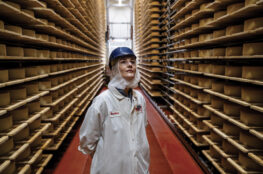


David Cecsarini is standing in a giant shoebox of a building, and there is no stage in sight.
Cecsarini almost looks in character, wearing a hard hat and carrying a roll of blueprints, but it’s no act. The Crane Bay building of the former Transpak industrial site is cavernous and empty right now, but come October, it will be filled with offices, construction shops, rehearsal space and, yes, a stage. A billboard-scale sign on the building will proclaim the new home of Next Act Theatre.
As its longtime artistic director, frequent actor and director, and sometime sound designer, Cecsarini knows everything about putting on a show, but putting up a building is a different matter entirely. Shouting to be heard above the grind and clang of welders and air hammers, Cecsarini and his Next Act cohorts (managing director Charles Kakuk and marketing manager Matt Kemple) are a fitting symbol of the new Milwaukee arts scene. Between them, Cecsarini and Kakuk have almost six decades of experience. But you never know all the answers and must always be open to change.
And this year, with the arts facing enemies on multiple fronts – financial struggles, competition from new media, cuts in school arts education – there are challenges aplenty, and arts groups are responding by offering a strategic mix of old and new, innovation and surprise balanced by the time-tested and familiar.
In the months to come, you may see a new young conductor pursue his craft under the tutelage of an old master like Edo de Waart. You may join the audience when a lifelong Milwaukeean reflects on his city in a completely new performance genre. Or watch as a rising star who first sang a song at the Elm Creative Arts School returns to perform with her hometown opera company. Or enjoy how an established visual artist lends her life story to the creation of a world premiere play.
And you can try out a brand-new theater space, whose creation creates a brand-new future for Next Act Theatre. In 2009, the group was unable to renew the lease for its home of 11 years, the 99-seat black box Off-Broadway Theatre. With impressive speed, Next Act found a space, mounted a successful $1 million capital campaign and got Quorum Architects to work on a design.
The new theater is remarkably similar to the Off-Broadway – a squared-off thrust stage that wraps the audience around three sides of the acting area. Cecsarini likes bringing audiences close to the action. “We’ll still have the same intimacy of the old space,” he says. But there are changes as well.
“The pillars are gone,” he notes. And good riddance. The columns that stood on the four corners of the Off-Broadway stage posed challenges for actors and audiences alike. The new stage offers good sightlines from every seat in the house, even with 51 more places to sit.
That increase in seating is another major step forward, not just for Next Act, but the entire Milwaukee theater community. The number of performing groups in town has grown recently, but the number of spaces has not. In Tandem’s Tenth Street Theatre, which opened in 2007, and Bay View’s Alchemist Theatre, which opened in 2008, have been popular sites for small and so-called do-it-yourself groups, but neither can seat 100 people.
Cecsarini already has several guest theater bookings for this season, due partly to a grant specifically designed to subsidize its rentals at a reduced cost. As for Next Act itself, it will continue to stage work that is contemporary and often politically engaging but puts the focus on characters and dramatic situations. The Exonerated, which opens the new space on Oct. 6, certainly fits the bill. Jessica Blank and Erik Jensen’s docudrama is about people wrongly sent to death row. Edward Morgan will direct a cast of 10 actors (quite large by Next Act tradition) that includes Tami Workentin, James Pickering and Jonathan Wainwright.
***
Elsewhere are other artists making intense preparations. The Milwaukee Ballet’s expansive National Avenue rehearsal room is a sea of black and white Lycra one June morning. Except, that is, for Denis Malinkine, looking a bit rumpled in khakis, a T-shirt and sneakers. Still, there is no doubt he’s the leader of this pack of advanced students. He gracefully demonstrates some movements and, at times, steps in to partner, demonstrating the proper technique for an extended lift or turn. And when class is over, it ends with a centuries-old ballet ritual – each student approaches the ballet master individually, and they acknowledge each other with a quick bow.
Ballet is steeped in tradition, yet always evolving. And Malinkine – who shares his duties with ballet mistress Nadia Thompson – embodies this notion. Raised in Moscow, he attended the legendary Bolshoi Ballet Academy and joined the Moscow Classical Ballet after graduating in 1985. His training was “very organized and very intense,” a textbook example of The Russian Way. “It is very different from education outside Russia,” he says, sitting in his office after class. “There, everything had to be a certain way. The teachers know exactly how to take you from A to Z – step by step, building up your technique and performing qualities.”
But in the Moscow company, while performing works of contemporary choreographers like Maurice Béjart and Roland Petit, Malinkine got a taste of an expanded vocabulary. Moving on to the National Ballet of Portugal, where he was a principal for three years, he found his horizons widened further, encountering “different ways of moving and expression.”
From there, Malinkine discovered a radically different approach to ballet – he was invited to join England’s Northern Ballet Theatre by Christopher Gable, its artistic director. Gable had a strong background in theater, having worked with both the Royal Shakespeare Company and director Peter Brook. Gable’s attempt to bring a sense of theatrical realism to ballet movement was shared by his associate at NBT, Michael Pink. While it took Malinkine some time to distance himself from the “artificial acting,” as he puts it, of the old Russian tradition, he found the new style inspiring.
“It was real acting where you have to be engaged in each moment,” Malinkine says. And he obviously adapted well. Gable and Pink picked him to take the lead roles in several ballets, including Dracula, which will open the Milwaukee Ballet’s season in October.
Pink took over as artistic director here in 2002 and brought Malinkine up from the Atlanta Ballet in 2004. He is an integral part of Pink’s collaborative team, which often includes the dancers themselves – something quite different from the hierarchical Russian tradition. And he will no doubt be asked to draw on his experience when a new dancer takes the lead in Dracula. “You want to give the new dancer all the experience you had dancing the role,” he says. “But you need to give them the freedom to experience it on their own.”
Many artists remember the day they decided to be an artist. Della Wells remembers a series of dawning realizations. While still in her teens, she began volunteering at the Gallery Toward the Black Aesthetics, a former frame shop on North Third Street (now Dr. Martin Luther King Drive) that was one of the first galleries in town to show African-American art.
“I thought only white men made art,” Wells says while sitting in her studio just north of Downtown. “Then I found out that African-American men made art. Then I found out that women made art. It introduced me to a whole world.”
But it wasn’t her world yet. She was only 19 and planning on being a fashion designer. Later, when her son didn’t use the college money she had saved for him, she decided to get a degree herself, studying psychology. For an art history course that was part of her requirements, she departed from the usual final paper topics about Picasso or Rembrandt and wrote about a living Milwaukee artist – Evelyn Patricia Terry, whom she had met during her days at the Black Aesthetics gallery. She went to one of Terry’s shows at the Peltz Gallery, she recalls, “and it was like a voice told me to go create art.”
So she did, starting with monotypes and pastels. (“I always wanted to paint barns and flowers.”) But eventually, she decided she wanted to tell stories with her art, both from her life and her imagination. “I’ve always loved stories,” Wells says. “My mother was a schizophrenic and always in and out of reality. There were stories there. And I loved stories in pictures – ‘Rocky & Bullwinkle,’ James Thurber, Edward Lear, Alice in Wonderland.” Today, Wells’ intricate and playful collages are well known in Milwaukee and carried in galleries all over the United States.
Wells’ stories are so compelling, in fact, that they attracted the attention of a different medium. A few years ago, First Stage Children’s Theater artistic director Jeff Frank met Wells through UW-Milwaukee theater professor Anne Basting. And they started talking about turning Wells’ life story into a play. Don’t Tell Me I Can’t Fly, written by award-winning playwright Y York, draws on Wells’ life to tell the story of a young girl who finds solace in her creative life. She does so despite a father who is obsessed with order and “science,” and a mother who “has trouble keeping things straight in her mind” and is worried about the FBI taking her children away.
“Y and Della found they were kindred spirits even though their life paths are completely different,” Frank says.
The play was selected for The Kennedy Center’s New Visions/New Voices series in Washington, D.C., where it received a workshop and reading. As part of First Stage’s 25th anniversary season, the play will kick off a series of original works “that celebrate the history and people of Wisconsin.”
For Wells, working on the play has been bittersweet.
“It’s an honor,” she says, “but you have to deal with some emotions that you had growing up in a particular situation. I liked the fact the playwright didn’t talk down to kids, like ‘Barney.’ I plan on taking my grandkids.”
***
Hal Rammel is a musician. But things get a little tricky when you ask him what instrument he plays. There is an upright piano in the corner of his rustic living room, part of a converted barn outside Cedarburg. But when I ask him to play something, he heads not to the keyboard, but to a table to pick up what looks like painter’s palette studded with wires and bamboo skewers. He plugs in a cable, flips a switch and picks up the palette as if ready to paint a masterpiece. Instead, he dances a floppy wand (an old guitar string coated in vinyl) through the forest of wood and wire, and creates a lush, twinkly soundscape that fills the room right up to its weathered rafters.
You might call Rammel Milwaukee’s avant-garde Renaissance man. He writes. He draws. He builds unique instruments like this one and plays them. And, as producer and host of the “Alternating Currents” radio show and its live concert series at the Woodland Pattern Book Center in Riverwest, he’s at the center of the city’s experimental music scene. Rammel’s radio show blurb calls what he programs “composed, improvised, electronic, acoustic, electroacoustic, local and global” – which is to say, it stretches the boundaries of music.
As a high school student in Chicago in the mid-1960s, Rammel discovered the jazz of John Coltrane and Ornette Coleman. And the Association for the Advancement of Creative Musicians, a forward-looking collective that spawned groups such as the Art Ensemble of Chicago. “Starting to listen to jazz was of a piece with starting to read, starting to be interested in movies, poetry, writing,” Rammel recalls. “That was just part of exploring the world when I turned 15 or 16.”
And that interest in creative expression – and in expansive, experimental music – continues to this day. Standing before a few dozen people at Woodland Pattern, Rammel introduces Joshua Abrams at an Alternating Currents Live concert. Abrams plays the first set on upright bass – improvising, accompanying himself in a song with celestial imagery, and coaxing unearthly sounds from the instrument with the usual finger plucks and bowing, but also with rattles and percussion instruments he holds against the strings. In the second set, he plays a guimbri, a North African string instrument often used in ceremonies that induce trancelike states.
The New York Times called Abrams a leading figure in the “post-everything musical era.” And the same might be said of Rammel, who is ever in search of The New. “I really like the experience, whether it’s music or art,” he says, “of hearing or seeing something for the first time.”
***
One thing to know about Brent Gohde is that he likes connecting people. In an age when the status update and profile photo have become a major form of artistic expression, Gohde is something of an old master. Through the one-man organization he calls Cedar Block, Gohde has staged events that can defy category and challenge explanation. His first projects were “adult science fairs,” as he dubbed them, where both serious and tongue-in-cheek displays took on questions like, “Does West Allis exist in a 30-year time warp?” From there, he moved to events that piggybacked onto Milwaukee Art Museum exhibits. For the museum’s retrospective of Martín Ramírez, a so-called “outsider” artist who spent much of his life in a mental institution, Gohde got artists to mimic Ramírez’s world by limiting their tools. He handed out “kits” containing a few pencils and crayons – imagining what Ramírez would have access to in his monklike cell – and asked artists to create something using only those supplies. (The results were exhibited at the museum.)
“I just had so many talented friends who didn’t have a venue or an excuse or an audience,” he says by way of explanation. Like a 21st-century Gertrude Stein, Gohde is both catalyst and center of gravity, a guy who loves bringing creative people together.
And he knows a lot of artistic people, perhaps owing to his casually ebullient personality and a job history that weaves through Milwaukee’s creative community like a wayward planet bringing moons into its orbit. Since getting an English degree at UW-Milwaukee, Gohde has worked at the Peck School of the Arts, WMSE radio, Danceworks and the old Harry W. Schwartz bookstores.
The other thing to know about Brent Gohde is that he’s not your usual artsy-fartsy kind of guy. For a recent birthday, for example, his girlfriend gave him a trip to the Tevatron particle accelerator at Fermilab, near Chicago, which provided the inspiration for his next big event. Gohde learned that scientists were in a heated race to discover the Higgs boson particle, also known as the God particle, a hypothetical piece of atomic “stuff” that promises to help reveal the mysteries of the universe. But in 2008, the Swiss built an accelerator four times the size of the Tevatron, and the U.S. Department of Energy pulled the plug.
But Gohde – smitten with the science and eager to solve the riddles of existence – thinks there might be another approach. “Both physics and art are about interpreting the world in their own language,” he says. For his Alverno Presents event, “Sexy Results: Cedar Block’s Dig for the Higgs and How the Quest Was Won,” Gohde will invite artists to search for the God particle in their own way. He’s challenging the Swiss to a God particle throwdown.
“Maybe we don’t need a particle accelerator to find the Higgs boson,” he says. “Maybe we can do it with music, with visual art, with film, with sound waves, with all kinds of interactive works. So that’s what we’re trying to do. We’re going to find the Higgs boson particle. And win the Nobel Prize in physics for America.
***
Talk about a whirlwind career trajectory. Francesco Lecce-Chong begins his appointment as the Milwaukee Symphony Orchestra’s assistant conductor at the ripe old age of 24. A self-confessed “late bloomer” in music, Lecce-Chong grew up on a sheep farm outside of Boulder, Colo. The son of an architect and a painter, he started piano lessons at age 7 and then learned the violin because he thought it might be fun to play in the school orchestra. But around age 13, he got serious. His teacher, sensing his interest, asked him to help lead the elementary school ensembles. His mother began home schooling him to allow more time for music practice. And the seeds of his conducting career – his desire to share music – seemed to take root.
“Without musicians in the family,” he recalls, “I was the one who always had to bring the music back home. I developed the urge to share music as much as possible.”
Soon, he was applying to some of the most prestigious music conservatories in the country. He ended up at New York’s Mannes College for Music, one of two schools with undergraduate programs in conducting. He intended to study piano and composition, but found himself drawn to conducting and was accepted into that track after a year. Awards followed. And fellowships. And graduate study at Philadelphia’s Curtis Institute of Music with the legendary conducting teacher Otto-Werner Mueller (whose former students include Alan Gilbert, music director of the New York Philharmonic).
So why the switch from piano to conducting? “As a performer, the highest you can achieve is to become a soloist,” he says, “and travel all over the world. You inspire people for a night, and then you’re off to the next place. I want to make a difference in one place. Conducting is a way to actually make a difference – arts-wise, music-wise – in the same community and to instill something there.”
***
Tom Crawford is a hometown kind of guy. “People who are agoraphobic won’t leave the room,” he muses. “Some won’t leave the house. Some won’t leave the yard. I’m one of those guys who barely leaves the city. I’ve got about a 28 to 40 mile radius, and outside of that, I start to get squirrelly.”
The title of Crawford’s odd new storytelling series, “Terminal Milwaukee,” quirkily announces his Milwaukee centrism. The longtime station manager of WMSE-FM 91.7 has a deep commitment to his hometown that is probably no secret to his friends or those familiar with the ethos of WMSE. But it came through loud and clear last year when he appeared at Ex Fabula, the storytelling group that has become an important way station on Milwaukee’s cultural landscape.
Ex Fabula invites people to deliver a five-minute personal story that fits the evening’s theme. In his first appearance (theme: Busted), Crawford talked about getting caught cutting school as a young boy. Invited back for the All-Star event at year’s end (theme: Epic Fail), he told a story about discovering his father’s long-kept romantic secret.
“David Ravel of Alverno Presents was there,” Crawford recalls, “and told me there was something unique about the way I told stories.” Ravel and other Ex Fabula regulars were also taken with the connection between Crawford’s life and his city.
And so “Terminal Milwaukee” was born, centering on a life rife with Milwaukee connections. After he dropped out of high school, Crawford worked on the docks as a longshoreman, in a tannery and as a baker’s assistant. From his front yard, he watched the National Guard move to quell the 1967 race riots.
The series, which started in June, will continue to offer Ex Fabula events in five different Milwaukee neighborhoods. Crawford is the central storyteller, but others tell tales set in the respective neighborhoods. It all culminates with a final event at Alverno’s Pitman Theatre in April.
The appeal of the Ex Fabula format is its simplicity and honesty. For Crawford, content trumps style. “I get on stage and just talk,” he says. “I’m not thinking about Samuel Beckett. I’m not thinking about years of being an actor, which I never was. I’m not thinking about being in plays, which I never did. I just stand in front of a microphone and open my mouth.”
***
Norman Moses is taking a sentimental journey. Wandering past a wall of photos from the half-century-plus history of the Skylight Opera Theatre, he sees images of friends, colleagues and characters from his own 40-year career. The wall offers a Who’s Who of Milwaukee theater history: “basso profundo” actor-singer Jack Strawbridge, longtime Skylight leader Colin Cabot, former music director Donald St. Pierre, director Robert Pitman (the namesake of Alverno’s Pitman Theatre), Marquette University’s Father John Walsh. And, of course, there are photos of people still active in Milwaukee theater: Leslie Fitzwater, Dale Gutzman, Bill Theisen and Moses himself.
Moses made his Skylight debut while still in high school with a 1972 production of The Fantasticks. From Whitefish Bay High School, he went to UW-Milwaukee and was in the first class of its Professional Theatre Training Program. Other than a brief time in Houston (“I didn’t really like it there,” he says), he has pretty much spent his entire career as a freelance Milwaukee actor.
That’s no easy feat. In fact, Moses’ wife, Carrie Hitchcock, left the profession after 20 years to pursue a nursing career, helping ease the waiting-for-the-phone-call financial anxiety in the household. Moses also helps by doing part-time accounting work, with several area actors as his clients.
“I manage to work a lot because I’m pretty versatile,” he says, pointing to his classical training at UWM. “Being able to sing and dance is just one more arrow in the quiver.”
And this season, he hit the bull’s-eye. As part of the Skylight’s ambitious 2011-12 season – which includes two world premieres and two large-scale Broadway musicals – Moses will play Harold Hill in The Music Man, a show that he and Skylight artistic director Bill Theisen have been talking about for a while. “It was one of those things where we couldn’t wait too much longer,” says Moses with a grin, “or I’d have to be doing it with a walker.”
***
As a soprano specializing in early and Baroque music, Erica Schuller has played her share of shepherdesses and goddesses on stage. So it isn’t surprising that things feel a bit pastoral – well, laid back, anyway – when we meet for coffee on a warm June day near her home in Riverwest. Schuller has signed on for her second season as one of the Florentine Opera’s studio artists, a contract that involves a complete season of work in the company’s major productions, education outreach productions, community events and concerts.
She sang at Alterra over the summer. She’ll sing tunes by Mozart while wearing a costume as part of The Three Little Pigs, the Florentine’s “Opera in the Schools” tour. She’ll have supporting roles in three mainstage productions and will be a lead performer in Isn’t it Romantic?, the company’s concert of operetta and Broadway love songs that features the three other studio artists.
Despite her wide range of musical duties, Schuller remains passionate about early and Baroque music, as she has since her days at Milwaukee’s High School of the Arts. “I got in trouble there for bringing in music by Bach and Purcell to work on,” she says. “They kept telling me to concentrate on the ‘normal’ music like Schubert.”
But Schuller didn’t know she could specialize in early music until she was well into her studies at the Eastman School of Music. She connected with Paul O’Dette, director of the school’s early music concentration, and dug deep into the repertoire.
It paid off. As she showed in the Florentine’s Baroque double bill last season, Schuller handles the music with command and grace, with a voice that’s clear and agile and delicately expressive.
“I think people are just born with an affinity for certain music,” she says. “Some people love country music. Some people like pop. I just happen to love this music. People misconceive it as simply ‘pretty ditties.’ But it’s actually cerebral and complicated, unexpected and beautifully constructed. And it’s so much about pure expression.”
***
Gwendolyn Rice is a writer who loves crafting dialogue and has supported herself as an arts administrator. So it’s not surprising she would write a play like A Thousand Words.
As you might guess, the play is about pictures. Famous ones. Taken by the pioneering 1930s documentary photographer Walker Evans.
The play developed from a list of various writing ideas she constantly edits and refreshes. “I like to read the local section of the paper,” she says, “because it always has the strangest, weirdest little snippets. I get a lot of ideas from odd news.”
A few years ago, Rice read a report about a group of Evans’ photographs discovered in a boarded-up room that Ernest Hemingway once lived in. “They spent about two weeks together in Cuba, basically getting drunk and hanging out.” She was intrigued. “I wonder what they talked about for two weeks. And I wonder how the photos got there?”
As the deadline approached for Wisconsin Wrights, an annual play development competition, Rice began to have second thoughts about the Hemingway character: “I got this sinking feeling that no matter how I wrote him, someone would think I got him wrong.” She began to focus on Evans, and the intersection of forces that might have swirled around the photographs – museums clamoring for a lucrative show, an artist seeking to maintain his integrity, and the subjects of the pictures (or their families) cleaving to the photos as family heirlooms. A few months worth of thoughtful lunch-hour walks and evening writing sessions, and A Thousand Words was born.
The play was an award-winner at Wisconsin Wrights and came to the attention of both Jacque Troy at the Milwaukee Chamber Theatre and Jennifer Uphoff Gray, artistic director of the new Forward Theater in Madison (where Rice now works). After a reading at the Chamber Theatre, the two theaters decided to share a production. After opening in January at Forward, the production will move to Milwaukee to open Feb. 16.
For Rice, exploring what happens between the click of a shutter and opening a show offers important insights into the ways of the art world: “It’s upsetting to think about something beautiful and lovely having a business side behind it,” she says, “and the trade-offs you have to make. It sort of demystifies the art. But the truth is, you have to look at it that way, or it won’t be around anymore.”