
Wisconsin Democrats now have more than enough candidates in the 2026 governor’s race to form a baseball team. The big question is whether any of those candidates will become the standout player that the party needs to bring home a third straight title.
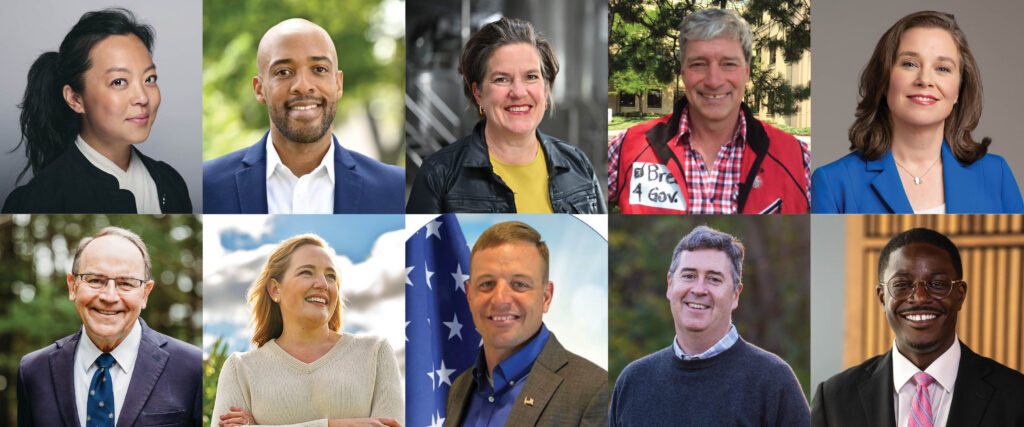
After former Lt. Gov. Mandela Barnes and former Greater Milwaukee Committee President Joel Brennan declared their candidacies last month, the number of announced Democratic hopefuls grew to 10. Meanwhile, the Republican side is holding at three, while a Hall of Fame veteran drops hints that his glory days might not be over.

Celebrate this year’s winners of the Betty Awards!
If everyone stays in the race and makes it onto the ballot – which is far from certain in these early innings – it would be the second time in three elections that Democratic primary voters can choose among a large field of candidates.
This Is One of the Most Diverse Democratic Primaries Yet
Like 2018, the 2026 election will come in the middle of Republican President Donald Trump’s term, as his lackluster approval ratings fuel Democratic hopes for a nationwide blue wave, says Barry Burden, director of the Elections Research Center at UW-Madison. However, this gubernatorial primary group is younger and more diverse than the party’s 10 competitors in 2018, Burden notes.
It’s the first time that two of the top contenders for a major-party nomination are 39-year-old Black men from Milwaukee, as Barnes joins County Executive David Crowley in the race. Like Mayor Cavalier Johnson (also 39, also Black, he’s backing Crowley), Barnes and Crowley grew up in the city’s historically underprivileged 53206 ZIP code.
Also running is 37-year-old state Rep. Francesca Hong (D-Madison), one of four women in a field that includes Lt. Gov. Sara Rodriguez, state Sen. Kelda Roys (D-Madison) and former Wisconsin Economic Development Corp. Secretary Missy Hughes. The youngest of the group is 22-year-old longshot Zach Roper, while former Rep. Brett Hulsey of Madison is the only 60-something in the race.
Overall, the average age of 2026 Democratic candidates so far is around 45, or about a decade younger than the 2018 group, which included such older white men as Tony Evers, then state superintendent of public instruction and now the retiring two-term incumbent governor; former Madison Mayor Paul Soglin; former state party leader Matt Flynn; and longtime activist Mike McCabe. Notably, the three candidates who finished next behind Evers were the most diverse: Black firefighters union leader Mahlon Mitchell, and two women, then-Rep. Roys and then-Sen. Kathleen Vinehout of Alma.
This time, six of the Democratic candidates are aiming to score a demographic first for the only statewide office that has been held exclusively by white guys. Barnes or Crowley would be the first Black governor; Rodriguez, Roys, Hughes or Hong would be the first woman to be governor; and Hong would be the first Asian-American governor.
By contrast, Burden notes, the GOP field is all white men, and Republicans have never nominated a woman for governor. Former Lt. Gov. Rebecca Kleefisch lost a bitter 2022 GOP primary, while former Commerce Secretary Mary Burke was the unsuccessful 2014 Democratic nominee.
Although Black candidates have long faced major hurdles in statewide races, Marquette University Law School Poll Director Charles Franklin has argued that Barnes’ competitive showing in the 2022 U.S. Senate race indicates that voters are open to Black hopefuls.
Conversely, some Democrats worry that Barnes’ narrow loss to GOP incumbent Ron Johnson may be a red flag that Barnes is not electable. Research by Franklin and Craig Gilbert, a fellow at the law school, found it’s been more than five decades since anybody who lost a statewide general election for governor or senator has won a comeback bid for either office.
That could be a warning sign for Republican Tommy Thompson, Wisconsin’s longest-serving governor, as he toys with the idea of yet another race for the office he held for 14 years. Coincidentally, 14 years is also how long Thompson has been off the ballot — and despite his statewide name recognition and popularity, he lost a 2012 Senate bid to Democrat Tammy Baldwin, then a congresswoman. In Democratic primaries, Roys came in third behind Evers in 2018, and Hulsey ran a distant second to Burke in 2014.
How Do the Candidates Line Up Geographically?
Geographically, the 2026 field is less diverse than the 2018 group. All of the major Democratic candidates are based in either the Milwaukee or Madison areas, although Hughes is originally from southwestern Wisconsin and Roys was born in Marshfield. The 2018 field was led by Evers, who is from Sheboygan County, and included Vinehout and then-Rep. Dana Wachs, both from western Wisconsin. Burden says Democrats used to be wary about being tagged as the party of Milwaukee and Madison, but the shift represents the growing strength of progressives from the state’s biggest blue strongholds.
By contrast, the two major Republican contenders represent the two major sources of GOP power – U.S. Rep. Tom Tiffany, from rural northern Wisconsin, and Washington County Executive Josh Schoemann, from the outer Milwaukee suburbs.
In some ways, the Republican primary resembles that of 2010, when a southeastern Wisconsin county executive – Scott Walker, then leading Milwaukee County – faced off against former congressman Mark Neumann.
But then, Burden says, the county exec was the favorite, after Walker attracted statewide attention as the first Republican in his officially nonpartisan office and gained goodwill in the party by dropping out of the 2006 governor’s race to avoid a primary against then-U.S. Rep. Mark Green. This time, the congressman is the favorite, with Tiffany leading Schoemann in name recognition and approval ratings, Burden notes.
That face-off between elected officials could signal that Republicans are losing their enthusiasm for nominating wealthy outsiders like Ron Johnson, Burden says. The party was stung by the losses of construction executive Tim Michels against Evers in 2022 and banking executive Eric Hovde against Baldwin in 2024, followed by the collapse of Whitefish Bay businessman Bill Berrien’s 2026 gubernatorial primary bid.
CLICK HERE TO READ MORE ABOUT ALL 13 DECLARED CANDIDATES FOR GOVERNOR
More candidates could still enter before the June 1 filing deadline. But Franklin says serious contenders will need time to build name recognition and bulk up their campaign war chests.
That means most of the players are already on the field as this ballgame is still getting started.