

Wait, didn’t we just do this?
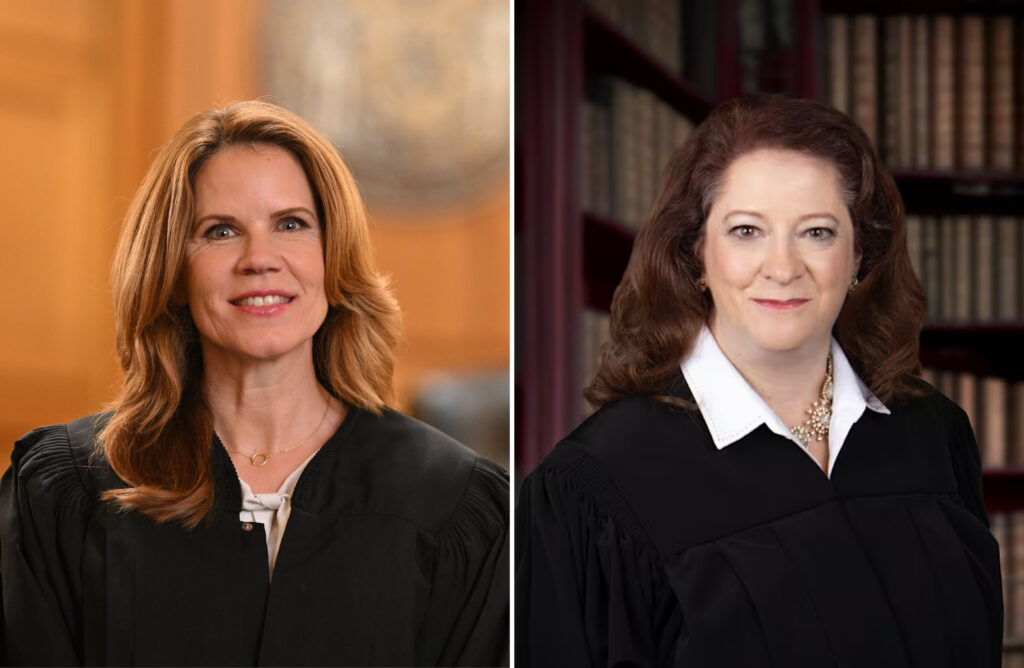
Wisconsin voters might have a sense of déjà vu as they go to the polls Tuesday for yet another liberal-vs.-conservative faceoff for the state’s highest court. This time, the candidates are both state Appeals Court judges: Liberal Chris Taylor, a former legislator who serves in Madison-based District 4, and conservative Maria Lazar, who sits in Waukesha-based District 2.
They are vying to replace conservative Justice Rebecca Bradley, who is not seeking re-election. It’s the second multi-million-dollar Supreme Court race in two years and the third in four years.

Celebrate this year’s winners of the Betty Awards!
Taylor spent nine years as a Democratic state representative from Madison and was considered one of the most liberal members of the Assembly. In 2020, Democratic Gov. Tony Evers appointed her to fill a Dane County Circuit Court vacancy, and she was elected unopposed to the Appeals Court in 2023.
Lazar was an assistant attorney general under Republican Brad Schimel when she won a Waukesha County Circuit Court election in 2015. In 2022, she defeated Evers appointee Lori Kornblum in a $1.05 million campaign that was almost certainly the second-most expensive Appeals Court election in Wisconsin history, after a $1.56 million contest in the same district a year earlier.
Abortion is a key issue in this year’s Supreme Court race. Taylor previously worked for Planned Parenthood and has praised the 2025 state high court ruling overturning an 1849 law that banned abortion. Lazar represented the state in defending a law restricting which doctors could perform abortions, and she has hailed the 2022 U.S. Supreme Court decision that overturned Roe v. Wade and revived Wisconsin’s long-dormant abortion ban.
At a debate last week, Lazar declined to say how she would have ruled in last year’s 4-3 decision to overturn the state’s 1849 abortion ban. “But I will tell you this: I totally 100% respect the decision that was made,” she added.
Where’s the Money?
Unlike the titanic battles of 2023 and 2025, this officially nonpartisan contest isn’t going to break any national spending records. This year’s campaign spending is on track to total well under $8 million, for the first time since 2018. And Lazar’s side is heavily outgunned financially.
As of March 23, Taylor’s campaign reported spending $5.3 million to Lazar’s $687,763, almost an 8-to-1 edge. Independent expenditures by allied groups on each side are similarly lopsided.
Lazar’s fundraising disadvantage may reflect conservative pessimism about her chances. After a string of conservative victories, liberals have won four of the last five Supreme Court races by 10 or more percentage points, while the lone conservative win by now-Justice Brian Hagedorn was one of the narrowest in the court’s history.
At the same time, Lazar could be at risk of suffering what political scientists call a “presidential penalty” as conservative high court candidates are swept up in the midterm backlash against Republican President Donald Trump, whose approval ratings are now at a record low in Wisconsin.
What’s the Effect on the Wisconsin Supreme Court?
One important difference between this Supreme Court race and the last two is that ideological control of the court isn’t at stake. The outgoing Bradley has been one of the court’s most conservative justices. Liberals still would hold a 4-3 majority if Lazar wins, while a Taylor victory would expand the liberal advantage to 5-2 and give the left more of a cushion to keep control in future years.
However, the high court race could have an impact on the ideological balance of Lazar’s district, the only one of the four Appeals Court districts that now has a mixture of conservative and liberal judges.
Conservative Anthony LoCoco is running unopposed to replace retiring liberal Lisa Neubauer in District 2, which covers 12 southeastern and south-central counties, not including Milwaukee County. If Taylor wins, Lazar would stay on the court and conservatives would hold all four seats. But if Lazar wins, Evers could name a liberal to replace her, maintaining the current 3-1 conservative majority. By contrast, the District 4 bench would likely remain entirely liberal regardless of whether Taylor wins or loses.
One thing that this race won’t change is the gender balance on the Supreme Court, where women hold six of seven seats. Women have won eight of the last nine high court races. Hagedorn’s 2019 victory was the exception, and he is now the lone male justice. Despite that trend, this is the first high court race in a decade to feature two female candidates in a general election.
Editor’s note: This article has been updated to include comments from the debate.