

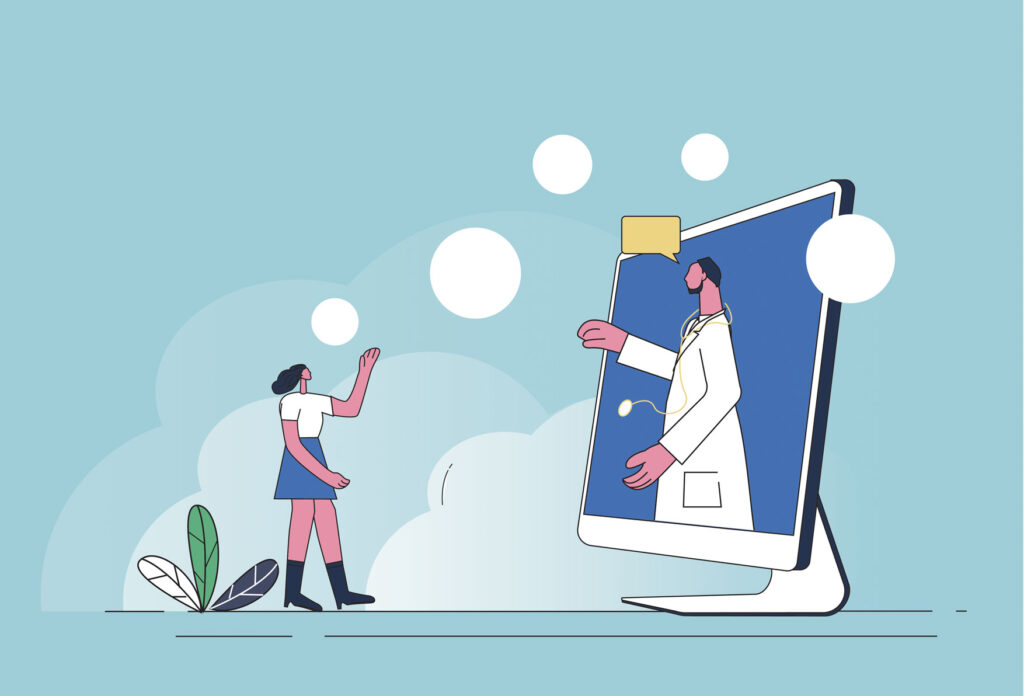
Dr. Bradley Crotty’s great-great-grandfather was a physician in rural West Virginia in the late 19th century, making house calls on horseback to care for the community. No commutes or waiting rooms – just a patient, doctor and the familiar comfort of home.
Much has changed since the days of health care by horseback. But to Crotty, chief digital engagement officer with the Froedtert & Medical College of Wisconsin health network, telehealth could be a way back to his great grandpa’s time. “We now have the tools to help us move toward that patient-centered care,” he says.
The technology behind telehealth isn’t new, but until recently, video visits weren’t the standard – more of the exception to the rule, especially for run-of-the-mill appointments. An emergency department doctor at a small hospital, for example, might dial in a consulting specialist.
“If someone came in with a heart attack and they didn’t have a cardiologist available, they could do a video call with one from the ER,” says Dr. Michael Chen, a family medicine physician with UW Health in Madison.

Check It Out!
Today, most health care organizations offer telehealth visits with primary care and urgent care doctors. For some patients, telehealth is a convenient replacement for in-person care – even with specialists ranging from dietitians and pharmacists to endocrinologists and rheumatologists. While a video visit isn’t ideal for everyone or everything, doctors say the option can help improve public health by making care more accessible and convenient.
BY NECESSITY, VIRTUAL CARE shifted from exception to norm during COVID-19. One national study showed telehealth ballooned in the first three months of the pandemic, up from 0.3% of all appointments in March to June 2019 to nearly 24% in the same months of 2020.
Many health care organizations stopped nonemergency in-person visits in March 2020, but people still needed to see their doctors. “We had urgent needs and limited resources and needed to quickly figure out how to help patients,” says Dr. Karen Fickel, the senior medical director for population health with Froedtert & MCW. Telehealth allowed doctors to see patients for chronic disease management, med refills and sick visits. Even physical therapists could remotely help patients with their exercises.
Pre-pandemic, tight regulations on virtual visits made it a less common way for doctors to treat patients. The biggest issue: Most insurance companies didn’t reimburse medical providers well for telehealth visits, says Dr. Matthew C. Anderson, medical director of virtual health for Aurora Health Care, part of Advocate Health.
In March 2020, Congress enacted a waiver allowing Medicare to pay medical providers the in-person equivalent for telehealth visits, and private insurance companies followed suit. (At the time of printing, that waiver is still active.) What started as an emergency response became a way to help more patients in less time, Chen says: “It almost seemed like, why weren’t we doing this before?”

ROUTINE PRIMARY CARE VISITS – think asking questions about a medication or managing symptoms of a chronic illness – are the bread and butter of telehealth, says Chen. It’s also often faster to get in with an urgent care provider via video than in person for a sick visit. Plus, more and more hospitals are launching “hospital at home” programs that use telehealth visits with providers to allow certain patients to get the same level of around-the-clock care in the comfort of their own homes.
Most doctors know how to examine patients through a screen, whether asking about your symptoms or having you open your mouth to see inside your throat. Advancing technology – including glucose monitors, blood pressure cuffs and even smart watches that upload data to doctors – can make the process more efficient, leading to faster care. “For example, if we see a trend in someone’s blood sugar, we can quickly adjust their insulin in real time,” says Anderson.
In person, your doctor’s office provides all the medical equipment for checking vitals and physical exams. If you have a chronic condition, your doctor has probably already recommended certain home medical equipment (like a glucometer for diabetic patients).
Having a few other tools on hand can make for a more efficient telehealth appointment with a primary or urgent care provider, says Dr. Bradley Crotty, chief digital engagement officer with the Froedtert & MCW health network.
Consider investing in these basics if you anticipate more than one or two annual telehealth visits:
→ Thermometer
→ Blood pressure cuff
→ Scale
→ Heart rate monitor
→ Pulse oximeter
→ Digital otoscope (in-ear camera)
→ At-home tests for common illnesses, like COVID-19 and influenza
No matter what is being treated, telehealth’s main appeal is convenience. Logging on for a virtual visit, doctor’s appointments don’t have to interrupt someone’s whole day. “When you’re able to fit an appointment into your life without taking time off work or finding childcare, it’s a lot easier to access health care,” says Crotty.
Accessibility is especially valuable for people who don’t live near their doctor or seniors who don’t have access to transportation. For people with chronic diseases that require regular check-ins, telehealth can be a major time-saver. Without these barriers, Crotty says, people may be more likely to make and keep appointments and stay on top of their treatment plans.
Another benefit? People may feel more comfortable in their own homes, so they’re less likely to suffer from appointment anxiety known to cause blood pressure to spike. Plus, virtual appointments offer doctors a unique glimpse into a person’s home life. Seeing someone’s home environment can even help a doctor provide better care – maybe a doctor notices a fall risk in a senior’s home, or picks up on social isolation in a person with depression. At appointments, doctors ask patients to bring their medication list, but it’s easy to forget the name or dosage. At home, Chen says, people can just walk to their medicine cabinet.
TELEMEDICINE, THOUGH, IS NOT ALWAYS the best option. Emergencies, of course, need prompt in-person care. And figuring out if your appendix is about to burst or diagnosing a broken leg usually require a hands-on exam. Chronic conditions are sometimes best treated in person, too. Fickel usually recommends her patients with multiple chronic medical conditions visit in person at least once a year for a physical: “Sometimes we pick up on things a patient may not know to report, or know is important.” And if you’re dealing with a serious, life-altering condition, in-person bedside manner can be comforting.
Technology can also be a barrier for telehealth – video appointments are best done in a quiet space, on a computer with a reliable internet connection, which not everyone has. Frustrating WiFi blips or unexpected Zoom updates can take up valuable time in a short appointment.
Some people, Crotty says, just like seeing a doctor at a brick-and-mortar clinic, whether for a hands-on exam to rule out concerns, the warmth of an in-person conversation or just a much-needed break from being on a screen all the time. “Telehealth can be valuable,” says Crotty. “But it’s just one tool in the toolbox that patients and clinicians can use together.”
A QUICK TELEHEALTH visit with your primary care or an urgent care doctor may be a viable option for more conditions than you think. Certain diagnoses may require an in-person trip to a lab, says Dr. Sarah Pierce, an urgent care physician with Aurora Health Care. But you can still save time – and get faster care – by seeing the doctor virtually beforehand.
Chronic illness
A question about a chronic condition like diabetes or high blood pressure can often be easily answered virtually.
Upper respiratory infections
Infections like COVID-19 and influenza can be diagnosed with a video visit based on your symptoms and at-home testing. For strep throat, “your doctor can have you open your mouth and shine a light in it, and then you can go to a local lab for a test if needed,” says Pierce.
Ear infections
Your doctor can diagnose these with pictures or videos from a digital otoscope, a small handheld device with a microscopic camera. Find them in pharmacies or online for under $40.
Urinary tract infections
Diagnosing a UTI requires a urine sample, but you can save time by seeing your doctor virtually and then scheduling a lab visit.
Mild injuries
On telehealth, doctors can give advice for treating cuts, burns, stings and sprains at home. But they may recommend coming in for an in-person exam or imaging after a video visit.
Time to Go In!
Potential emergencies, like shortness of breath, chest pain or severe injuries, should prompt a 911 call or emergency room visit. “If you suspect it could involve loss of life or limb, it’s always best to go in,” says Dr. Karen Fickel, the senior medical director for population health with Froedtert & MCW.
If you’re not sure whether to schedule in person or a telehealth visit, your primary care provider’s office can help you decide.
Meeting of the Minds
Finding mental health support can be hard. When you’re already feeling down or stressed, it can be overwhelming to search for someone in your area who takes your insurance. And with therapists in short supply around the country, even finding someone with openings can be difficult work. One way to make getting mental health help easier? Virtual psychotherapy.
Therapy is an ideal application for telehealth: Unlike medical visits, therapy typically doesn’t involve hands-on components like a physical exam or vital checks. Plus, many therapists can see patients in other geographic areas – even other states – thanks to changes in licensing requirements made during the pandemic, says Stacey Nye, psychology clinic director and clinical psychology professor at UW-Milwaukee.
Research shows that, on average, telehealth-based psychotherapy is generally as effective as in-person sessions. “Being at home might make some people more comfortable opening up to a therapist,” says Andrew Schramm, a psychologist with Froedtert & Medical College of Wisconsin. In-home therapy can also give your therapist a unique glimpse into your life: One of Schramm’s patients once turned the camera to show a memorial they made to a lost loved one, which prompted a helpful conversation about grief in session.
- Use a computer instead of a phone.
- Set up in a well-lit, private room where you won’t be distracted.
- Turn your phone to do-not-disturb mode and close other browser tabs.
- Use headphones for extra privacy if you’re not alone.
- Position the camera so your entire face and upper body are in frame.
- Check your internet connection before the appointment (and make sure your Zoom, etc., doesn’t need an update).
- Know the phone number to call if you lose connection.
Virtual therapy can be especially beneficial for people with symptoms that make it hard to get out of the house for therapy – think depression or social anxiety. “Some of these patients may be more likely to drop out of therapy,” says Munther Barakat, director of behavioral health for Aurora Health Care. “The convenience of a virtual session makes it easier to attend.”
But for some, virtual therapy can hinder growth. Barakat says he may recommend patients with social anxiety or agoraphobia – the fear of going out in public – eventually begin sessions in person to work on their fear.
Certain types of therapy are best done in person, as a general rule. A therapist may recommend people working through traumatic memories come in person. “I don’t want someone to have an internet connection issue when they’re in the middle of working through something intense,” says Schramm. Anyone experiencing thoughts of self-harm or suicide should also seek immediate in-person care.
Therapists often rely on patients’ body language to make observations about how they’re doing, and Schramm says a screen can make that challenging. Another component: Driving or taking a bus to and from therapy can be good times to process before and after a session. On a screen, patients may need more time to transition to “therapy mode.”
To determine whether telehealth is a good fit, Schramm often meets with patients in person for an initial consultation. Even if your therapist recommends in-person therapy, virtual visits can be a great way to keep up with appointments when you can’t get out (say, a sick kid, back-to-back work meetings or a Wisconsin snowstorm). “Whether [there’s] a pandemic or something that came up at home, telehealth allows us to continue to help people,” says Nye.