
In the summer of 1967, the anger finally boiled over. After decades of substandard housing, substandard jobs and substandard treatment generally, Black Milwaukeeans rose up in resistance.
That “long, hot summer” is remembered for a riot on July 30-31 that left three people dead and 1,740 arrested, but the same season marked the beginning of a much longer and more focused expression of dissatisfaction with the status quo.

Check It Out!
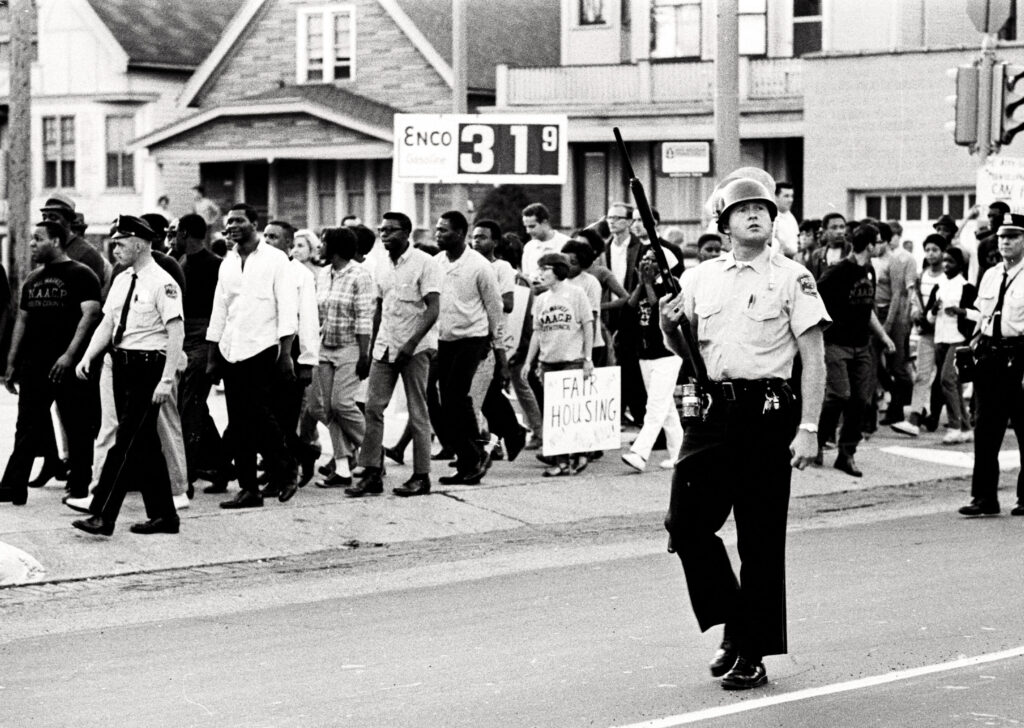
For 200 consecutive days, civil rights activists marched to demonstrate their support for a city ordinance banning racial discrimination in the local real estate market.
Ald. Vel Phillips had introduced an open housing measure multiple times since her election to the Common Council in 1956, but she was invariably the lone affirmative vote.
In 1967, the NAACP Youth Council, advised by Father James Groppi, joined the movement. At first the protesters marched on the homes of individual aldermen, but on Aug. 28, less than a month after the riot, the Youth Council shifted its focus to neighborhoods where they expected resistance.
They found it, especially on the South Side. After crossing the 16th Street viaduct and continuing down what is now Cesar Chavez Drive, the Youth Council ran a gauntlet of hatred, including violent counterprotesters, that continued to Kosciuszko Park. The marches shifted in other directions, including the North Side neighborhood pictured here, through autumn winds and winter snows.
March 21, 1968, proved to be the last march. On April 30, the Milwaukee Common Council passed a citywide open housing ordinance, 19 days after a federal law was enacted.
Open housing didn’t cure all, of course. Milwaukee remains deeply segregated today – a legacy of decades of discrimination – but most of the neighborhoods targeted by the Youth Council in 1967 are now home to significant Black populations.
And activists carry on the spirit of the marchers: Last year, the marches were memorialized with nine new historical markers commemorating the fair housing movement in Milwaukee.
Thanks to Adam Carr for research assistance.
IN COLLABORATION WITH MILWAUKEE COUNTY HISTORICAL SOCIETY