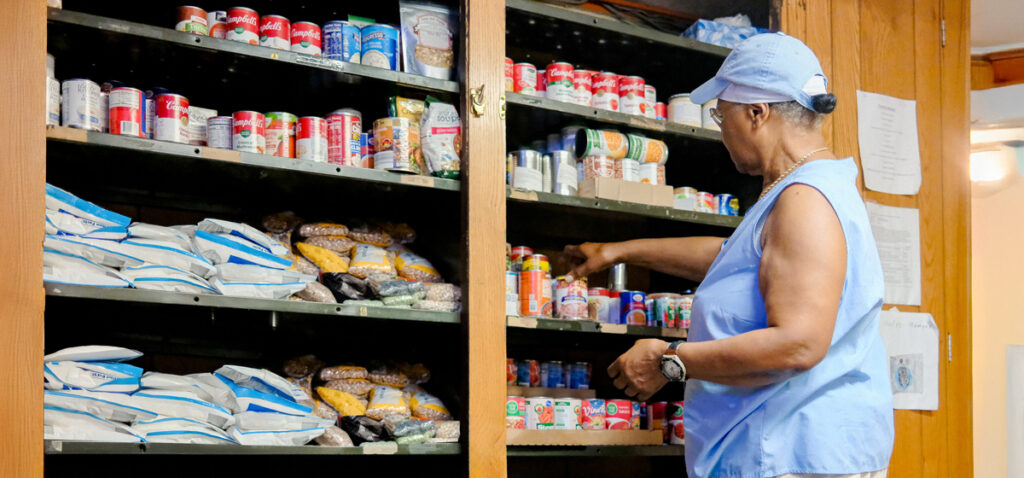
The impacts of the government shutdown entering its second month – and the Trump administration’s decision not to expend emergency funding in order to make ends meet for the 42 million Americans, including 16.3 million youth, who receive food stamps – are already being felt here in Southeastern Wisconsin.
Last week, before the cutoff in funding to SNAP (Supplemental Nutrition Assistance Program) became a reality, Hunger Task Force CEO Matt King was in front of an international audience. He told BBC News that food pantries in Wisconsin and across the country “already” were facing far-increased demand. “There was a 50% increase in visits [in the final week of October], which isn’t sustainable,” he said. “We’re compounding an already challenging situation by adding this SNAP benefit delay onto it.”
More than 930,000 people received food stamps (a.k.a. SNAP, EBT or FoodShare) in Wisconsin last year, including just shy of 309,000 in Milwaukee County.
Grocery store prices are up 29% over the past five years and about 7% since Donald Trump took office for his second term. When research shows that 37% of all Americans have less than $400 saved up, every extra dollar spent on food is another dollar unable to be spent on rent, used in an emergency or saved for a rainy day.
How to Get Help
Finding out how to get help is simple: Call 2-1-1.
Many food pantries require a referral from an outside agency (most-often Impact 211) to begin providing support. By calling 2-1-1, an operator can let you know what agencies are able to help nearest to you, and can make the referral so you can get the food or other services you need.
Click Here to Download a List of Milwaukee-Area Food Pantries.
Click Here for a List of Milwaukee-Area Meal Programs.
How to Help
This isn’t super complicated. You can donate and volunteer.
IN THE SHORT TERM: Donating a basket of canned goods, some boxes of pasta and a few spices to a food bank means that another family will eat. Every meal donated to a food bank or food pantry is another meal for an individual in need. There’s no corporate wastage here. Nobody is standing in line at food pantries who doesn’t actually need help. You can make a donation to Feeding America or Hunger Task Force, or your local church’s meal program, or to a local food pantry.
IN THE LONG TERM: Becoming a recurring donor and devoting your time continually are more impactful than a one-time donation. Why? Because whenever this shutdown ends, hunger will continue. Poverty has been part of the human condition since we first stood on two legs, but it doesn’t need to be part of our story forever.
DONATING MONEY: When nonprofits have an idea of how much money is coming in, they are better able to plan for tomorrow. Becoming a planned giving donor at even $10 a month is better in the long run than donating $100 now and never again.
DONATING YOUR TIME AND TALENT: You can also invite a group of friends to collectively set aside one night a month to make a meal at whatever meal program is nearest you. Many charities are looking for groups to regularly cook meals or perform other simple but necessary services, like cleaning up the neighborhood and organizing the storeroom. Becoming a driver through Meals on Wheels or Disabled American Veterans is another way to connect underserved individuals and families with basic needs.
ORGANIZING A FOOD DRIVE: To collectively galvanize resources (and maybe to inject some friendly competition), plan a food drive through your employer, church or friend group. This doesn’t have to be complicated. You can just say you’re doing it, make a Facebook event, and challenge your friends/family/coworkers to go through their pantries or pick up a few extra things at Aldi.