READ MORE FROM OUR 2025 HOME & DESIGN FEATURE HERE.
The promise of what could be – in this case, an inviting front porch, perfect for spontaneous gatherings with friends or neighbors – is what initially attracted homeowners Phu Ngo and John Cassanos to their 101-year-old bungalow, a former duplex located in Shorewood.
“We own another house down the street, and we kept walking by [the duplex],” recalls Ngo. “Originally, it had a three-season room in the front. We loved the shape of the house but it looked a little closed up. We said, ‘Wow, if we ever had a chance to buy it, we would just rip out [the three-season room] and put back the porch.’ We’re kind of chatty and love to meet neighbors.”


If someone has inspired you through their service, leadership or dedication, the Unity Awards are your opportunity to recognize them!
And so, when the opportunity to purchase the property arose in early 2023, the pair dove in, entering a nine-months-long renovation process with Ngo, an apparel industry veteran who now dabbles in interior design, as designer and Paloma Construction as general contractor for most of the project. (Cassanos served as “live-in task rabbit,” he adds with a laugh.)

The original architectural features of the home – e.g., the curved doorways, coved ceilings, and built-in cabinetry and shelving – were kept or restored, and every room was repainted. Wall-to-wall carpeting was removed to reveal honey-oak hardwood floors; Ngo opted to refinish them, choosing an airy white-oak sealant.
The most ambitious part of the renovation, however, was the transformation of the footprint, from duplex to single-family home.

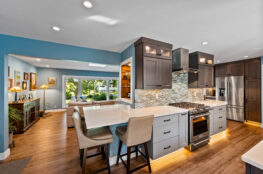
Entrances to the kitchen were relocated to allow for improved flow, a staircase that formerly connected the upstairs unit to an exterior side door was reconfigured, and the bathrooms and kitchens were gutted and repurposed or renovated. Furthermore, many of the design decisions, such as the choice to fully update the lower-
level bathroom, were made with multi-generational living in mind.

“One day, somebody is really going to appreciate the fact that there is a full bathroom downstairs,” Ngo notes, adding that several neighborhood families often host their parents or grandparents.
“We had owned an 1850s house in upstate New York, in the Hudson Valley, and it really gets driven home that you are just a caretaker [of a house],” Cassanos explains. “The previous family lived there for 50 years, so you have this notion that you’re going to pass it along to whoever is going to take care of it later. We’re building it, taking care of it, for the next family to enjoy it.”

The project was deemed complete in January of 2024, and the result is a home composed of carefully edited spaces – each filled with decor, whether art, object, or otherwise, that has a story to tell.
In the dining room, for example, a vintage ceramic chandelier, sourced via an overseas dealer on Etsy, arrived with one broken arm, but was repaired locally at BBC Lighting. “When I picked it up, I didn’t even know what arm it was that had broken,” Ngo recalls.

Upstairs, a collection of instruments, which Ngo says were crafted from everyday objects such as cigar boxes and date back to 1800s Appalachia, are displayed on the primary suite’s eastern wall, serving as a visual representation of Ngo’s uncanny ability to seamlessly mix old and new.
“People found a way to make music, regardless of what they had,” he says of the instruments.


A great deal of the decor carries personal weight, as well. Cassanos’ vast collection of books, for example, is artfully displayed throughout the house, with specific genres often complementing the room in which they reside.
A meticulously styled stack of cookbooks fills an otherwise-bare corner of the dining room, while the majority of Cassanos’ travel books call the library home.

“When pulling together a house [for clients],” explains Ngo, “I ask everybody, ‘What kind of books do you have?’ I think books really tell a story – of not just your interests, but your whole life.”
Regarding furniture and furnishings, it’s clear Ngo is drawn to a midcentury modern aesthetic. “I like clean forms, but with interesting details,” he muses. “[Each midcentury piece] feels more individual, and not so industrially made.” And yet, comfort remains imperative. “One of John’s requirements ,” Ngo continues, a smile emerging, “is that it can look nice, but it also has to be super comfortable. There is no suffering for design.”