Self-driving cars are only a matter of time – inevitable, even. Experts believe they will be commonplace on Milwaukee streets, at least in robotaxi form, within the next decade or two.
A lot has to change for that to come to pass. Wisconsin’s laws still require a human behind the wheel; the state is looking into changing that, but it’s not a priority for legislators right now. And even if policy caught up, there’s another big obstacle: snow.
Until an autonomous vehicle (AV) from the likes of Waymo or Uber can become trustworthy in a busy, slippery intersection with the pavement markings shrouded in snow (no small task even for a winter-seasoned human), we’ll be driving ourselves.

If someone has inspired you through their service, leadership or dedication, the Unity Awards are your opportunity to recognize them!
In the decade-plus since commercial AVs became a thing, they’ve been made remarkably safe. Arthur Harrington, an attorney on the panel that advises the state Department of Transportation on AVs, is quick to cite federal data that indicates as much as 94-98% of car crashes are the result of operator error. Google’s Waymo robotaxi service, meanwhile, has been found to be nearly seven times less likely to be involved in an injury crash than the average human driver.
Those figures come from more than 7 million driverless miles traveled from 2019 to 2023 in Waymo’s first markets: Phoenix, San Francisco and Los Angeles. Notice what those cities lack that Milwaukee usually has plenty of this time of year? Yeah.
Xiaowei Shi, who leads UW-Milwaukee’s Connected & Electric Mobility Systems Lab, says self-driving technology is already so advanced in clear driving conditions that his team is now focused on “long-tail problems” – one-in-a-billion events. For example, a cat runs into the street, but it’s covered by a plastic bag.
An AV right now probably wouldn’t be able to identify what would be going on there, or, worse, ignore the cat because it only recognized the bag. “There’s no data to train this strange situation,” Shi says. “We need to figure out a way to figure out these irregularities.” As any Wisconsin driver knows, irregularities become more regular during a December whiteout.
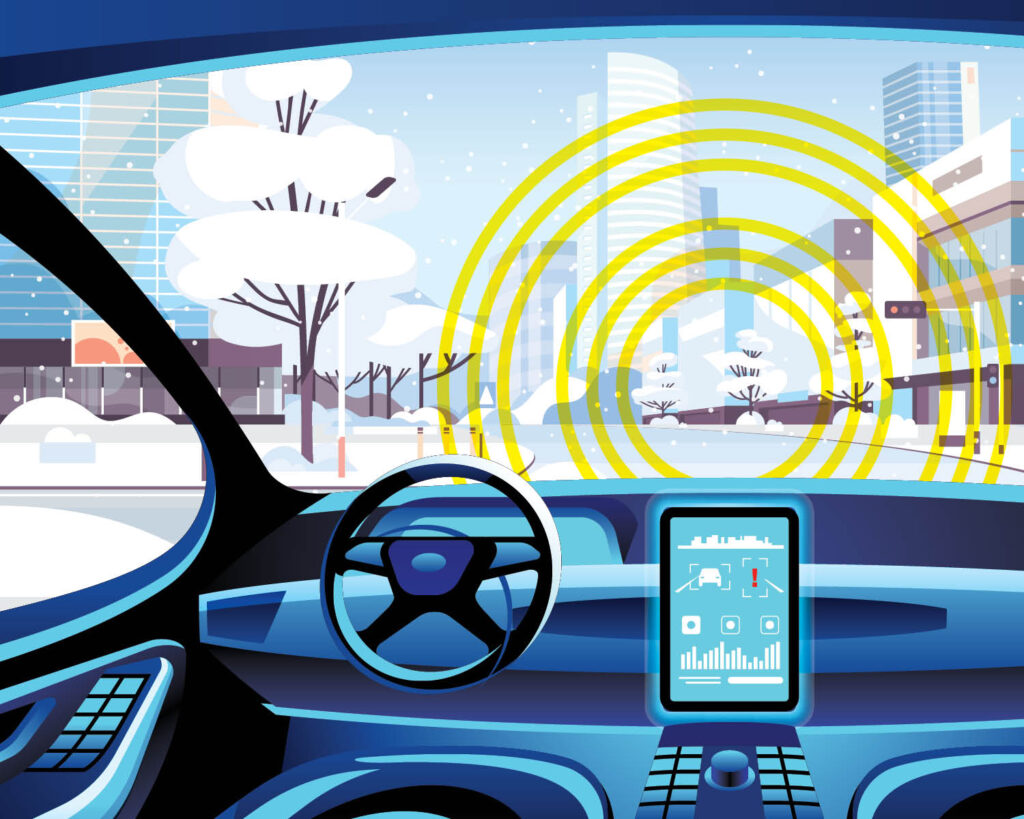
AVs use four primary types of sensors that feed into a central processing system that helps them understand the environment around them. Two of them (cameras and lidar) are really reliable when the weather is good, but their lines of sight and laser beams, respectively, can be blinded by snow. The other two (GPS and radar) are relied on mainly as redundancies now but work better in snow.
But experts believe self-driving vehicles will come to Milwaukee as the industry giants dedicate years to training their vehicles on how to survive icy winters. All self-driving technologies rely on machine learning, a branch of artificial intelligence. The systems are trained on countless hours of footage and experience on roads to inform how they should navigate safely.
Much like a human driver, if they’ve never encountered snow before, they don’t know how to drive defensively – say, prepare for that sedan to slide into the intersection or watch for overzealous kids sledding into this hillside road.
Snow has long stymied AV researchers. The general consensus over the past decade, has been “We’ll get to snow, but we’re not there yet,” says Professor Steven Waslander, director of the University of Toronto’s Robotics and AI Laboratory.
Now, they are starting to get to snow: Waymo announced in August that it is beginning testing in New York City.