

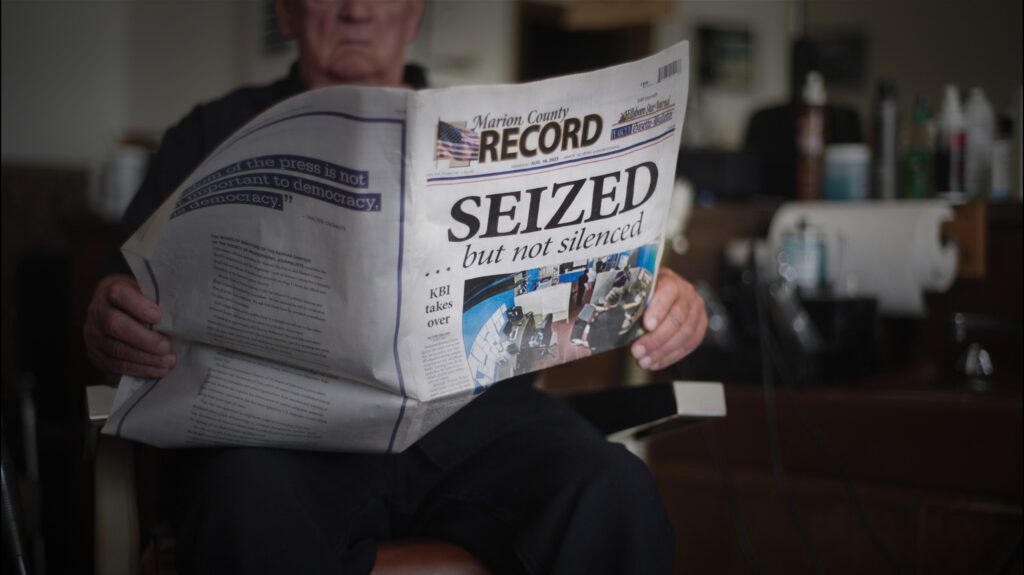
A police raid on a newspaper in a small Kansas town on Aug. 11, 2023, drew worldwide attention and ignited a fierce debate about abuse of power, journalistic ethics and the U.S. Constitution. The spotlight intensified a day later, when claims surfaced that the stress of the raid at the Marion County Record and the homes of some of its staffers contributed to the death of its 98-year-old co-owner, Joan Meyer, the mother of the paper’s editor and publisher, Eric Meyer.
Journalism under siege within the context of the decline of local newspapers is the focus of Sharon Liese’s documentary Seized, which drew a near-capacity crowd at the Oriental Theatre for its initial Milwaukee Film Festival showing.

Celebrate this year’s winners of the Betty Awards!
Seized is a captivating documentary that details the painstaking effort to hold public officials to account through the power of dogged journalism, fueled by the Marion County Record’s tiny, yet hard-working staff led by Eric Meyer. Meyer spent 18 years in a variety of editorial roles, including copy desk chief, at the Milwaukee Journal while also teaching part-time at Marquette University, before leaving the city in the mid-1990s.
The Marion County Record serves a county of fewer than 12,000 residents and had a circulation of 4,000 that jumped to about 6,000 in the aftermath of the raids three years ago. The weekly publication is so small and the budget so tight that all staff chip in to fold the newspapers each week.
A now-famous banner headline – “SEIZED…but not silenced” – appeared in the Marion County Record’s edition immediately following the raids. Commemorative copies of the newspaper were doled out to those attending the Milwaukee Film Festival screening.
The outcry over press freedom violations ignited when law enforcement officers forced their way into the newspaper’s office and confiscated computers, cellphones and other items reporters used to carry out their jobs. Police also made sweeps of the homes of some the Marion County Record‘s staff, including the house shared by Eric Meyer and his mother. The raids came about after the newspaper was wrongly accused of identity theft and illegal computer use to obtain the driving record of a local restaurant operator for a story that had yet to be published. Then-Police Chief Gideon Cody led the raid, which aimed to identify a confidential source and halt reporting on the restaurateur and a separate investigation into Cody’s own background.
A driving force of the documentary is the rarity of raids like this anywhere in the United States, let alone a small community in middle America.
The newspaper carried on after the raids, seemingly with added determination to report news it deemed important to the community, even if it alienated the staff, especially the often-stubborn Meyer, from fellow citizens. Especially interesting is the day-to-day doings of Finn Hartnett, a young reporter and outsider – he’s from New York City, of all places – who is eager, yet obviously uncomfortable with the conflict that often comes with Meyer’s brand of old-school journalism. Hartnett arrives in Marion shortly after the raids, and his effort to fit in offers, at times, a bit of comedic relief.
The film’s main focus, however, is the tireless Meyer, who spent 26 years teaching journalism at the University of Illinois after leaving Milwaukee, before retiring in 2021 to focus on running the Marion County Record, which he purchased with his parents in 1998, preventing a sale to a corporate newspaper chain. Meyer’s father, Bill, had worked at the Marion County Record from 1948 until his retirement.
In a post-screening Q&A, Liese said she tends to focus on films that have an “under the radar” story, like she did in co-directing The Flagmakers. The 2022 documentary for National Geographic Films tells the story of employee-owned Eder Flag, which sews and ships millions of American flags per year from its factory in Oak Creek with a workforce comprised of locals, immigrants and refugees, many of whom wrestle with identity and belonging.
“This story was a little bit of a departure for me, but I knew it was really important,” Liese said of Seized. She made the two-hour trek to Marion from her office in Overland Park, Kansas, in the immediate aftermath of the raids to meet with Meyer, which set her on the course to doing the documentary.
Meyer, who also was present for the Q&A session, said he had no involvement in the direction of the documentary. “I like the fact that this was traditional journalism and was going to present both sides,” Meyer said. “Now, there are some people in Marion that don’t believe that. They believe I hired Sharon and she went off and did all this.”
In November 2025, Marion County agreed to a settlement of more than $3 million and admitted wrongdoing for the raids, with funds distributed among the newspaper, its staff and local residents targeted during the investigation. The deal included a formal apology from the sheriff’s office.
“There were so many places where things failed,” Meyer said of the now-disavowed raids.
Catch the Milwaukee Film Festival’s final showing of Seized at the Downer Theatre on Tuesday, April 28 at 2 p.m.