

Every year, the Mary L. Nohl Fellowship awards funds to individual southeastern Wisconsin artists for the creation of new works or the continuation of current projects. The recipients are split into two cohorts: established and emerging artists. The 2024 emerging artist awardees are filmmaker Justin Goodrum, photo artist Jovanny Hernandez Caballero, and painter Nicholas Perry. At the end of the fellowship, their works will be shown in a group exhibition at the Haggerty Museum of Art in 2025.

Check It Out!
Tell us a bit about yourself and what you’re planning to do during the fellowship.
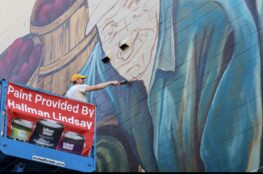
Nicholas Perry: I’m a painter here in Milwaukee. I graduated from UW-Milwaukee in 2018. My practice entails making these figurative portraiture works that previously revolved around obsession, sincerity, isolation and anxiety. But it is now evolving to a more outwardly relationship with landscape.
The ultimate project is to continue being full-time or partially full-time in my studio. I think, for me, (it) was about constantly trying to become better as a painter. … No matter it’s the reading that I’m doing, what I’m looking at every single day, the experiences when I’m out in the field exploring the flora and fauna of the natural landscape that is very uniquely embedded here in Milwaukee. It’s a very rare opportunity for people living in a metro to have such a strong preservation initiative throughout the city.
Justin Goodrum: I run my own film production company called Good Entertainment, and currently the films I’m working on touch on a perspective that I haven’t seen in film a lot. So, I use that to put in my work and hope to create change through my lens of the world.
My project is my first feature-length film called Christopher. Some of the things that I touch on are topics that aren’t usually viewed in film as much, and that’s mental health – specifically in Milwaukee’s Black community. The funds really helped me focus on this fully. It’s a portion that I greatly appreciate because it was needed. Still a lot more to do as far as fundraising and sweat equity. But it gives me more time to work on the craft of filmmaking as well as the story. And figure out ways to make it more sustainable here in Milwaukee as a filmmaker.
Jovanny Hernandez Caballero: My focus is really as a community artist. A lot of the projects I do are very community-based. A lot of people think that photo is my main art practice, and it kind of isn’t. I will always view photography as my job, as a photojournalist for the Milwaukee Journal Sentinel. But when it comes to my art practice, it’s focused on pushing photography to be more installation-based, or to create an immersive experience piece. And that’s what I’m going to focus on for my Nohl Fellowship – continuing to push that boundary.
I know (my project) is going to be very family-oriented, in the sense that I come from a long line of family members who are artists. My family is from a small village in Oaxaca. We are Indigenous. We are Mixtecos. … With this installation piece, I want to pay homage to my family’s history of being Indigenous artisans. I want to focus on showcasing some of the woven items my grandmother has made, and my great grandmother – stuff that has been passed down. … My grandmother, she makes blankets using the sheep in her farm. And being able to capture that through photography has been unique and amazing. But I think with this project, I want to showcase them too as artists because I think just showing an image of the object isn’t enough. I want them to be a part of this exhibition because my family is very important to me.
What’s something you’ve learned in your time in your craft?
NP: It’s really accepting just how organic development can truly be, and that you’re only learning when you feel like you don’t know what you’re doing.
JHC: My goal is to think of art as a tool. I love being a storyteller. And I found that art, especially visuals, have been such a great tool for that because it’s like the universal language that everyone can understand, especially coming from a family who mostly spoke Spanish.
JG: It takes patience. Another one is that art is subjective. Just because a small portion of the world doesn’t get your work or understand it doesn’t mean it’s not good. (It’s) not letting that discourage you.
How would you describe Milwaukee’s arts scene?
JG: What I’ve noticed is the camaraderie. You’re one or two people away from anybody here in the city. That helps when creating – how connected everyone is and how willing people are to work together.
NP: What makes it unique is the level of diversity and just sheer raw talent that is in this city. It has become slowly more globally recognized and viewed as a hub to develop and create this wonderful outreach and be more representative of what the art world could really, truly look like.
What’s your favorite thing about what you do?
NP: When it all snaps into focus, and those projections, all those notes, all that reading, all the pictures and all the drawings – it all comes together and you’re like, that was worth it.
JG: The biggest joy is when a film is finished and seeing people react to it. I’m creating something that’s like a affecting a real emotion, which is crazy once you think about it.
JHC: My favorite thing has to be the way my work has connected with my community. What I mean by that is coming from the South Side of Milwaukee, coming from a Latino/Mexican neighborhood. There are rarely artists who reach a level where they’re showcasing their work at a higher level, who are getting recognition at a bigger scale. As for me, I’m always grateful for the opportunities I’ve had in my life. One victory for me is also a victory for my family and for my community, because the work I’m doing – it is unique in some aspects to my family’s story, but it is a story that is shared with many families here in the South Side of Milwaukee. … The work that I’m doing resonates them because it reminds them of their home.
What’s something you’d like to see for the future of Milwaukee arts scene?
NP: When I go through Downtown and I see those empty office spaces… OK, granted, those are probably incredibly expensive, and typically our community starts from the ground up rather than at those particular locations, but I seriously think we have the infrastructure in the city to be able to handle a larger arts market.
JG: I think a lot of things are changing, in my experience, as far as artists being supported. I just would like to see that times 10 as we move forward.
JHC: That continuation of collaborative work. How can we help each other grow in our careers? How can we help each other grow as artists? We’re all trying to get some of the same opportunities because they’re so limited. But I’ve had interaction with artists that try to help out other artists, or help them reach their potential, which I think is also very unique here in Milwaukee.