
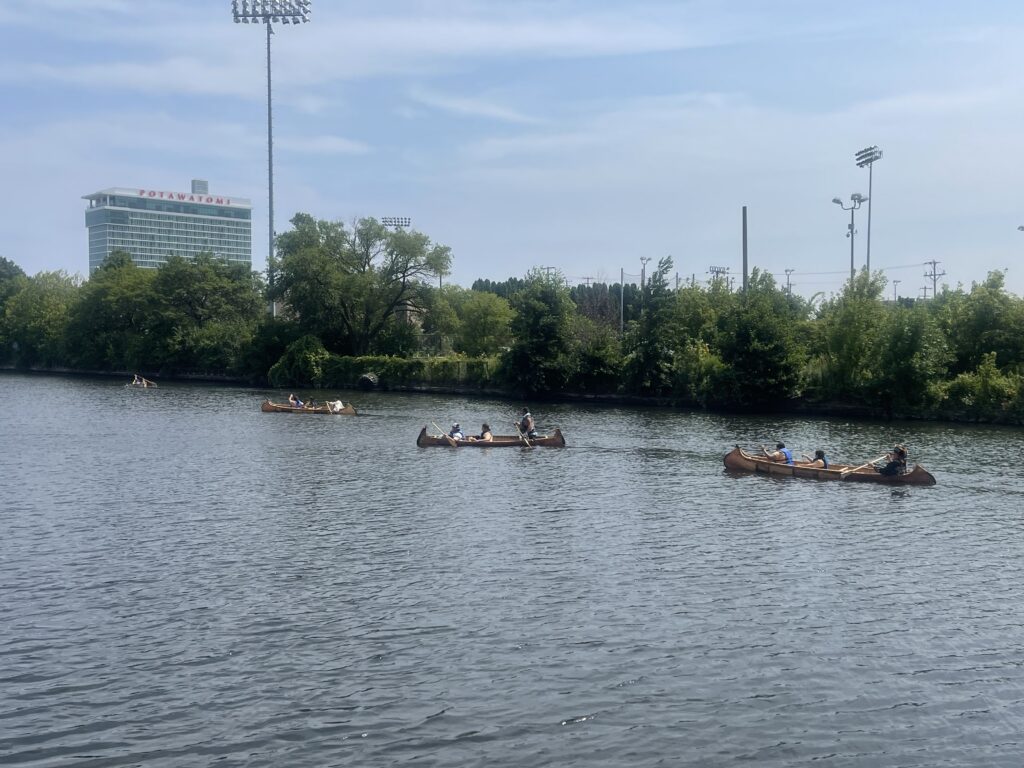
The Forest County Potawatomi tribe was forced out of their homes along the Menomonee River Valley 188 years ago. However, on Aug. 14, they returned to the river so their youth could experience navigating the waterway in five handcrafted birch canoes.
This project was part of a larger program led by Forest County Potawatomi tribe member and canoe builder Lawrence Mann.
“This summer we did a birchbark canoe project and part of their reward for the end of the program was bringing the kids here to the Menomonee River to paddle their canoes,” Mann said, pointing out a group of students who have gathered for a traditional drum circle before the boat launch. “I’m hoping that they reclaim part of their culture and bring that back to encourage younger people to build canoes, so we don’t lose this form of art for our people.”

Celebrate this year’s winners of the Betty Awards!
The summer-long project began by gathering materials from the forest, but Mann explains that’s not as simple as finding the nearest birch tree.
“When we start collecting, we have to look for the right bark – some of it can be a quarter inch thick and the bark needs to be in great shape, so it’ll take looking at 100 trees before finding the right one,” said Mann. He explained that the students looking for two different types of bark – “the summer bark which is what you see on a lot of these but the stuff with etchings on,” he points to a nearby canoe with flowers engraved into it, “that’s the winter bark, we use that to keep our history and stories on, that can only be collected November through March.”
Mann says the canoe interior is made from cedar and the students again had to find the right stuff – straight pieces with no twists. The parts are then melded together using pitch; some people use a synthetic version, but Mann said some are also made in the traditional way, with spruce gum and animal fat heated over coals as a binding agent.
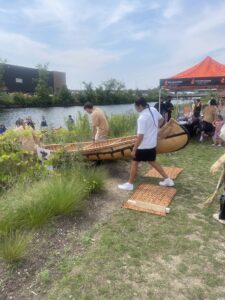
As he talks, Mann is examining the canoes, propped up on sawhorses while the drum circle continues in the background, using a technique called wiigwaasi jiiman, or “the birchbark that receives a kiss.” The canoes can receive small cracks from transporting them over bumpy roads, so they are traditionally inspected by pressing the mouth over the bark and inhaling to detect any holes. Those are usually patched by pitch, but today Mann is making quick fixes with a hot glue gun.
After the canoes are inspected, Andrew Daniels, one of the participating students, helps carry one down to the dock on the riverbank. Daniels helped find some of the materials used to build the canoes.
“It’s a pretty special moment because it’s been such a long time,” Daniels said. “This is the first time in almost 200 years we’ll be back here in our own canoes.”
As he continues, the rest of the canoes are brought down to a dock on the riverbed one by one; ready to disembark and begin a historic journey.
“I’m going to try to think of what this looked like back in the day,” Daniels said before heading down to the dock, smiling brightly. “I’m going to just enjoy the moment and be happy I’m here representing my people.”
The canoes fill with students and teachers, and glide smoothly onto the river. With the Potawatomi Casino’s hotel towers in the background, a group of a few dozen people cheer as they embark east on their journey; a full circle return to their history and land.