
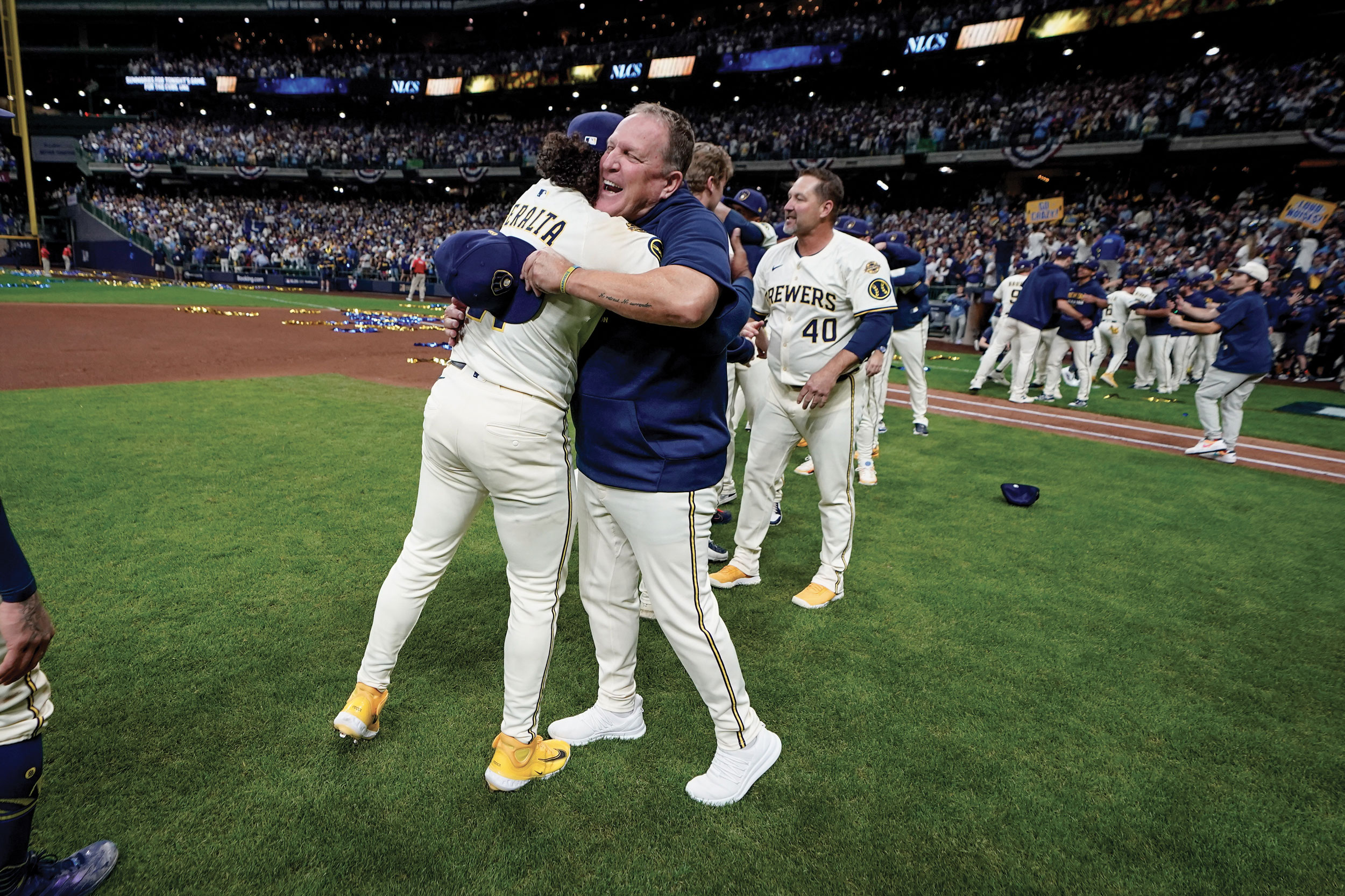
As the jubilant chaos erupts throughout American Family Field, Pat Murphy does not rush to join his players, now converging at the pitcher’s mound in a flash mob of leaping and yelling, embraces and the widest of smiles. Old-school baseball managers, after all, are supposed to hang back in the dugout for somewhat more dignified celebrations.
So that’s where Murphy sees the wild scene play out as blue and gold streamers fall from above and the sellout crowd bathes everything in its own deafening cascade of cheers – a release years, if not decades, in the making.
Yes, the overachieving and comparatively under-resourced Milwaukee Brewers have vanquished their rivalrous Chicago Cubs, winning the decisive Game 5 of their 2025 National League Division Series amidst a cauldron of nervous, knife-edge anticipation.
History will record the Brewers victorious in the first-ever postseason meeting between the two franchises. Victorious in their first postseason meeting against former Brewers and current Cubs manager Craig Counsell, too.
Victorious, in fact, for the first time in any postseason series since 2018. And poignantly victorious in their first postseason series since beloved legend Bob Uecker’s death, commemorated with the many “Uecker Magic” signs scattered throughout the crowd.

Check It Out!
Before the series, Murphy had proudly displayed a new tattoo honoring Uecker on his left bicep, mirroring the patch players wore on their uniforms throughout the season. Now, that tat is part of hug after emphatic hug that Murphy delivers. They go to his fellow coaches in the dugout, then to each player as, the initial outburst spent, they work down a congratulatory receiving line and toward the clubhouse, where cold champagne and beer await.
With every single encounter, Murphy makes a point of looking each person in the eye, of telling them how much he appreciates them, of cementing how they’ve accomplished this together. “Meaningful exchanges,” he calls the encounters. “The emotion of that series was as much as I’ve seen in my 10 years in the big leagues.” After more than 40 years of coaching in college and the pros, Murphy’s not-so-secret ingredient to success remains a remarkable ability to forge relationships – a seemingly ordinary approach to delivering extraordinary results.
More such exchanges follow inside the clubhouse. With champagne bottle in hand and ski goggles guarding his forehead rather than his eyes, he addresses the players and staff poised around him: “All year long, all year long, they called us the Average Joes, OK?” a nod to the underdog mentality these Brewers embraced. “Today, you’re the not-so-freaking Average Joes!” And with that, he pumps the bottle, sprays it into the air, and screams to launch more jubilant chaos.
Not every celebration, after all, need be so dignified.
He takes some stinging hits of champagne to the eyes – the goggles didn’t come down fast enough. Then, after doing some clubhouse interviews, he heads for the relative quiet of his office. His three sons – 25-year-old Kai, 10-year-old Austin and 6-year-old Jaxon – are there to greet him.
“When he walks through the door and hugs my brothers, the look on his face,” Kai says of his father. “Trust me, we live a great life and we’re happy and joke around. But I haven’t seen that look in a really, really long time. Of just complete relief. Happiness. Just like, letting go. Freedom.”
As the evening continues, more moments punctuate it. A lifelong friend texts Murphy, and he heads out into the concourse hallway to meet him. It’s Counsell, the man Murphy had coached at Notre Dame, who brought him into the Brewers organization, and who is still processing the end of his own season. They exchange heartfelt hugs and well-wishes before heading their separate ways.
Later, Murphy is joined in his office by Mark Attanasio, the club’s principal owner, and Matt Arnold, the general manager. As they soak up the afterglow, they recall how, about a year ago, a far more somber postgame conversation had taken place. It came after Milwaukee’s heart-wrenching loss to the New York Mets in a best-of-three Wild Card Series. The Brewers entered the ninth inning with a 2-0 lead and a roaring home crowd at their backs. Victory was two outs away when a three-run Mets homer condemned a 4-2 Brewers defeat.
Just like that, high postseason hopes became wait-till-next-year, but with extraordinary overtones. Though it wasn’t yet public knowledge, those in Brewers uniforms knew that Uecker’s failing health made it a near-certainty that he’d just broadcast his last game.
“The year before,” Murphy says, “we sat there ’til 3 or 4 in the morning and talked about Ueck, and really were sad.
“This was the opposite.”
NOT QUITE TWO YEARS PRIOR, on Nov. 15, 2023, the Milwaukee Brewers made Patrick Thomas Murphy the 20th manager in franchise history. He succeeded Counsell, the homegrown prodigy who named Murphy his bench coach in 2015, and who departed for a new challenge – and baseball’s then richest-ever managerial contract – with those bigger-market, better-moneyed Cubs.
It’s easy to forget, in light of what Murphy’s accomplished in just two seasons, that despite his long and respected tenure with the Brewers, he was no shoo-in to become their skipper. He was a baseball lifer with some 50 years in college and pro dugouts, convinced that his shot at managing a major league team had passed, and mostly content as a behind-the-scenes source of wisdom. He expected to stay in that role and follow Counsell to Chicago, even while interviewing for the Brewers post. Then he got a phone call from Matt Arnold’s preteen son, Tyler.
“We wanted to know,” a giggling Tyler says in video posted by the Brewers, “if you wanted to be the manager of the Brewers.” “Nice, bro!” Murphy responds. “Something I dream about, man.” Then, a beat later, ever the jokester: “Tell your dad to go out in the garage and get the wheelbarrow, all right?”
More than just a cute moment for posterity, it was a nod toward Murphy’s soft spot for kids. And in the time since, he’s become rather well-known for having young people – be it his own children or someone else’s – flank him at press conferences. He’s also become known at those conferences for asking unfamiliar faces – be they a new camera operator or visiting reporters from Japan – to introduce themselves. And, yes, he’s become rather well-known for winning beyond expectations.
In both of his seasons managing the Brewers, he’s led them to National League Central Division titles. In 2025, he did so while posting the best regular-season mark in all of baseball, with a single-season franchise-record 97 wins. That secured his second consecutive NL Manager of the Year honor, a feat accomplished by only one other man, Bobby Cox, the longtime Atlanta Braves skipper who’s in the Hall of Fame.
“The manager of a team with a 56-year history that has the highest winning percentage is Pat Murphy,” Attanasio said amidst those Game 5 victory celebrations. “You can say, ‘Well, it’s only two seasons,’ but when you’re No. 1, you’re No. 1. He’s just brought his own energy to this group of young players and believed in all of them.”
Murphy’s crafted that franchise-best .588 winning percentage even as the Brewers face massive payroll disadvantages against other top teams. According to the salary experts at Spotrac, in the 2025 playoffs, Milwaukee’s roster made $121 million and beat a Cubs roster making $211 million, then lost in the National League Championship Series to the Los Angeles Dodgers and their record-high payroll of $350 million.
Which invites the constant question from baseball observers: How? How are Murphy and the Brewers doing so much more with so much less?
Murphy’s answer hasn’t changed since he laid out his blueprint and philosophy at his introductory press conference. He emphasized then that you don’t win championships with resources, but with people. His bottom-line job, therefore, is to get them to their peak performance. And he believes in a managerial approach rooted in love and discipline, in that order, which happens to be the same approach he’s taken with raising his children. It’s worked equally well.
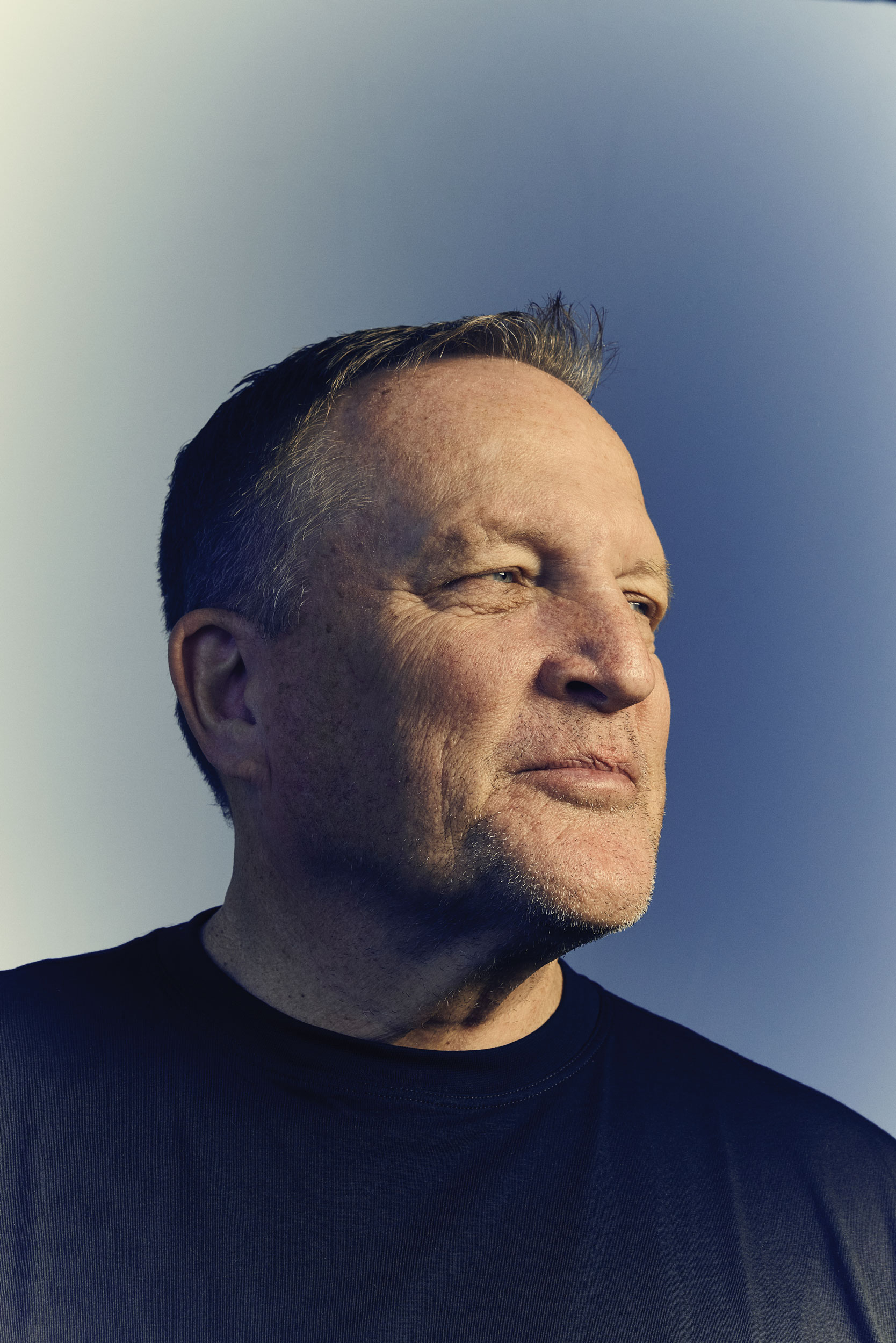
FROM VETERAN LEADERS like former MVP Christian Yelich to impact rookies like pitching phenom Jacob Misiorowski, the refrain is the same. Murphy’s as genuine as they come, a true straight shooter who’ll tell you the things you need to hear, even when – perhaps especially when – it’s uncomfortable. “Oh yeah, I’ve gotten some meetings with Murph, gotten set straight,” says Misiorowski, whose 2025 journey went from top prospect to winning Game 5 against the Cubs. “It comes from a place of love.”
To really see it hit home, ask a new player. Like first baseman Andrew Vaughn, the onetime Chicago White Sox first-round draft pick who’d spent four seasons with their big league club before slumping to Triple-A in 2025. Rescued by a midseason trade to the Brewers and promoted back to the majors, he homered in his first at-bat with his new club, became a stabilizing middle-of-the-order power hitter, and slugged the go-ahead homer in Game 5. And while Vaughn’s resurgence wasn’t as simple as absorbing some mystical, magical Murphy aura, he quickly learned why guys so love playing for him.
“He cares. His passion is unbelievable,” Vaughn says. “He’s gonna tell you how it is. He’s gonna walk up to you, man to man, and I respect that so much.”
Murphy paints this unvarnished truth and draws such close connections with the skills of a Renaissance artist, honed throughout his lifetime and still being refined. He turned 67 in November, and at the birthday get-together, the kids in attendance had a field day regaling him with the whole “six-seven” trend. Murphy played along, in his boomer role, by regularly asking them, “What is this?”
Humor is certainly part of his success formula. He’s known throughout baseball as an all-star jokester, and the bits come in many forms, be they quick-hitters or elaborate practical jokes. During pregame introductions, he’ll playfully snub players expecting the traditional high-five or handshake, and his media sessions can morph into open-mic comedy nights. Sal Frelick went through a fair portion of his first big league spring training thinking Murphy was the Brewers video guy. Perhaps Murphy’s most famed hoodwinking came as manager of the Triple-A El Paso Chihuahuas: an intricate long-con persuading former big leaguer Jeff Francoeur that one of his teammates was deaf, the results immortalized in the YouTube short film “On Jeff Ears.”
He’s built incredible longevity and resilience by taking his great successes and setbacks, both professionally and personally, and honing a Zen-like penchant for growth from either result. He was the uber-successful college coach who was forced to resign, only to rebuild and reinvent himself in the professional game. His three marriages might not have found happily ever after, but his relationships with his four children certainly have.
“He continues to work on himself, and he’s the best version that he’s ever been,” says 39-year-old daughter Keli Álvarez, now a mom of two who’s pursuing her master’s degree in clinical mental health counseling at Bradley University. “And I know he’s going to get even better.”
Murphy credits much of his success to revered baseball mental coach Harvey Dorfman, and became such a disciple of his teachings that the two developed a lifelong friendship. He loves repeating Dorfman’s mantra that nothing can screw you up without your consent. It’s Dorfman who crystallized Murphy’s love and discipline approach, and so many other lessons he puts to use daily, and not just for his job.
“Harvey helped me with parenting more than anything else,” says Murphy. “He’d say, ‘You know, Murph, parenting is love and discipline. And as they get older, the [amounts of] love and discipline get pretty close. But never let that discipline get over the love.’ And then he’d say, ‘Kids spell love T-I-M-E.’ And I still write that in my notes.”
Ah, the notes. Murphy is a notoriously early riser, up at 4 or 5 a.m. daily, even during the season. It’s a quiet time, and it’s his time, before his kids are up or any other duties demand his attention. “I call it piddling around,” Murphy quips. Perhaps, but to a distinct purpose.
It’s in these moments, before he watches the sun rise, that Murphy makes plans short-term and long. He makes a list of the day’s priorities and goals, and puts practical thought toward them. He’ll write down the names of people, and what specific things to focus on with them. His children’s names feature prominently, as does what to do with their time together.
THE IMAGE WILL FOREVER BE ETCHED in Kai Murphy’s mind, in a cherished photograph and, eventually, elsewhere. It’s June 2005, and Pat Murphy’s Arizona State University Sun Devils are in the College World Series, one of four trips he’ll make in his tenure there. Per tradition, the teams march an introductory parade onto the field, like an Olympics Opening Ceremony, with managers at the vanguard of each contingent.
As Murphy leads the Sun Devils down the first base line and toward home plate, wearing a quarter-zip pullover and blue jeans, his left hand is holding something. It’s the right hand of 4-year-old Kai, dressed in a ballcap and Sun Devils jersey that drapes to his knees, waving his left hand toward the cheering crowd.
“That was the first time I remember thinking, ‘This is different. My dad is super cool,” Kai says some 20 years later, now a minor league outfielder in the San Diego Padres organization.
A photographer captured the moment, and for years the print hung in the Murphy home. When he moved into his own place, Kai asked to take the photo with him.
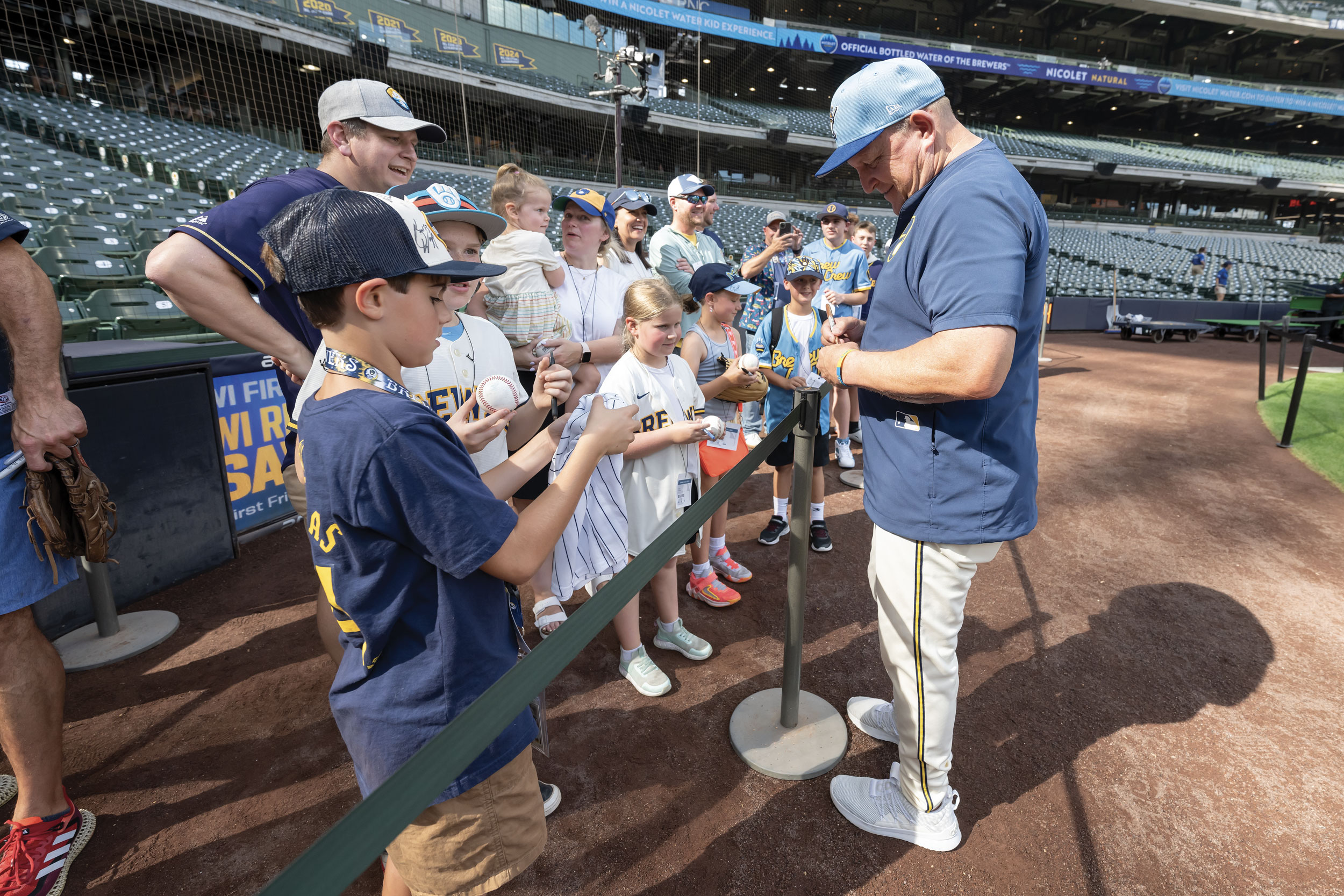
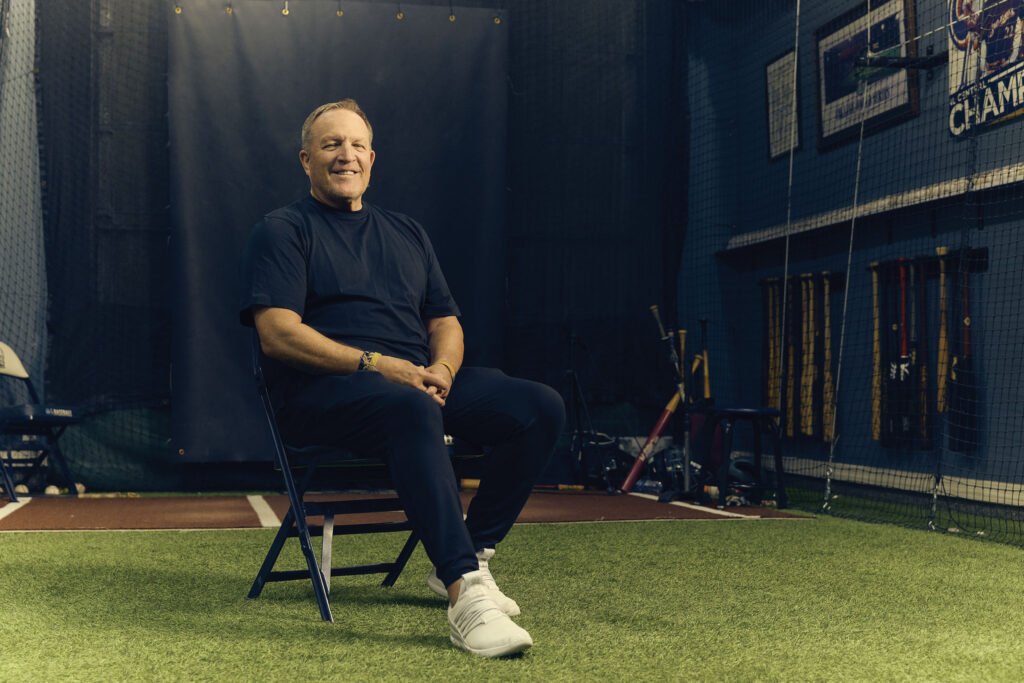
him at press conferences. Photo by Kirsten Schmitt/Milwaukee Brewers.
The elder Murphy spent 15 seasons at Arizona State (after seven remarkably successful seasons coaching at Notre Dame) and he might still be there, but for what he terms the “gross injustice” that led to his departure. The NCAA had its magnifying glass on the school because of previous rules violations by the football team. So when a disgruntled former baseball player and employee went to ASU administrators with allegations and complaints, Murphy’s program came under NCAA scrutiny.
He was so sure of his innocence that he readily admits a too-smug approach toward the process and those running it. It cost him.
As the investigation continued, he faced a resign-or-be-fired ultimatum in 2009, and he chose the former. ASU painted his departure as an example of how serious it took compliance. But when the investigation’s final results came in, they boiled down to this: Murphy cleared of ethical violations, guilty of a cavalier attitude toward investigators.
Kai remembers dad picking him up at school and telling him he wouldn’t be the coach at ASU anymore. He and Keli, who attended Arizona State, trashed all of their Sun Devils gear. Murphy was 50 years old, and financially and emotionally devastated. “It was a horrible time in every way, shape and form,” he says, so he did the only thing he could. “I had to go back to work, but not just for the money. I had to go back to work because it’s what I do.” And he wanted to show Kai that how you get back up is more important than how you got knocked down.
He had good connections with the Padres, and started working his way up the pro ball managerial ladder, beginning with Single-A Eugene in 2011 and a $30,000 salary, still raising Kai, who loved the life.
“We have a saying when you’re running marathons that you have to run the mile you’re in,” says Keli, whose personal-best Boston Marathon time of 3 hours, 19 minutes, 10 seconds is tattooed on her father’s left wrist. “You can’t look at having 25 miles to go. It’s not pretty. So, you run the mile you’re in. You do the things you need in that mile to get to the next mile, and the next mile, to get to the finish line. He’s the master of running the mile he’s in.”
By 2015, Pat Murphy was managing El Paso when the Padres fired big league manager Bud Black and named Murphy their interim manager. He went 42-54, wasn’t retained, and Counsell called him to Milwaukee.
By then, fences with Arizona State had mended somewhat, and Kai actually signed to play for the Sun Devils in 2021. A year or so later, he surprised his father by unveiling a new, painstakingly detailed tattoo on his upper right chest.
It depicts Pat Murphy holding the hand of 4-year-old Kai, a replica of that old College World Series photo.
“That blew me away,” the elder Murphy says, choking up a bit. “I still get emotional thinking about it, because he’s that way.”
PAT MURPHY HAS OPENED HIS EYES, but all he can see is gray, and his body won’t move. He hears nothing. He is freezing cold. Only one explanation makes sense.
“I was convinced I was dead.”
His mind still works, because in light of this morbid conclusion, he thinks how grateful he is for having had such a good life. His thoughts go to his children, to his oldest, Keli, and how excited he is for the career and family she’s grown. He thinks of elder son Kai, who is taking his first steps down the baseball career path that had so richly rewarded Pat. He’s at peace knowing both will be just fine.
The thoughts turn to his two youngest sons, Austin and Jaxon. And though he’s also confident in their future, he wishes he could be with them as they grow up through grade school and onwards, the guiding father to shape their path with love and discipline. The Irish Catholic man hopes he’ll find some connection with them across whatever metaphysical barrier might separate them. “I hope to God that I can still influence them from here.” He figures it’s possible, because he knows he’s not in hell. It’s too freaking cold.
The gray disperses enough that he sees a woman peripherally appear from his left. An angel, he thinks, as she arrives next to him and puts her hand on his chest. He hears her say something: “You’re gonna be fine.” Tears fall from his eyes. He has another thought.
“Wow. That must mean I’m alive.”
He emerges from the hallucination. He is not in purgatory. He is very much alive, recovering in the cardiac ward at Froedtert Hospital, owner of a new heart stent. It is Aug. 1, 2020.
He’d felt the jaw pain and shortness of breath during an afternoon workout at the ballpark, and was fortunate that trainers and team physician Dr. Mark Neidfeldt recognized the seriousness. Murphy stubbornly denied that seriousness, wanting to drive himself home rather than leave in the back of an ambulance, until the normally mild-mannered Neidfeldt got stern with him. “He pointed at me,” Murphy recalls, “and said, ‘Look, you’re having a heart attack, and we’ve got to get you there now.’ It startled me, because he doesn’t do that.”
Kai was about to play a baseball game for the Kenosha Kingfish when he heard there was a phone call for him. It was Counsell, simultaneously delivering news of the heart attack and reassuring Kai that, all things considered, the outlook was positive. Since Kai wouldn’t be able to see him until the next day anyway, he stayed for the game. He remembers playing poorly.
Keli hadn’t heard from Counsell for a long time, so when she saw his call, she knew something was up. She and husband Pedro Álvarez, recently retired from eight years as a big league corner infielder, were in Nashville, and she was “super pregnant” with their second daughter. Counsell was equally reassuring with her, sharing details that put her at ease. “It was scary at first,” she says. “Come to find out, he’s making jokes in the ambulance and operating room. When Craig told me that, I was like, all right, this guy’s not going anywhere. He’s got too much left.”
Murphy spent part of his recovery with her and the family in Nashville, and one day they went for a long walk despite the Tennessee heat, heart attack survivor and very pregnant mom, side by side. When folks expressed surprise, she would laugh and respond, “This man is invincible. He doesn’t have a limit.”
Murphy was back with the Brewers before season’s end, with a sharper focus on staying healthy, and a renewed appreciation for T-I-M-E. “I joke that I’m in the fourth quarter and I only have one 20-second timeout left,” he says. “I’ve got to use my time wisely.”
The Pat Murphy Resume
1983: Maryville College (Tenn.)
1984-85: Florida Atlantic (Asst. Coach)
1986-87: Claremont-Mudd-Scripps Colleges (Calif.)
1988-94: Notre Dame. Amassed 318-116-6 record; three-time Midwest Collegiate Conference Coach of the Year
1995-2009: Arizona State. Compiled 629-284-1 record and four College World Series appearances; four-time Pac 10 Coach of the Year; National Coach of the Year in 1998, when Sun Devils reached national championship game
2000: Managed Netherlands in 2000 Summer Olympics in Sydney, Australia
2010-15: San Diego Padres. Began as special assistant to baseball operations, then managed from 2011-12 at Single-A Eugene, and then from 2013-15 at Triple-A in Tucson and El Paso. Was interim manager of the Padres (42-54) in 2015.
2016-present: Milwaukee Brewers. Bench coach, 2016-23; manager 2024-present (190-134 record); NL Manager of the Year both seasons.
MURPHY’S LAST VICTORY AT ARIZONA STATE, a 12-5 drubbing of North Carolina in the 2009 College World Series, just happened to be the 1,000th college of win of his career. And, in some cheeky foreshadowing by the baseball gods, his first four wins of that 2009 season happened to be against UW-Milwaukee.
No one back then could have known where Murphy’s baseball path would lead. But the path he was on might have led to the greatest coaching career in NCAA baseball history. He’d averaged 49.6 wins in his last three seasons at Arizona State, so it’s no stretch to say that, by 2025, he could have been around 1,800 victories. The all-time career record for NCAA wins is 2,029.
“For me, his college baseball coaching career, it would’ve been insane, the level of success he would’ve had,” says Keli, who invokes the name of college football legend Nick Saban by comparison.
Murphy himself is not one for looking back, nor is he one for predictions. But he appreciates that, if his college baseball chapter doesn’t end when and how it did, his professional baseball chapter almost certainly never begins. And he is, most certainly, a man who believes in meant-to-be. “It’s been too prevalent in my life,” he explains, and launches into a story about growing up as a Notre Dame fan in Syracuse, N.Y.
He’d listen to every Fighting Irish football game on the radio and could name entire rosters from memory. He got the South Bend Tribune delivered by mail four days late, just to digest every morsel of Notre Dame information possible.
“So to become the head baseball coach at Notre Dame,” Murphy says, “was strictly meant to be. And then everything I did turned to gold there.”
He says that not from a place of ego, but borderline surprise. Prior to his arrival, Notre Dame baseball was mediocre at best. From 1988-94, he built them into a perennial top-25 program – not with the refined approach he uses today, but with the blunt force of a football coach in the wrong sport. “It made me look like a good coach, and I wasn’t,” Murphy says. “Please believe me, I wasn’t. I was a tyrant.”
Somehow, that tyrant forged a bond with a 1989 recruit from Whitefish Bay, Wisconsin, named Craig Counsell. And somehow, 26 years later, they shared a dugout in Milwaukee. And 10 years after that, they shared a hug in the concourse of a jubilant stadium.
“It was meant to be.”