

Milwaukee Ballet opened its season last weekend with a ghost story, launching a year of big, bold ballets collectively titled Beyond Belief. Last weekend’s Giselle tells a century-old fairy tale through the lens of real-life atrocities in war-torn Europe, dabbling in themes like life and death; and class, power and agency.
Milwaukee Ballet’s updated Giselle is now more than 20 years old, but it reads as fresh and relevant in 2025. Rather than an ancient century storybook village, this Giselle takes place in a 1940s Jewish ghetto at the height of World War II.

Check It Out!
The ballet marked the official homecoming for Milwaukee native Jennifer Hackbarth, who danced the title role (shared with Lahna Vanderbush) as a newly instated leading artist with the Milwaukee Ballet. Hackbarth’s resume dancing in New York, Europe and Florida includes lead roles in many of the classics – which is perhaps why she was brought in last season as a guest artist to dance Aurora in Sleeping Beauty. There, artistic director Michael Pink stuck uncharacteristically close to the traditional staging and choreography. Giselle, on the other hand, tests whether Hackbarth is comfortable in a ballet that merely winks and nods at its nearly two-century-old steps by Jean Coralli and Jules Perrot, while unabashedly veering off script. Turns out, she’s fine with that. Terrific, in fact, and well-matched with partner Parker Brasser-Vos, who unlike Hackbarth has spent his entire professional career dancing Pink’s iconoclastic choreography.
Pink, who worked with Christopher Gable to reimagine the 1841 ballet, keeps the story largely the same: An upper-class guy, Albrecht (also danced by Randy Crespo), falls in love with a working-class woman, Giselle. He disguises himself to fit in and woo her. It works. Giselle falls hard, despite objections from Hilarion, who would much rather it be him she’s in love with. When it’s discovered Albrecht is not who he says he is, Giselle descends into madness and dies – only to return as a spirit among spirits exacting revenge on those who’ve wronged them.

In this version, Giselle doesn’t simply die of a broken heart. It’s teased she’s had a health condition all along. She’s doted on by her mother (Kristen Marshall) and adored by a community that manages to find joy despite their situation (evidenced by an ample supply of merry group dances). And Albrecht is not simply a rich guy but a uniformed Nazi soldier who immerses himself in and is largely accepted by that community – though Hilarion, danced Friday and Saturday evening by Eric Figueredo, still seems skeptical. For all we know, Albrecht is genuine in his adoration for Giselle, appearing willing to take great risk to abandon the evil cause he’s associated with. But it’s not like he can stop them, either. Once Albrecht’s true identity becomes known, Giselle’s downward spiral annoys Bathilde, a menacing German aristocrat danced Saturday by Marize Fumero, resulting in a mass execution. Albrecht escapes alive and merely miserable.
Critical to Giselle’s success – if it hasn’t been said yet, this indeed is a gorgeous triumph for the company – is its music, played handily by the Milwaukee Ballet Orchestra under Andrews Sill’s baton. While having a dedicated orchestra has been a justified bragging right, Giselle was meant to be the only production this year to have live music. A decision to cut the orchestra from both The Nutcracker and a May 2026 production of Septime Webre’s ALICE (in Wonderland) was met with public outcry until an angel benefactor came to the rescue to ensure the orchestra would be included in Nutcracker this December. Whether they’ll reverse course on ALICE appears to now be an open question, given an invitation in Giselle’s program book to contribute to a live music fund.
Whether or not the orchestra will be a thing moving forward, it was critical for Giselle, whose 1841 score by Adolphe Adam was brilliantly adapted to more adequately fit this era and setting. Gavin Sutherland’s arrangement prominently features alto saxophone (Jon Lovas) – an instrument barely invented when Adam composed the original score – and leans into colors, rhythms and nuances which feel surprisingly fitting. During the first act, on stage performances by Cally Laughlin (clarinet), Janna Ernst on a dilapidated piano, cornetist Daniel Birnschein, piccoloist Vanessa Lopez, and Anna Carlson, playing a Holocaust-era violin through a partnership with Violins of Hope, further add to a cohesive pairing of 19th-century music and 20th-century material.

In total, it’s a poignant and beautiful take on a ballet so old it can easily look staid. Not so here, thanks to moody lighting by David Grill and elegant sets and costumes by Lez Brotherston. To this critic, Giselle comes across as handling a painful history with respect, though I’m left wondering if 1940s Albrecht deserves a pass like his 1840s counterpart.
In the original ballet’s second act, Giselle appears to Albrecht in spirit form. She’s part of a flock of dead maidens called wilis who exact revenge by haunting the men who have wronged them and forcing them to dance to death. Many, many ballets pedal in themes of class and power; rare is the one that actually gives power to the powerless and lets them decide what to do with it.
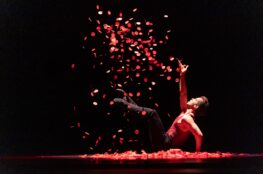
Giselle spares Albrecht, using her newfound power for good. And here, the wilis are Giselle’s senselessly killed friends, family and neighbors. Pink exchanges a virginal corps of women in fluffy, romantic tutus for a zombified cluster of men and women dressed in simple white, drapey garbs who dance swirling, contemporary vocabulary around Albrecht. Hackbarth is the only dancer who keeps her pointe shoes on, elevating her both literally and figuratively amongst the group. That feels weird given how differently she died. And with Albrecht as the only visible target, the community’s killers are notably absent from the second act. Maybe it makes sense to spare the one guy who showed them kindness, but we’re left wondering if he (and others who perhaps inadvertently find themselves on the wrong side of history) could have done something different.