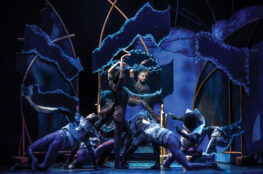


Switzerland is a psychological thriller, a character study, an examination of the end of life – and an important moment for the play’s director, Laura Gordon. The longtime Milwaukee actor and director is returning to the theater for the first time since her husband Jonathan Smoots’ death in March. Smoots was a co-founder of Next Act Theatre, its first artistic director and an actor at nearly every local company – the couple has been a cornerstone of Milwaukee’s theater scene for over three decades.
We spoke to Gordon about the new show at Renaissance Theaterworks, grief and the importance of theater.

Check It Out!
Switzerland follows Patricia Highsmith – the novelist behind The Talented Mr. Ripley and Strangers on a Train. What interested you about this story?
The play takes place in 1995, the year Highsmith died, living alone in Switzerland. She’s visited by a young man from her New York publisher, who is trying to get her to write one more Ripley novel before she dies. The playwright, Joanna Murray-Smith, captures not only the character of Patricia Highsmith but the way she writes. The play almost feels like it could have been written by Highsmith.
She was a complicated person with a lot of really unpleasant traits. She was antisemitic; she was racist; she was homophobic though she was a lesbian; she was acerbic. She had a very troubled childhood; you see this in her characters. But she was also very funny, and in the play that’s what you hook onto right away. The relationship between her and this young man forms and changes throughout the play and is very intriguing.
What is it like to return to the theater after Jonathan’s death?
When Jonathan was diagnosed [with Stage 4 pancreatic cancer], I cleared my schedule. We went to the state of Oregon because he was terminal. Oregon has this law, [the Death With Dignity Act that allows terminally ill people to end their lives], so we went to a doctor there.
When I first got home after his death, I couldn’t read. I couldn’t concentrate. I couldn’t follow a narrative. I just watched cooking shows. That was about six weeks before I began to be able to read again. And then this came along, and I began to read Patricia Highsmith. This has been a great way to get back to work, while still having the time I need to take it all on and go forward.
What are you looking forward to audiences experiencing at this play?
It’s always a good sign when the more you read the play, the more you like it. The more you read, the more it reveals. On one level, it’s this psychological thriller, this character-driven story that’s also very funny. But I also – and I think this might be coming to the surface for me because of what I recently experienced with my husband – this is a play about a woman at the very end of her life. For me, the ending of this play resonates in a strong way. She’s reflecting on who she is and the choices she’s made.
See Renaissance Theaterworks’ Switzerland, Oct. 19-Nov. 9 at Next Act Theatre, rtwmke.org.