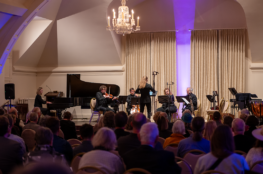


Julia Holter’s songs are steeped in a whirlpool of musical influences – from classical to jazz to pop to electronic avant-garde. As a result, her music is amorphous and ambitious. This hard-to-define sound has earned her critical acclaim and a dedicated fanbase. It’s also why Present Music tapped the Los Angeles singer and composer for its season finale concert “Baroque Pop!” on May 25 at the Milwaukee Art Museum.
The concert will be Holter’s first in Milwaukee, where she was born and spent the first six years of her life. She’ll be joined by her partner and experimental composer Tashi Wada. We asked Holter and Wada about genre, harpsichord, what it’s like playing together and returning to the Cream City.

Check It Out!
How did this collaboration with Present Music come about?
Julia Holter: Eric (Segnitz, Present Music co-artistic director) just wrote me and asked if I wanted to be involved in some kind of concert. (He) had this idea of baroque pop – a good example might be the Beach Boys. It’s not necessarily something I’m aware of as a genre so deeply, but there’s an idea that I’m a songwriter and I work with instruments in ways that people think of as chamber pop. I also use a lot of harpsichord sound in my music.
Also, Eric had originally wanted to incorporate Alex Temple’s Behind the Wallpaper cycle that she wrote for me to sing that has some poppy elements. It’s a string quartet and voice piece. And now Tashi also is a part (of the concert), and his last record has harpsichord and incorporates Baroque tuning, actually. And we will actually be playing on a harpsichord, which is very exciting for us.
It seems like the idea behind the concert is to stretch the term “baroque pop.” I feel like it arose with the Beach Boys as way of saying there’s these arranged elements to a pop song. But the program seems to analyze what “Baroque” and “pop” actually mean.
Tashi Wada: I would say one thing from my side with that term. I work with a lot of historical tunings and alternative tunings, some that come from this period of Baroque. There were a lot of different tuning systems that people were using, specifically meantone tunings, and there’s a richness to the harmony of the music. And I think for me, there is some correlation between Baroque and pop music beyond the signifiers of harpsichord and certain instruments and timbrel sounds. You could draw a connection in terms of the harmony. If you think of the Beach Boys and their vocal harmonies, they’re quite thick and almost Baroque, you could say.
The concert will end with Tashi joining with bagpipes, drones and those unique tunings you mention. What inspired the tuning system on your new album, and what response does that invoke for you?
TW: On my latest album What Is Not Strange, I was working with a tuning based on one proposed by the composer Jean-Philippe Rameau. What I find interesting is (it’s) not equal temperament. This gets into more music theory talk, but when you modulate around keys with chords, the qualities of the chords change, so the steps between the pitches aren’t the same as you go up or down. I find that to be very rewarding and interesting to work with.
Say you had primary colors, and then you started mixing the colors together, and then you had more and more shades. This opens up a whole world. And it’s just kind of sitting there – (Rameau) just laid this out. And there are thousands of tuning systems from around the world.
Julia, you first performed Alex Temple’s Behind the Wallpaper with Spektral Quartet in 2015. Will this be your first time performing it since the studio recording in 2023?
JH: Yes! It will be fun to revisit because it was challenging for me to learn, just because it’s written very well for my voice. I’m not a classical singer, so I have certain limitations. (Temple) did a really good job of working with what I could do as a vocalist. But singing with a string quartet, singing someone else’s music where there are very precise rhythms – they’re not crazy complex, but it’s a different thing from what I usually do because it’s written very specifically, note by note and not improvised at all. I have to pay attention to every little detail. Now that I’ve learned it, it’s a lot easier and more fun. (This concert) will also be with new players. It’ll be different if you’re playing with different people. Theo (Espy) from Spektral Quartet is joining us, though.
Your voice is such a defining element of your music, but it didn’t start out that way. What gravitated you toward using your voice?
JH: I think I was always interested in singing, but I didn’t take it very seriously. And then when I discovered that you should be able to enjoy making music, I realized that I should let myself sing. I think it’s that simple. I enjoyed singing. It was not on my agenda of what I wanted to do because I wanted to be a serious artist, and I thought that singing wasn’t serious, which is sad.
You’ve said in other interviews that intuition guides how you compose music. Considering how this concert plays with genre labels, do you ever think about genre when writing music?
JH: Genre is always tough for me to think about when I’m writing because it feels very limiting. I might think about it as things develop a little more, like how this sits or what not. I like to make things where I don’t really know what it is I’m making. I like to go in with a blindfold and be like, “What’s this that’s happening?”
As partners, what’s it like to perform with each other?
JH: Never thought about it like that.
TW: I mean, we’ve been performing together for a long time, even before we were in a relationship together. I also performed with my dad (Yoshi Wada) for many years, so that kind of familial working with people who are in your everyday life feels normal to me. But if I was trying to step out, I would say there’s a trust and an ease. You can get to the good place when you’re on stage easily, where it’s playful and you’re in it and you’re not concerned about extraneous, technical things. You can kind of just jump in and have fun with it, which I think comes with that closeness.
Will you rehearse for the concert?
JH: We’re gonna have several rehearsals in Milwaukee. And Tashi and I have played each other’s music for years now, so that is solid.
TW: We did one thing in preparation. We have a friend, Sepand (Shahab), who is a harpsichord specialist here in Los Angeles, where we live. So we bugged him, and he let us try out some of our music on a real harpsichord and showed us some little tricks. It’s a quite different instrument when it comes down to it. It has a keyboard, but it’s just very, very detailed – the sound. We wanted to make sure we’re not embarrassing ourselves and that the things that we do on our keyboards with harpsichord sounds actually translate to acoustic harpsichord. For the most part, it does, but it’s a different way of playing. I was finding that it made me want to play slower, which was cool, because the acoustic sound is very interesting and has a lot of character. The digital or electric electronic sound has an evenness that’s predictable.
Is the harpsichord what you’re looking forward to the most?
TW: Yeah, and the string players. We’re in the world of, generally when we’re performing, everything’s plugged in and dialed in. The fragility of something like harpsichord and strings, and the humanness of that sound is appealing, maybe especially right now.
Julia, this concert is billed as a sort of homecoming. How would you describe your connection to Milwaukee and the Midwest?
JH: I moved from Milwaukee when I was 6, so I was pretty young. One of my best memories of it was going to Lake Park. I’m excited to go there again. I went to some nice schools there, too, and I had some good friends there – one of whom I’m still in touch with. And I have memories of Downer Avenue and the (Harry W. Schwartz) bookstore there. They’re positive memories. The part of the museum we’re playing in wasn’t there when I was a kid, so I’m excited to go and see it. I moved in 1991, so that was a long time ago. But my dad is from Minnesota, and so I’ve gone there many, many times in my life. I also went to school in Michigan. I’ve spent 10 years of my life in the Midwest, basically. So yeah, that’s a good portion of my life, I’d say.