
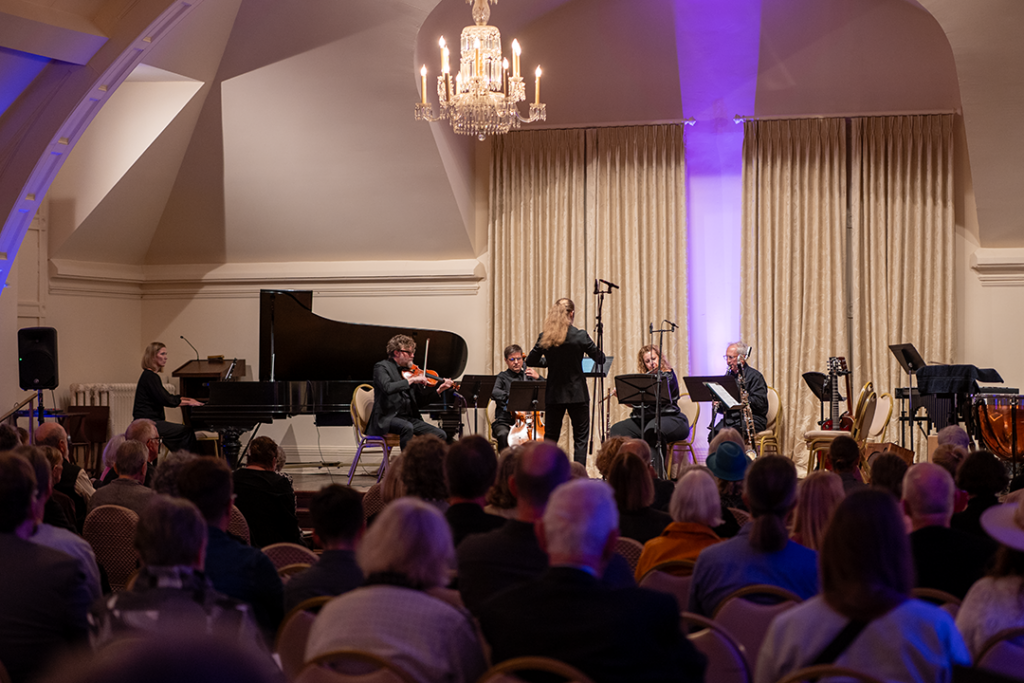
Thursday night’s “Composed for WCW” at the Woman’s Club of Wisconsin grew from a seed planted together by Present Music, Luna Composition Lab and the Woman’s Club of Wisconsin. The three Milwaukee-area groups worked in harmony to unearth new works with “inclusive programming for emerging talent” through “mentorship for young female, nonbinary, and gender-nonconforming composers.” Featuring three world premier performances, Thursday night was a trio of celebrations: the 150th anniversary of Woman’s Club of Wisconsin, the 45th season of Present Music, and the 10th anniversary of Luna Composition Lab.
My first thought upon exiting the misty evening and entering the luminescent Woman’s Club of Wisconsin was “I’m glad I wore a blazer over this black tee.” This was indeed a formal affair, despite the program’s promise for a “musical Rubik’s cube” and its younger generation of composers on the docket. I was received warmly by the staff and directed to ascend the staircase to the left or the right. As I mulled the proper ascension, a helpful staff opined, “Left is always better.” I concur and make my way to the lovely, historic ballroom, which feels enriched by the ghosts of a complicated past.

Check It Out!
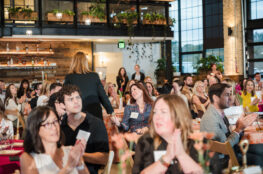
Carrie Matteson, president of Woman’s Club of Wisconsin opened this night of triple celebration by reminding the audience how the WCW opened its doors before women in America had received the right to vote. Matteson reminded the crowd that “generations of people have come through these doors to feel grounded, to find connection and to gather the courage to make a difference.” Both Matteson and Eric Segnitz, the Artistic Director of Present Music, spoke warmly of the efforts of the recently deceased Dan Petry, who helped to sow the seeds among the three organizations. Matteson concluded the speech by saying: “We hope you leave tonight not only inspired by the music but with a sense of belonging and a belief that your voice, at every age, can help shape what comes next.”
Conductor David Bloom led the ensemble of musicians, supported by David Vartanian’s sound design. Three emerging composers introduced the world premiers of their works while two established composers’ pieces rounded out a program of celebration for the three organizations. Below are an amateur’s impressions of the experience and of each performance.
Missy Mazzoli, “Ecstatic Science” (2016)
As a three-time Grammy-award winning composer and co-founder of Milwaukee’s Luna Composition Lab, Mazzoli walks the walk as a mentor to young composers. Thursday’s performance of “Ecstatic Science” took flight like a parade of butterfly-driven ambulances, soaring above traffic to deliver treatment. Voluminous Varèse sirens seared through strings of violin pulled like saltwater taffy delightfully near the breaking point before gently replacing the rug that had been pulled from beneath our feet. While the piece took turns at alarm, with dynamic leaps posing realities filled to the brim with both unease and ecstasy, ultimately Mazzoli’s “Ecstatic Science” sent us soaring.
Olivia Bennett, “In the Garden Walls” – World Premiere
Bennett introduced the piece, citing recent “experience restoring a historic garden on a castle estate in Scotland” as inspiration for Garden Walls. If these Garden Walls could talk…perhaps their opening salvo sounded much like the sky unzipping to reveal a flute fluttering queasy question marks in place of the birds we saw just moments ago, rummaging through the garden for emerging worms. Is history after us? Are we out to get history? Who’s the bird, who’s the worm? The piece continues its questions, rounding corners to unseen plights of percussive crescendo, sneaking up on us all before concluding with an ultimate mark of question, eliciting gasps of appreciation from the audience.
Zola Saadi-Klein, “hopefully see you there :)” – World Premiere
The title, “hopefully see you there :)” draws from the last words that Saadi-Klein’s mentor wrote and this composition serves as a tribute to Sarah Elizabeth Gibson, whom Saadi-Klein thanked for “wisdom, whimsy and imagination.” The piece enters as a gentle storm that uproots your neighborhood’s trees in near silence, the wood eventually peeled from the bark by a wind so subtle you mistook the incoming cyclone for a pirouette. The performers transcended their seated positions at the head of the ballroom as the piece accelerated to its midsection, punctuated by a sudden “hey!” from someone on stage. The storm continued as the violinist tore through strings like tiles de-thatching from a roof. For an extended moment, composer David Bloom remained completely still, his direction either understood, telepathic, or perhaps unnecessary. Meanwhile, the percussionist played soft to the edge of non-extant, the act of thrift delivering swift notes of implication before giving way to gentle thunder bedrocking the violinist, who: coaxed pitch so high, so, fine that appeared to be playing air. An exultant hand raised from the crowd as the piece came to an end, though I suspect the piece continues for Gibson elsewhere, beyond our grasp.
Alex Temple, “7x7x7” – World Premiere
“This new work weaves variations of the number into a musical Rubik’s cube: seven-note chords, played seven times, seven instruments.” Temple introduced the piece with the following caveat: “The problem is, the risk is that people listen technically and analytically”, but Temple suggested that “feeling is a type of understanding,” and encouraged the crowd to listen openly. Thankfully, I am fine with feeling for understanding and having failed college algebra, discovered I can live with or without mathematical understanding. Back to Temple’s serpent of sevens, I felt some swing, an energy nearer to jazz at times, that would suddenly flit away into a huff of heptagons, to electric guitar licks, to a place of all-night macrosevens, where we go for technical feelings, to analyze understanding and return six more than we once were. Also, if you haven’t already heard, Temple’s interview on Dr. Sushi’s Free Jazz BBQ on WMSE this September 15th was exquisite and includes more of Temple’s music.
Liz Carroll, “A Tune for the Girls” (2002)
Wrote to “celebrate the musical powerhouse of women…it has become an anthem for women in the traditional fiddle scene.” Steeped in Irish traditional style, the piece “celebrates the composer’s work with String Sisters, a supergroup featuring six of the world’s leading fiddlers across Celtic and Nordic music.” This piece brought a decidedly uptempo, rollicking finish to the program, delivering on its promise to be a “barnstormer.” This particular arrangement (by Kurt Cowling) was inspired in part by a Steve Reich piece called “Violin Phase,” and had the crowd clapping in time as the performers unleashed their evening’s enthusiasm on this triumphant conclusion to a night of celebration, composition and community.