


In the last year, immigration issues have dominated news cycles. The number of undocumented immigrants in the United States had reached a record high of 14 million in 2023, and immigration was a key factor in Donald Trump’s election. The president moved quickly in his second term.
On the first day, among other immigration decrees, he signed an executive order calling for an end to “birthright citizenship” for babies born on U.S. soil – a right that has been recognized since the 14th Amendment was ratified in 1868. The following year brought increased enforcement including surges of masked federal agents to major cities – Los Angeles, Chicago, Minneapolis.

Check It Out!
A century ago, Milwaukee was forever changed by the influx of Germans, Irish, Polish and Italians. In the 21st century, the city is again being transformed by immigrants, particularly from Mexico and Central America. While Milwaukee’s overall population fell in the 2020 census, the Hispanic/Latino community grew by about 8%.
Behind every statistic and policy change is an immigrant mother, father, grandparent or toddler who calls Milwaukee home. Here are a few of their stories in this moment when issues of migration are front and center.
Due to the sensitive nature of the topic, some sources in these stories, are identified by pseudonyms or their first names only to allow them to speak openly.
Santiago & Isabella
IN ANOTHER LIFE, decades ago, Santiago and Isabella were 16-year-old sweethearts in Mexico City. Before long, they had two children and their jobs – when there were jobs – paid little. The future looked bleak. So they crossed the Rio Grande with their kids and made their way to Milwaukee, where Isabella had relatives.
Santiago found work at a small factory and has been there ever since, almost 30 years. Isabella has had a range of jobs, many in manufacturing. They have worked hard and saved enough to buy a modest home.
More than at any time he can remember, Santiago knows that all he has could disappear. But he long ago decided that he could not live his life looking over his shoulder in fear. “I’m worried, but fear – real fear? That’s gone,” he says.
Immigration Info
The term immigrant includes all residents who were not U.S. citizens at birth – those who have become U.S. citizens (Elon Musk, for example), those with legal papers (such as refugees) and those without legal papers.
There is, of course, a caveat. His two adult children have intermediary status through the Deferred Action for Childhood Arrivals (DACA) program. His two grandchildren were born in the United States and are thus U.S. citizens. His main concern, he says, “is that they might send me or my wife away and separate the family. … It’s the only thing that would affect me right now.”
Santiago has dreamed of getting papers to work legally. But his pathways are complicated, expensive and extremely limited. The last significant immigration reform was in 1986, when Ronald Reagan signed bipartisan legislation legalizing the status of nearly 3 million undocumented immigrants who had lived in the United States before 1982.

Santiago has seen presidential promises come and go, from both Democrats and Republicans. “Obama said, ‘I am going to fix those who have been here for 10 years, 15 years. I am going to give them a work permit,’” Santiago says. “He proposed it, he became president. And what happened?”
Santiago has learned to navigate the intricacies of life as an undocumented person. He’s never been arrested. For many years, he had a Wisconsin driver’s license, but the state ended that with a law passed in 2007. He and his wife drive carefully – very carefully – and he keeps his head down, focused on work and family.
Of the 80 or so people who work with him at the factory, Santiago says that almost all are undocumented, and the owners know. “Thank God, we have never had a problem,” Santiago says. “Never, never, never.”
Isabella, meanwhile, worries enough for both of them. “I am one of those who spends time watching news, to inform myself,” she says.
“We cannot take it lightly,” she adds, and is apprehensive that ICE raids will descend upon Milwaukee. “I know that one day they might be here, as they have been in Chicago or Los Angeles.”
Immigration Info
All babies born on U.S. soil are considered citizens, based on the 14th Amendment. The U.S. Supreme Court has agreed to rule on President Donald Trump’s executive order claiming to end birthright citizenship; a decision is expected this summer.
The Dreamers
FERNANDA, A 25-YEAR-OLD Mexican immigrant, is a “Dreamer” – the term for young immigrants with legal status through the Deferred Action for Childhood Arrivals program (DACA). But her dreams go beyond immigration policy.
“There’s a famous phrase, ni de aquí, ni de allá – ‘You’re not from here nor there,’” says Fernanda, who helped found the youth activist group Comité Sin Fronteras. “I hate that saying because it really makes you feel like you belong nowhere.
“A lot of us in Comité have changed that narrative,” Fernanda continues. “We’ve said, ‘No, we are from here and we are from there – de aquí, de allá – and that’s OK.’”
That disdain for borders stems, in part, from the particularities of the DACA program, which forces young immigrants to live in a legal limbo and, for Fernanda, to look for belonging in ideals and friendships, not necessarily citizenship.
Mario, another Comité member, is particularly clear that he sees himself as a global citizen, concerned not just with immigration but also climate justice. Would he like to return to Mexico someday? “The air I breathe has never come out of my lungs and told me to go home,” he says. “So no matter where I am in this world, I’ll always be home.”
Comité Sin Fronteras comprises young adults and is an offshoot of the immigration rights organization Voces de la Frontera. Four Comité members gathered for an interview last fall. They are all in their 20s, from “blended” families with undocumented parents. They have the energy and ideals of youth and are unafraid to publicly speak out – the day of the interview, the Comité had helped lead an anti-ICE protest. They describe the community they find in Comité as an antidote to the fear among many of the undocumented people in their orbits.
Immigration Info
Immigrants account for about 12% of Milwaukee residents, 11% of Milwaukee County residents, and 5% of Wisconsin residents. Latinos/Hispanics account for about 20% of Milwaukee residents.
And they are all Dreamers. The DACA program was created in 2012 to protect undocumented children who entered the U.S. at a young age. There are roughly 525,000 DACA recipients in the United States, and 5,300 in Wisconsin. Since late 2017, the government has not processed new DACA applications.
Those in DACA can get a Wisconsin driver’s license and a Social Security number that allows them to work legally. But Wisconsin does not grant in-state university and technical college tuition for DACA recipients, which limits post-high school options. More significant, DACA does not provide a path toward citizenship and is perpetually on the verge of being ended, potentially exposing DACA immigrants to deportation.
The four Dreamers from Comité emphasized that they are inspired by their parents who, even without legal status, have built a life in Wisconsin. “Growing up, my dad said, ‘Hey, you know, whether there’s reform or not, a pathway to citizenship or not, we’re still here,’” Fatima says. “‘We can still make it.’”
Laisha has also been influenced by her parents, who in turn support her activism. They worked low-wage jobs, never complaining, to raise her and her siblings.
“Why,” Laisha asks rhetorically, “why wouldn’t I fight for them?”
Immigration Info
Almost half of all immigrants are naturalized U.S. citizens. Almost a quarter are lawful permanent residents, about 4% are lawful temporary residents, usually due to their jobs or studies, and about 27% do not have legal papers.
Elena
“WHY WERE THE Federalist Papers important?”
“James Madison is famous for many things. Name one.”
“When did all women get the right to vote?”
Such questions, perplexing to even high school civics students, are in the new and more difficult U.S. citizenship test.
Elena, a graduate of South Division High School and of Mount Mary University in 2016, entered the United States from Mexico, undocumented, as a toddler. She hopes to become a U.S. citizen, and answering enough of those questions correctly is the least of her worries.
Given the backlog and chaos in all things immigration, she considers herself fortunate. This fall – a quarter-century after she entered the United States, five years after she married a naturalized citizen, and three years after receiving her green card granting legal residency – she plans to apply for her citizenship test. She’s keeping her fingers crossed the test will be in 2027.
Immigration Info
Roughly 52 million immigrants lived in the United States as of June, accounting for 15% of all residents. About 22% of immigrants were born in Mexico.
When people wonder why undocumented immigrants don’t just “get in line” and apply for legal status, Elena is bewildered. “It’s a flawed system that we have,” she says. “Everybody’s saying, ‘get in line.’ The line is nonexistent at this point.”
The U.S. immigration system, long viewed as a Kafkaesque maze, has gotten worse. Staff shortages, funding shortfalls and regulatory changes led to a record high in 2025 of 11.3 million pending applications for people seeking to remain in the U.S., ranging from green cards to work permits to employment-based visas.

Overall, there are roughly 185 types of U.S. visas. Due to quotas, to cite a particularly egregious example, there have not been visas issued for F4 applicants (the siblings of U.S. citizens) from Mexico since 2001.
Elena’s parents, both undocumented, applied four years ago for a U-visa, granted to crime victims helping authorities. She estimates it could take over eight years for her parents to know if they get the U-visa.
Elena wants to have children and start a family. Green cards can be revoked, so she has pulled back in publicly advocating for change. “It’s a huge risk to put yourself out there,” she says, “just because of how this administration is targeting those who speak up.”
Elena grew up on the South Side, where her neighborhood felt like family. “I feel like we’re losing that,” she says. “Right now, there’s just a lot of fear.”
Immigration Info
The number of people detained by ICE jumped to a record 65,735 last November, up from about 39,000 in January 2025. More than half had no criminal conviction.
Jorge Franco
JORGE FRANCO, HEAD OF THE HISPANIC Chamber of Commerce of Wisconsin, sees one main reason for the increased Hispanic vote for Donald Trump in 2024: the economy. “That roaring economy back in Trump’s first term was just amazing,” he says. “And we, both authorized and unauthorized Hispanics in Wisconsin, would give anything to have that back.”
So many people, and not just in the Hispanic community, “want to see a new tomorrow,” he explains. “The president did a very good job of getting a message out to those individuals.” Beyond that, especially when it comes to immigration, hard and fast conclusions are difficult. “It’s complicated, deeply complicated,” he says.
Franco sees both sides of the debate, both locally and nationally. In addition to his current role, he is a former chairman of the board of the U.S. Hispanic Chamber of Commerce, and remains active in national coalitions. Although he prefers the term “unauthorized” for undocumented immigrants, he understands why some call them illegal. “They are here illegally,” he says. “And that’s a problem.”
The chamber doesn’t ask members their status, nor does it keep a tally on who is a Democrat, Republican or independent. “We help and serve everyone who walks through the door,” he says. Franco is sure that some of his members agree with Trump, who “very openly and candidly announced” his immigration agenda and deportation plans. He is equally sure that others do not. “It’s really, really disheartening to see people being physically detained against their will,” he says.
Economically, Franco also sees both sides. “There are costs to having unauthorized immigrants here, and I empathize with the taxpayer,” he says. At the same time, if unauthorized immigrants “were gone tomorrow, the ag and dairy industries would tank and take down the Wisconsin economy along with them.”
Franco estimates that there are more than 20,000 Hispanic-owned businesses in Wisconsin; the HCCW had about 1,000 members before the COVID pandemic and is rebuilding toward that number. It provides a range of services to businesses such as loans and consulting but also has programs in workforce development, provides scholarships and engages in advocacy. Franco has little doubt that his members include business owners without legal status, although he doesn’t know how many.
There are no magic answers on the immigration issue, but Franco is hopeful that in the foreseeable future there will be bipartisan “baby steps” toward reform. One possibility: that unauthorized immigrants who have not committed any violent crime be allowed to pay a fine. They would not automatically be citizens, but they would receive legal papers.
As for predicting when there might be comprehensive reform, Franco says, “That’s beyond my pay grade.” First, people need to become weary of hard-and-fast positions. At that point, he says, “we’ll be forced to come to the table with each other.”
Immigration Info
The Trump administration has set a cap of 7,500 on refugee admissions for the fiscal year that ends Sept. 30, a record low, and reserved most of the slots for white Afrikaners from South Africa.
Soraya
AS AN AFGAN WOMAN,Soraya has learned to be resilient in the face of precarious political circumstances, both at home and now here in Milwaukee. She remains hopeful she will be granted asylum to remain in the United States and will not be forced to return to life under the Taliban.
“I have high hopes with the case that I have,” says Soraya. “I have a lawyer that will represent me, and I speak English, and returning home would be very dangerous.”
At just 28, Soraya already has a lifetime of experiences. Her family fled to Pakistan after the Taliban seized Kabul in the late 1990s and returned after U.S.-backed forces gained control in 2001. Soraya finished the equivalent of high school, but as a woman and a member of the Hazara ethnic minority, her future was limited. She earned a scholarship to a women’s university in Bangladesh, graduating in 2023. But by then, U.S. forces had withdrawn from Afghanistan and the Taliban once again had control of Kabul.
“I spoke with my mother and asked, ‘How do you feel if I come back home?’” Soraya recalls. “She said, ‘I wouldn’t feel safe, you coming home as a young, Westernized, educated Hazara woman speaking English.’”
Soraya looked elsewhere to continue her education. As the result of determination, grit and good fortune, she was accepted into the master’s program in sustainable peacebuilding at UW-Milwaukee, graduating with honors last May. She applied for asylum shortly after arriving in the United States, and as a result is lawfully present until that application is adjudicated. But she has no date for her asylum interview, nor a sense of when she might get one.
Late last fall, the Trump administration halted decisions on all asylum applications, regardless of nationality. Immigrants from selected “third world” countries, meanwhile, including Afghanistan, are no longer eligible for the “temporary protected status” that shields them from deportation.
Soraya, who is fluent in three languages and conversant in four more, has a smile and upbeat attitude that masks the pain of separation from her family.
She is close to her mother and hasn’t seen her in five years. Nor does she know when, or if, she will see her again. “When I think about that, it’s heavy here,” she says, putting her hand on her heart. “There are times that I’m like, ‘I haven’t done anything wrong. Why cannot I live a normal life?’
“I do not like politics in general, not just in my country,” Soraya says. Policymakers and bureaucrats craft laws from on high, with great impacts on people very distant from those decisions. “They are not part of it, but it applies to them,” she says.
“You know, no one would ever leave their country unless they didn’t feel safe,” Soraya says. “I am grateful to be here, but I love my country and our culture, and if my country is ever back [to] normal, I want to go right back. I wish the Taliban were gone.”
Immigration Info
Stephen Miller, a key architect of Trump’s immigration policies, has called for arresting about 3,000 immigrants a day and deporting roughly 1 million immigrants a year.
Rev. Javier Bustos
IT’S SUNDAY EVENING, and hundreds of people are gathered at Holy Apostles Catholic Parish in New Berlin. The Rev. Javier Bustos, who leads two parishes on Milwaukee’s South Side, is speaking on immigration.
Father Bustos makes clear he will not talk politics but will focus on Catholic Church teaching. Speaking as a theologian – not as a lawyer in a U.S. courtroom – he unequivocally states that church teaching “is crystal clear,” with its focus on justice and the common good.
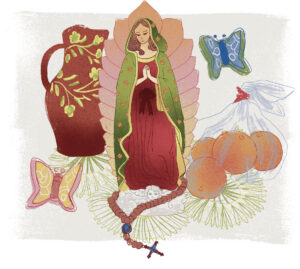
Venezuelan by birth, Bustos came to Milwaukee almost 30 years ago. It is not an unusual trajectory – roughly a quarter of priests serving in the United States are foreign-born, and a significant portion are on temporary religious visas.
Bustos studied moral theology in Rome for four years, then returned to Milwaukee. He currently teaches at Sacred Heart Seminary in Hales Corners and leads two South Side churches, Blessed Sacrament and Our Lady Queen of Peace.
The Catholic Church has long recognized the right to migrate, a concept which dates to the Old Testament, Bustos explains in an interview at the Blessed Sacrament office. The church also believes that countries have the right to regulate their border. And they are responsible for promoting the common good – but for both migrants and citizens.
“Right now, there are people who have been in the United States for 30 years,” he says. “And, for one reason or the other, they are here undocumented. But they are hardworking people. They are really good for this community. They are not criminals at all. And I know some people would say, ‘Oh, wait, wait, wait a minute, Father. The minute they cross that border there, they are criminals.’
“Well, not really. Not really,” Bustos says.
In explaining Catholic teaching to the parishioners at Holy Apostles, Bustos cites St. Augustine, the fifth century theologian who laid out essential church views on “just law.” He also notes a more contemporary example: the Rev. Martin Luther King Jr.’s case against Jim Crow laws. For a law to be a law, Bustos tells the group, “it has to contain truth. … When a law lacks truth, it lacks the most important aspect of the law, which is justice.”
Immigration Info
Almost 40% of undocumented immigrants are the result of people overstaying their visa.
Nationally, more than a third of U.S. adult Catholics are Hispanic, and roughly a quarter of parishioners in the Milwaukee Archdiocese, according to Bustos. In an indication of the importance of immigration issues, several hundred people – including two local bishops – gathered on Oct. 22 at Cathedral Square in Downtown Milwaukee as part of a nationwide “Catholic Public Witness For Immigrants” supported by the U.S. Conference of Catholic Bishops.
In November, meanwhile, U.S. Catholic bishops overwhelmingly passed a resolution opposing the “indiscriminate mass deportation of people.”
“To our immigrant brothers and sisters,” the statement read, “we stand with you in your suffering, since, when one member suffers, all suffer (1 Corinthians 12:26). You are not alone!”
For those gathered in New Berlin, Father Bustos chooses a more Socratic method. After presenting a series of “myths vs. facts” on immigrants, he reiterates that “an unjust law is not the law at all.”
“The question I’m going to leave you with: Is immigration law unjust?”