

There’s nothing like your 200th (or so) Messiah.
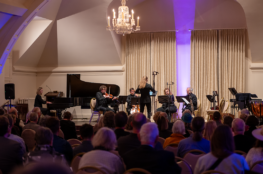
That’s about how many times Nicholas McGegan figures he’s conducted the iconic 1742 orchestral work by George Frederic Handel, known for its ecstatic “Hallelujah” chorus. The 18th-century music specialist will add to that total when he comes to Cream City to lead the Milwaukee Symphony Orchestra in three performances at the Bradley Symphony Center from Nov. 21-23.
Performing Handel’s Messiah is an on-and-off holiday tradition for the MSO, as it is for many orchestra across the country, and it’s also part of a season-long 50th anniversary celebration of the Symphony Chorus. This will be McGegan’s third time conducting the Messiah at MSO’s new hall. His first time conducting in Milwaukee? That would be 1985, the year he became music director of the Philharmonia Baroque Orchestra in San Francisco, a role he served until 2019.
McGegan talked with us about returning to Milwaukee, what he enjoys about Messiah, and how he keeps the piece feeling fresh after performing it for decades.

Celebrate this year’s winners of the Betty Awards!
Why do you feel like Handel’s Messiah is a piece that has resonated during the holiday season?
Let’s start off with the fact that Handel never intended it to be done at Christmas. It’s an Easter piece. In fact, about two years ago, I conducted it on Good Friday in Dublin, which is the day and the place he gave the first performance. It’s more about the passion of Christ, and the suffering, the crucifixion and then the resurrection. It’s partly because Christmas is a good time for celebration. People like to sing, people like to take families to concerts, and if they’re not going to Messiah, then maybe they’ll go to The Nutcracker. So it’s become, in English-speaking countries, part of a Christmas tradition. There’s nothing wrong with that! It’s just not how it was intended.
Beyond the holidays, Messiah is one of the most revered oratorios (sacred, dramatic choral works). What in the piece lends itself that status?
There is, of course, the music, but it’s also the words. Handel sets the words much less elaborately than he does, say, in an opera or his other oratorios. It’s an unusual piece in the sense that most of the oratorios have dramatic roles with names. There are no named characters in Messiah. The story is dramatic, but it’s not being told through characters, which is what Handel usually did. The chorus, for example, only twice gets to sing in character – once as angels in Bethlehem, and once as people mocking Christ on the cross. Every other time, it’s all comment rather than drama.
So Handel doesn’t put too much in the way of understanding the words and appreciating them. He doesn’t have very elaborate orchestration, except for pretty obviously the trumpet sound. [The audience in that time] went for the amazing virtuoso singing, very different from people going to Messiah to have what you might call a religious experience.
One thing that’s very important about it, which is why it’s so good to be doing it with symphony orchestras, is that Handel almost never did it in a sacred space. It’s not a churchy piece at all. Actually, secretly, it’s Handel knowing how to make money because theaters were closed during Lent. They couldn’t do opera. The audience wanted to see things. The orchestra was otherwise unemployed. He saw a financial opportunity and took it. In the late 1730s, he was nearly bankrupt. By the time he died, he was worth 20,000 pounds, which is several million now, through doing oratorios in the Lenten season. He was a canny businessman.
What else is unique about the piece?
There are Handelian traditions, like the fact that people stand up for the “Hallelujah” chorus. This is because the King [George II of England] did. There are all sorts of reasons for that. Maybe he thought it was about himself. Someone said he simply had hemorrhoids. But when the king stood up, then everybody stood up. It’s a tradition that a lot of people still do. There’s no reason why, because a king did it, that anyone in America should do it, but they still like to. Some people even sing along, which is a little distressing (laughs).
How so?
Because they don’t know it as well as they think they do.
Has your approach to conducting the piece changed over the years?
Yes. When I’m conducting it, I don’t say to a singer, “You will take this speed,” or “You will do it this way.” I’m feeding off what those soloists bring to it, in the same way as if I was a stage director and I was staging a Shakespeare play. What could the actors who are playing this week bring to the table? What they like to perform, what their strengths are, how fast their voice works. Some of them are more dramatic than others, so it’s never the same.
Do you have a favorite moment in Messiah? Is there a particular section that comes to mind, or a motif?
The second act – that is to say, the passion part of it, the sad bit – is just so beautifully constructed. The way it goes from one chorus to the next aria, it flows beautifully up from the depths of despair. From the beginning right up to the “Hallelujah” chorus, that’s always a terrific journey to take. And then the third act, which is much shorter, is like dessert, really.
What’s life been like after stepping down from the Philharmonia Baroque Orchestra?
I don’t have to raise money, which is very nice. I don’t have to go to board meetings. I just have to make music, and that’s enough for me right now.
How do you feel about returning to Milwaukee?
Milwaukee is a great town, and I love the art museum. The collection’s wonderful, and it’s great on the water there. It’s a real jewel in the crown of Milwaukee. And of course, the new concert hall [Bradley Symphony Center] – the new old concert hall, I should call it – is terrific, too.
What feeling does Handel’s Messiah give you?
Well, obviously at the end, great joy. There’s nothing like conducting a “Hallelujah” chorus. It’s like conducting a disco piece. It’s also nice to constantly discover something new. I may have done it 200 times, but there’s always something you find that you haven’t noticed, or something that you’ve forgotten. A singer who does something new, that’s always great. If I felt that I was sticking it in the microwave, I would be doing a disservice to the audience.
Even if everything else is the same, the audience gives it a different energy. Even though I’ve got my back to the audience, I can sense what they’re like. An audience that doesn’t want to be there will make itself known. They suck the energy out of a room. Doesn’t happen very often, but just occasionally. On the other hand, an audience that’s right there gives you energy, and then it feels like a rock concert, you know?
And this piece has the tendency to get loud.
It’s good fun, yes. Everyone likes it. Everyone likes trumpets.