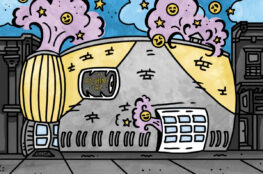


If familiarity breeds contempt, then Beethoven’s “Pastoral” symphony has to be one of the most hated of all the master’s oeuvre. It’s not so much that we know its dulcet strains better than the thunderbolt opening of The Fifth, or the “Ode to Joy.” But for folks of a certain age, showing after showing of  Fantasia has made visions of Disneyesque flora and fauna inseparable from the Sixth Symphony’s lilting melodies. I doubt Edo de Waart had Walt on his mind when he crafted his reading of the “Pastoral,” the centerpiece of the Milwaukee Symphony Orchestra’s first concert of 2015 this weekend, but his approach was a palate cleanser of the best kind, offering a thoughtful reading of the music that helped it cast off any cultural baggage still be hanging on in the 21st century.
Beethoven worked on his Fifth and Sixth symphonies simultaneously, and they represent near polar opposites of his musical ideas. While the Fifth is full of dramatic tension and rigorous development, the Sixth is built on an almost Zen-like faith in the power of simple melodies and ideas. De Waart embraces this simplicity whole-heartedly, and instead of pushing the music into hyper-romantic swooning, he calmly attends to the often repeating melodic motifs, bringing out the subtle shifts in color and texture that accompany each iteration of Beethoven’s lovely ideas. In the first movement, De Waart drives the orchestra into a slight accelerando in the final part of the second theme, but for the most part his tempos are easy, steady and—for lack of a better word—“laid back.” He doesn’t so much push the music as roll it gently across a dappled meadow.
Along the way, of course, there are chances for the musicians to shine. The strings are serene and lush, and the MSO’s superb woodwind leads–Flutist Sonora Slocum, oboist Katherine Young Steele, and clarinetist Todd Levy–play the frequent soli passages beautifully.
 There was no shying away from “Hollywood” in the other pieces on the program. Violinist Philippe Quint—a last minute substitution for the scheduled soloist, Daniel Hope—played Erich Korngold’s Violin Concerto with an Errol Flynn-like panache that was completely appropriate to Korngold’s movie roots (he made his career working on film scores after emigrating from Austria
just before World War II). Quint’s big sound (he plays a 1708 Stradivarius), impressive technique and liberal use of vibrato certainly pays homage to Jascha Heifitz, who premiered the piece in 1947. And his style is equally suited to Korngold’s angular, modernist lines and the composer’s love for lush romantic melodies. Quint got a well-deserved long ovation.
 Another part of California is the programmatic setting of the concert opener, the world premiere of Mason Bates’s Garages of the Valley. Although the piece was commissioned by three orchestras, it’s dedicated to De Waart, “who lived just north of the Valley when some of its garages were just starting to burst with energy.” Yes, that’s Silicon Valley, not the sylvan dales of rural Germany (De Waart lead the San Francisco Symphony in the late ’70s and early ’80s). Bates’s piece pays tribute to the tech and computer innovations that bubbled up from the garage workshops of the time. But any fear that the 17-minute piece would be a collection of aleatoric beeps and bloops (the sort of music computer buffs like Morton Subotnik created) disappear after the first few notes. Instead, Bates’s music is rhythmic, shimmery and generous on the ears. At one point, he evokes the dog-whistle electronic feedback of circuit boards using harmonic bowing in the violins. But for the most part, Garages is beautiful and celebratory. As it draws to a close, Bates tosses motifs back and forth between lush strings and subdued brass chorales, and you can almost feel the mellow computer-age genius percolating under the California sun.
The concert repeats tonight (Saturday, January 17) at 8 pm.