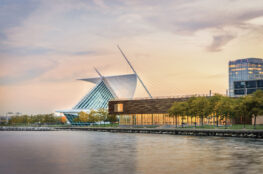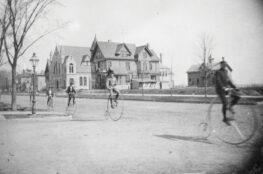


A single word describes Milwaukee’s Downtown lakefront in the early 1940s: quiet. Today’s beehive of activity was utterly undeveloped in the World War II era. Where Henry Maier Festival Park, the Milwaukee Art Museum and Discovery World now draw hundreds of thousands of visitors every year, Milwaukeeans of the day had only a few scruffy baseball diamonds and a shoreline of inhospitable rock.

Check It Out!
The lakefront was undergoing one of its multiple transitions when the shutter clicked on this scene. It had been submerged lakebed for centuries, but in the early 1870s, the Chicago & North Western Railroad began to fill in the lake for track construction and erosion control.
Trains gave way to planes in 1927, when Maitland Field opened as a landing strip for small aircraft. Six years later, with the Depression grounding local aviators, the lakefront became the home of the Milwaukee Midsummer Festival, a sort of proto-Summerfest that offered a week of free entertainment every year from 1933 to 1941, drawing more than 1 million patrons at its peak.
World War II brought the festival to an untimely end, and this aerial view documents the ensuing calm. The lakefront would come to life again, but at the leisurely pace characteristic of Milwaukee. Maitland Field reopened in 1945, only to be replaced by a Nike antiaircraft missile base in 1956. The War Memorial Center was dedicated in 1957, followed by Maier Festival Park in 1970, and then came a flurry of activity: the Art Museum’s Calatrava addition in 2001, Discovery World in 2006 and Lakeshore State Park in 2007.
It took a half-century, but the Downtown lakefront has been completely transformed. It is now a cultural theme park that has become one of the leading tourist destinations in the state, on land once used for nothing more ambitious than sandlot baseball.
TAKE A CLOSER LOOK:
- Completed in 1930, the Wisconsin Telephone Co. building was designed by prominent local architect Alexander Eschweiler.
- City Hall was the tallest building on Milwaukee’s skyline until it was eclipsed by the First Wisconsin (now US Bank) center in 1973.
- The Chicago & North Western depot dominated the east end of Downtown from 1889 until its demolition in 1968.
- Built in 1927, the Elks Club was razed in 1971 for the expansion of Northwestern Mutual’s campus.
- The Buena Vista Flats (1909, now The Cudahy) and the Cudahy Tower (1929) started a trend of luxury lakefront living.
IN COLLABORATION WITH MILWAUKEE COUNTY HISTORICAL SOCIETY