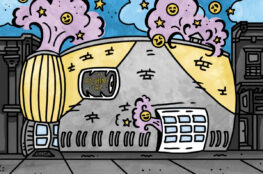
Consider the basement rec room, the site of many an Old Style vintage beer sign, well-worn pool table, and—these days—a sofa whereupon Xbox battles are raged. In the Milwaukee Chamber Theatre’s madcap production of The Complete Works of William Shakespeare (Abridged) [Revised], Steve Barnes’ rec room of a set is dominated by musical instruments—the stuff of an aspiring cover band working to put their personal stamp on classics by Aerosmith and Journey. Today, however, the guys have decided to fool around with The Bard. For an invited audience—that’s you and me—they are going to perform all of Shakespeare’s plays in the span of two hours—or enough that you get the gist, anyway.
Adam Long, Daniel Singer and Jess Winfield (otherwise known as The Reduced Shakespeare Company) first performed this play over 25 years ago, and have since turned the Complete Works… idea into something of a franchise, offering “complete” versions of world history, American history, the Bible and the “great books.” It’s no surprise that the idea has legs—it’s loose-limbed, improv-style comedy with a cultural imprimatur. And it’s a perfect vehicle for an imaginative comic mind like that of Ray Jivoff, who directed the show.
Playing on the “guys in the rec room” theme, Jivoff assembled a cast of old friends—who all graduated from the theater program at UW-Whitewater. Keeping with the spirit of the show, they use the script as a jumping off point—there’s a aura of free-wheeling improv throughout the evening.
And the cast has a ball. There are sight gags galore, hilarious improvised props, and the kind of subtle, imaginative touches that makes the show work on many levels. Listen to Marcus Truschinski’s hilarious accent as Romeo—as if Ridgemont High’s Spicoli spent a year abroad in Glasgow. Chris Klopatek plays Gertrude as half Real Housewife and half exile from Falcon Crest. Rick Pendzich uses heavy eye makeup to give his Hamlet the full Fall Out Boy emo vibe. And Chase Stoeger has great fun with his Ophelia hissy fits.
There’s plenty of audience participation, sexual innuendo, and local references—even including a few asides directed at the production of Wizard of Oz down the hall. It’s a delight for classical newbies and Shakespearean veterans, alike–both cozily familiar and full of surprises, even for those hard-core Bardologists who have actually seen a production of King John.
****
 There is almost nothing really surprising in Skylight Opera Theatre’s The Wizard of Oz. John Kane’s 1987 adaptation of the classic 1939 movie honors the dialogue almost word for word. The songs are all there, and there’s even a little bit extra—several of them include the seldom-heard introductions. It’s also no surprise that the cast—composed largely of local, non-equity performers—is first rate. We’ve seen many of them recently in accomplished Skylight productions (Hair, Les Miserables). Susan Wiedmeyer is a charming Dorothy, who sings a fresh and lovely version of “Over the Rainbow.” Ryan Cappleman is a deliciously lanky Scarecrow, Doug Clemons a sweet and tender-hearted tin man, and Andrew Varela has the comic chops and pipes to do justice to “The King of the Forest.” And the orchestra—lead by the impressively credentialed Leslie Dunner—sounds terrific: lively, tuneful and much “bigger” than its pared down numbers.
What is surprising—and it’s a major issue—is that this show lacks “style.” In its major incarnations—mounted by the RSC in 1979 and revived several times in big-budget touring productions—this stage Wizard had high-tech, high-budget glitz, which you would expect for a play based on a movie that is a masterpiece of design and—for its day—special effects. The Skylight has neither the stage apparatus—nor the budget—to wow audiences with gleaming emerald towers, aerial monkeys and crows, and the assorted pyrotechnics that makes the show a spectacle of itself.
A situation like that calls for a different kind of theater resources—imagination, “poor-theater” innovations, creative ways of helping an audience suspend its disbelief. But instead, director Linda Brovsky and her designers give us high-school-level attempts at big budget “stage magic” that makes it hard to get swept away by the familiar and engaging story. Peter Dean Beck has designed several Skylight productions, but the Wizard presents significantly greater challenges. Unlike a show written for the stage, The Wizard of Oz requires umpteen different locations and settings, and moving between them drags the pace of the show considerably. Kristy Leigh Hall’s costumes are generally spot on homages to the original movie, but how to explain the witch’s guards, the so-called Winkies, who bear the familiar imposingly Medieval spears, but are dressed in yellow raincoats and look like oversized minions from Despicable Me? Brovsky is new to the Skylight, and works primarily in grand opera, which might explain the show’s stiff acting and leaden pacing (the show clocks in just shy of a lugubrious 3 hours—despite the note on the Skylight website says it lasts 2 hours). The Sunday afternoon performance I attended included quite a few restless toddlers.
Can you really blame the Skylight for staging a “title” instead of a well-conceived, imaginative production? Like many local arts groups, it’s strapped by decreasing audiences, paltry government support, and declining contributions. The holiday shows that pop up here every year–The Nutcracker, A Christmas Carol, Rudolf the Red-Nosed Reindeer, etc. –aren’t just charming celebrations of the season, they are survival mechanisms. I have no doubt that The Wizard of Oz will draw its share of people—including many who are not regular theatergoers–looking for a wonderful night out with the family. But I hope they’ll come back and buy tickets to another Skylight show that offers a better showcase for that company’s considerable talents.
****
 There are no flying monkeys or tornadoes in Duetted and Connected, two short dance performances presented this weekend by Dan Schuchart and Monica Rodero. But these very different events—performed at Danceworks’ no-nonsense theater–offered razzle dazzle of a different sort—intelligence, honesty, psychological insight, and often breathtaking beauty.
Duetted featured Rodero and Schuchart in seven short pieces, most choreographed by the dancers themselves, but others by New York choreographer Susan Marshall, Wild Space choreographer Debra Loewen and former Wild Space dancer Suniti Dernovsek.
“Taped Hands” opened the program with a piece that might be a signature for Schuchart and Rodero’s work together. It starts as the couple holds hands, and then wrap several layers of masking tape around them. The dance that follows offers a devilishly more rigorous variation on the old jitterbug twirls and turns, with tension created and released with limbs looped over and under and twisted and released.
Much of the couple’s work explores the intimacy of contact, and the way meaning can change with the subtlest shifts of mood and perspective. Marshall’s “Sound” opens with an extended duet with Schuchart’s hand clamped down over Rodero’s mouth, the violent overtones slip into a series of primal screams—somewhere between joy and terror–and eventually the relationship turns intimate and tender with a kiss.
 The sense of connection turns profoundly beautiful with “Don’t Wake the Wind,” images of the couple sleeping peacefully, side-by-side, shift into short duets before resting again in silence. Then Schuchart moves into a different role, the leader of a physical call and response of sorts. While Rodero reclines on her side, his hand hovers above her knee, then flexes—and her leg rises to meet his palm. Then the shoulder, elbow, hip. Rodero is still feigning sleep, eyes closed, and Schuchart is like some sort of mad puppeteer. But the spirit is one of tenderness, not madness. And the connection is so charged–so precise, effortless, and yet invisible—that it evokes a kind of Platonic ideal of a human relationships. The fact that it is part improvised—if you listen closely, you can hear Schuchart quietly whispering one-word instructions—“shoulder”…”head”—makes it all the more remarkable and moving.
With the kind of grace and unity displayed in this program, one could easily title it “Connected.” But the second event presented this weekend was about a different kind of connections—between Schuchart and an audience. It didn’t take long for them to realize that this wasn’t your usual dance concert. A few minutes after Schuchart took the stage, I found myself standing in a large circle with the rest of the audience, massaging the shoulders of a stranger while another stranger massaged mine. During the next 45 minutes, I also found myself dancing to Vampire Weekend (“A-Punk” has a great beat for a “happy dance”), sitting on the floor listening to a poem about the hunger of absorbing every kind of experience in order to live fully and creatively, and lying face-down on the floor, watching a pop-art “meditation circle” while “vocalizing.” While Schuchart was taking us through these exercises, he described their meaning to him. It was a gently powerful and enlightening look at the ideas and practices behind his own personal take on the creative process.
***
 Death and Transfiguration is another personal work, describing the life and struggles of the artists. It isn’t Richard Strauss’s greatest work, but it is full of his characteristic color and sweeping programmatic ideas. The Milwaukee Symphony Orchestra played it under the baton of Asher Fisch in two concerts this weekend. On Friday morning, Fisch captured the sweep and majesty of the piece, drawing particularly fine music from the MSO’s stellar woodwind section. As it should be, the piece shifted between explosive orchestra tutti’s and quietly meditative passages.
Fisch had some trouble bringing the orchestra together in Robert Schumann’s Symphony No. 2, which opened the concert. A few ragged entrances were distracting, and some of Fisch’s rushed tempos didn’t fully allow the spirit of Schumann’s phrases to come through. Again, the winds shined here, particularly oboist Catherine Young Steele.
The highlight of the concert was Michelle DeYoung’s readings of Alban Berg’s “Seven Early Songs.” DeYoung sings with a burnished, full tone that is well suited to the sweeping romantic phrases in these love songs. It’s a roller coaster ride of sorts—with fluid key signatures and explosive dynamics. But Fisch and the orchestra offered a rich, sensitive accompaniment.