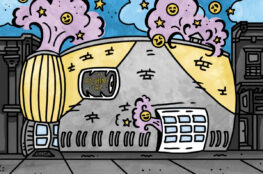
To get to The Underground Collective theater space these days, you walk through the sparkled and seasonally bustling Grand Avenue Mall, and descend the elegant staircases of the Plankington Arcade to the lower level. There, the hallways are in semi-darkness, and most of the spaces are non-descript offices. The theater itself is simple: black curtains around the walls, a few low platforms and an arrangement of generic chairs that are both set and audience seating.
 In fact, no one is credited for the set design of Dutchman, which The World’s Stage Theatre Company opened here this weekend. But I can’t think of a theater space more poetically charged than this simple room. There is a reason, after all, why LeRoi Jones set his incendiary 1964 play on a subway car, barreling down the length of Manhattan (Jones changed his name to Amira Baraka in 1967, in the aftermath of Malcolm X’s assassination). It’s the same reason why his play is so resonant 50 years later. He wants to dig down, get underneath, plumb places that are real but seldom see the light of day.
And here we are, underneath what might have become Milwaukee’s central marketplace, its agora, where people of all races mingled and bargained and celebrated in the middle of their community. But is now a shadow of what it once was, a telling sign of the city’s continued segregation.
Jones’s play is simple, surreal and allegorical. A white woman, Lula (Sasha Katharine Sigel), and a black man, Clay (Marques Causey), share the same subway car. Lula makes conversation, flirts, and all-but-seduces Clay. He responds tentatively, then eagerly. But in the end, explosive, vitriolic speeches give way to violence.
 But Dutchman’s potent, charged language isn’t really the stuff of realistic drama. Instead, it wallows and pokes around in the social underground, the churning id of American race relations: the sexual tension, the miscegenation taboo, racist stereotypes, Uncle Tom-isms. Eventually, in Clay’s final jeremiad, it offers a scorching lesson in black aesthetics, Jones’s take on the possible futility of a meeting of minds. White folks who say they love Charlie Parker or Bessie Smith? “Before love, suffering, desire, anything you can explain, she’s saying, and very plainly, ‘Kiss my black ass.’”
Here, director Sherrick Robinson and his cast find the right tone for Jones’s drama–a place that exists outside “anything you can explain.” In Sigel’s fine performance, Lula is always aware that she’s playing a part–seductress or scold—and she always seems in control. Causey shapes his performance beautifully, beginning shyly, then increasingly trusting the blossoming sexual chemistry, and finally erupting into Dutchman’s disturbing climax.
When TWS’s artistic director Gretchen Mahkorn chose Dutchman as the first play of a season titled “History, Justice, Onward,” it was long before the recent events in Ferguson sparked a national discussion of America’s continuing racial strife. It was a courageous choice, whatever the timing. But after weeks of “analysis” and “conversation” about racism’s fact and legacy, Dutchman shows that it takes a powerful artistic vision to get beyond the talking heads and op-ed pieces. As is often the case, the most potent truth is the deepest, found only by exploring the underneath.