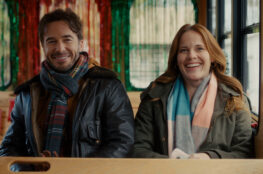


Photo courtesy of the Milwaukee Film Festival
First things first, if you didn’t know any better, you’d swear that the 2012 Milwaukee Film Festival has sex on the brain.
Want proof?
The 2012 edition of the now four-year old festival, opened with Starbuck, a French-Canadian comedy about a man whose frequent sperm donations from 20 years earlier have helped to yield 533 children, some of whom are interested in finding out the identity of their birth father. It marked the first time that the festival opened with a foreign-language film.
The festival closed with The Sessions, an autobiographical American comedy-drama that is based on the true story of American poet Mark O’Brien (masterfully played by John Hawkes), who confined to an iron lung, save for a few hours each day after contracting polio as a child. At the age of 38, he decides to lose his virginity and takes the necessary steps to make that happen under the counsel of a priest (wonderfully played by William H. Macy) and a sex surrogate (bravely played by Helen Hunt).
And there were other films that played during the festival that touched upon the subject like Gayby (in which a straight woman and her best friend, a gay male, decide to have a baby with one another albeit the old fashioned way); 3,2,1…Frankie Go Boom (where a man is publicly humiliated when his brother posts a truly embarrassing, sexually explicit video of him on YouTube); not to mention a racy short program that played three times during the run of the festival.
But of the 220 films (91 features & 131 shorts), that played at three local theaters (the Oriental, the Downer and the Fox-Bay Cinema) over the course of 15 days, the festival clearly had more than sex on the brain with its ambitious schedule.
The highlights of this year’s festival for me were:
The thought-provoking documentaries: As Goes Janesville (about the closing of a General Motors plant in Janesville, Wis., which was recently shown on PBS), How to Survive a Plague (about the fight to educate people ignorant about the AIDS crisis), The Imposter (about the heartbreaking disappearance and questionable reappearance of a missing boy), The Invisible War (which casts a spotlight on the disturbing surge in sexual assaults perpetrated upon female members of the military by their male counterparts), A Girl Like Her (about pregnant, unwed women in the 1950s and 1960s who gave birth in secret and gave their children up for adoption to spare themselves and their children from public scrutiny), and The Jeffrey Dahmer Files (an imaginative documentary that uses re-enactments and firsthand testimonials to shed light on the infamous Milwaukee-based serial killer responsible for the grisly deaths of 17 local men). Dahmer director Chris Thompson won the festival’s Filmmaker-in-Residence prize for his efforts.
As for narrative fare, Starbuck and The Sessions were first-rate, particularly the latter. There’s little doubt that it’ll be a major player comes awards season at year’s end and into early next year, certainly for Hawkes in the best actor race. Hunt and Macy will likely figure into the supporting races, though Hunt could be bumped up to lead.
Inspired by true events, the locally shot No God, No Master, starring Oscar nominee David Strathairn (Good Night, and Good Luck) as a federal investigator in circa-1919 New York probing a rash of mail bombs aimed at local politicians who then put forth sanctions that threaten everyone’s civil liberties, shared surprising parallels to post-9/11 America. The independently financed film served as a sobering and timely reminder that those who fail to learn from history are doomed to repeat it.
Dead Weight, the story of a Wisconsin man who sets out to meet up with his girlfriend in Wausau in the midst of an apocalyptic outbreak ravaging the Midwest proved to be a crafty piece of low-budget horror filmmaking.
The Sapphires is a rousing film with great music and a great performance by Bridesmaids breakout Chris O’Dowd as the manager of an all-female, Aborginal R&B group who entertained troops during the Vietnam War.
And “The Milwaukee Show,” a program of short films made by local filmmakers did not disappoint. Ten films were showcased this year and my personal favorites were Gears (a father-daughter story with a series of imaginative twists), The Evilest of Sorcerers (which, like Gears, presents itself as one thing and turns out to be something else entirely, with a crowd-pleasing twist, both written by Ryan Plato), Studies in Space (2010 Milwaukee Filmmaker-in-Residence Tate Bunker’s beautifully shot, meticulously designed love letter to dance), Reflection [Anarekli] (UWM film student Giorgi Mrevlishili‘s enchanting portrait of a traveling outdoor movie theater in eastern Europe) and The Vampire Formerly Known as Dracula, written by Milwaukee High School of the Arts student Ian Walls and directed by MATC graduate Nathaniel Schardin, is a cheeky, well-written, well-acted comedy of manners that won the 2012 Collaborative Cinema prize.
Attendance at this year’s festival was up 40 percent from last year’s festival, and sold-out screenings this year compared to last year were up a whopping 250 percent.
2012 MILWAUKEE FILM FESTIVAL JURY AWARDS
Competition Winner
Crulic – The Path to Beyond
(Anca Damian, director)
Competition: Honorable Mention
5 Broken Cameras
(Emad Burnat & Guy Davidi, directors)
Competition: Best Acting
Saul Williams, Tey
Competition: Best Directing
Mohammad Rasoulof, Goodbye
Cream City Cinema: Filmmaker-in-Residence
Chris James Thompson, The Jeffrey Dahmer Files
Cream City Cinema: Special Jury Prize for Short Film
So I Could Fly Away
(Blyth Renate Meier*, director)
Cream City Cinema: Special Jury Prize for Feature Film
As Goes Janesville
(Brad Lichtenstein, director)
2012 MILWAUKEE FILM FESTIVAL ALLAN H. (BUD) and SUZANNE L. SELIG AUDIENCE AWARDS
Best Feature Film: Mea Maxima Culpa: Silence In The House Of God (Alex Gibney, director) (an exposé about the sex abuse scandals within the Catholic Church and the massive cover-up that the Vatican knowingly sanctioned).
Best Short Film: Magic Piano (Martin Clapp, director) (a 3D film that was presented as part of the Kids Shorts: Size Large program).
*Meier is the marketing director for Milwaukee Film