
What does a space sound like?
A dance performance doesn’t seem like an opportune time to explore that question. Typically, an orchestra or recorded music is supplying the soundtrack, the dancers are on a stage, the only sounds of movement is the occasional squeak and click of a toe-shoe on the smooth surface.
But in Wild Space Dance Company’s Brew City Dreams, the space resounds. Six dancers in deck shoes scuff and stomp, and every sound rings through the spare space. There is music, but Tim Russell’s score (played by Colin O’Day and Bob Schaab) is an airy, open soundscape created almost entirely by beer bottles—plunked with mallets, blown into, or simply scraped on the rough floor.
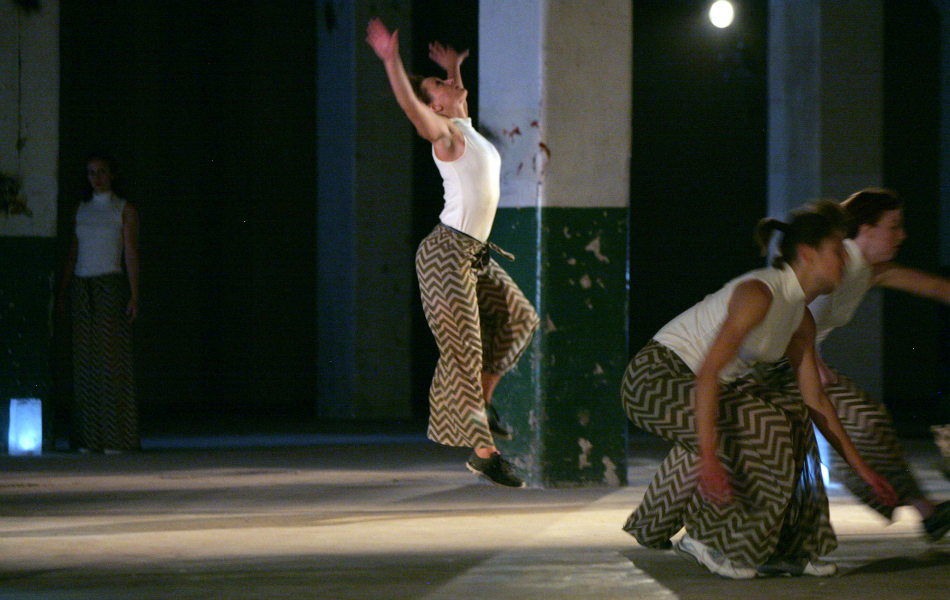 And what a space it is. The entire fifth floor of the old Schlitz Brewery Stock House—soon to be developed into offices as part of Schlitz Park’s ongoing development—is today just raw brick and concrete, and a gridded array of support columns give the vast space an otherworldly geometric precision, as if we’re sitting inside a Renaissance painting, or an Auto-CAD computer design program. Another choreographer might take advantage of this stage by bringing in legions of performers, filling the space with spectacle. But the cast here is smaller than most Wild Space performances—just six dancers (Cari Allison, Angela Frederick, Laura Murphy, Chloe Nagle, Kelly Radermacher and Emily Zakrzewski)—and they and Loewen create a different sort of spectacle—one of absence, openness, distance.
The result is—as the title suggests—ghostly and dream-like. Phil Cruise Warren’s simple and effective lighting washes the space in an even glow at times, and at other times he paints the space with angular chiaroscuro shadows. When the dancers enter, they place six luminarias in front of the six central columns, but the “playing area” isn’t confined, in keeping with the section’s title, “Far and Near.” A pair of dancers steps forward in a duet, your attention drawn to them, but it’s also free to roam around the space. The dancers are never “off stage,” even when they simply lean against a distant column and watch. As with all Loewen’s site-specific work, the movement evokes the history of the place, suggesting the polarities of emptiness and plenitude, and the history of labor with its efficiency and disconnection.
Eventually, in a section called “Between,” the dancers are corralled into a smaller space—a circle marked by the luminaria and surrounded by the audience. It’s as if the human emotions from the first, much longer, section have been distilled. There’s more human connection here—suspicious glances, camaraderie and beer-hall frolic. The cool clank of bottles is replaced with a twanging acoustic guitar. It’s as if we’ve gone from beer’s impersonal production to its gleeful consumption, and all the messy euphoria that goes along with it.
Photos by Matt Schwenke.