
 |
| [sic] by Youngblood Theatre |
If you take it back to its very first creative burst, Melissa James Gibson’s [sic] is over 15 years old (its first incarnation was staged at Steppenwolf Theatre in 1997). But Gibson must have been on to something, because there is no doubt that her debut play’s trio of big-city, thirty-something underachievers rings a bell in 2012. Even if you don’t read The Believer or frequent NYC’s East Village or Greenpoint Brooklyn, you can see them on sit-coms, or in a rarified form in Lena Dunham’s HBO 5th-floor walkup comedy, Girls.
But Gibson’s play doesn’t have the exhibitionist cache of Girls, or the laugh-track kookiness of Big Bang Theory. While it is often hilarious, it moves in mysterious ways, an amalgam of door-slamming farce and soap opera with a language palette that is equally drawn from screwball comedy and dada poetry. Unspooling in less than 90 charged minutes, Youngblood Theatre’s latest production—a Milwaukee premiere–is one claustrophobic roller coaster ride.
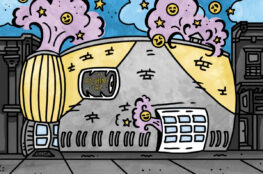
Koren Black’s terrific set has the audience sitting betwixt and between the closet-sized apartments of the three main players. Babette (Tess Cinpinski) is working on a book-length study of The Outburst in world history. Theo (Matt Koester) is using his music-school degree to write a theme song for an amusement park ride. And Frank (Benjamin James Wilson) has eyes on a career as an auctioneer. When we first arrive, the characters are sleeping, and Christine Barclay’s sound design—crescendos of street noise and bird song dying off into uncomfortable silences—creates just the right surreal mood.
But once the words take over, there’s no looking—or hearing—back. Director Jason Economus drives things at a fever pitch, just as it should be with language that is equally music and dialogue. Frank does tongue twisters and listens to a hilarious auctioneer training tape. Babette and Theo spat over borrowed money. And everyone wonders about the mysteriously absent Mrs. Jorgenson, made all the more enigmatic because her name is pronounced three different ways.
Eventually the characters’ lives are revealed to be as claustrophobic as their apartments. Another neighboring couple (James Boylan and Anna Figlesthaler—heard but seen only in silhouette) argue and decide to split up, enacting the ritual separation of books with a simple, “Yours! Mine! Yours!…” Meanwhile, the trio reveals its entwined social lives—romantic flings and break ups and party invitations and non-invitations. And Gibson’s whiz-bang language keeps skittering by, delicious and witty, but also reflecting a crowded melancholy cohort that can’t seem to see beyond the hallway limbo of apartment doors that define its world. As the unseen couple shows, breaking up is hard to do. But at least that pair is going somewhere.