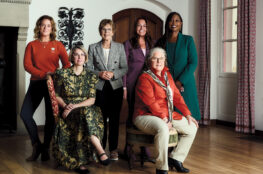

by Paul Kosidowski, photo by Dan Zaitz
An art gallery may seem a strange anachronism. In the age of digital reproduction, art buying and selling can happen in a flurry of Web hits and e-mails with nary a glance, an “ahh … O’Keeffe!” or a handshake being exchanged. Today, many sales are transacted just this way. And in a midsized city like Milwaukee, collectors of art – particularly the A-list pieces that keep galleries going in cities like New York or Los Angeles – are too few to keep most gallery doors open. Yet galleries persevere, because a stubborn group of art lovers takes a special pleasure in amassing beautiful things and offering it to a public: “Here’s what I love – come see. Come buy!” |
Which is good for us. And good for the city. Because each art gallery adds something unique and valuable; it is an indispensable part of a community – a nexus of artists and art lovers, a place of discovery, surprise and connection. While the Internet can be an efficient way to buy and sell art, a gallery is a place of entertainment that attracts audiences and serves art’s spirit and passions.
In recent years, galleries have come and gone; the scene is ever-changing. Gallery Night-goers will see dozens of venues showing a variety of things. We’ve chosen places where art is truly the focus.
Tory Folliard Gallery (223 N. Milwaukee St.)
For quite some time, this has been the place to be on Gallery Night. Its rooms are airy and generous; its Third Ward location, central. And the walls usually boast work by top Wisconsin artists, such as T.L. Solien, Mary Bero, Mark Mulhern, Tom Uttech and John Wilde. You won’t find the eclecticism of other Milwaukee galleries, but Folliard’s focus – “midcareer Midwestern figurative and landscape artists” – has been an instrument of its success. It was natural to start in the Midwest, says Folliard, in Wisconsin, Minneapolis and Chicago, and she’s handled painters like Uttech and Mulhern for more than two decades. She was drawn to work that reflected her taste, and new artists seek her out because their work seems to fit in with the Folliard stable. “I think Wisconsin has a great selection of artists,” she says. “That’s why I don’t have to go that far – they are sought after around the country.”
Green Gallery East (1500 N. Farwell Ave.)
As well as anyone, John Riepenhoff represents the cutting edge of Milwaukee art. He’s organized events like the international art fair at Riverwest’s Polish Falcon’s Nest bowling alley, and has staged other “conceptual” art fairs in Cologne and New York. The heady culture magazine Artforumpicked the first Falcon fest as one of the best art events of 2006, calling it “simultaneously fundamental, magical and possibly even a little subversive.” Riepenhoff and Jake Palmert run the Green Gallery, which benefits from connections with artists like former Milwaukeean Michelle Grabner (whose 2009 Green Gallery show also garnered national attention), as well as other dealers and curators. “It’s a social thing; it’s a business thing; it’s a geographic thing,” Riepenhoff says of the network he cultivates as a dealer. “When we ask someone to show here, we can offer a contemporary exhibition space and Midwestern Milwaukee hospitality – which really blows some people away.”
Green Gallery East (now 18 months old) is a striking space, a former pizza joint with clean lines and high-modernist aspirations; its long glass façade opens its exhibits to the Farwell Avenue traffic. Since this space opened, the Green Gallery West in Riverwest has become a venue for special events, including evenings of “that highest form of art,” stand-up comedy at the miniature comedy venue, Club Nuts. Artfully done, no doubt.
David Barnett Gallery (1024 E. State St.)
“We like the ‘salon style,’ ” says David Barnett as he leads me down the front hallway of his gallery. “It’s a good excuse for being an art-aholic.” Indeed. Every square inch of vertical wall space in this 1875 house is covered with paintings, prints, pastels and drawings, from postcard-sized Matisse doodles to substantial 17th-century canvases. In an upstairs room, look down the length of a conference table – itself half-covered with folios of prints and research materials – and you’ll see a half-dozen African sculptures gathered around a Victorian fireplace stretching to the crown-molded ceiling. The space reflects a lifetime of collecting and selling that started in a basement near 21st and Wisconsin, when Barnett was still a graduate student. His big break came in 1984, when the widow of Milton Avery allowed him to sell $4 million worth of early paintings on consignment.
By the time he moved to this house in 1985, he had plenty of art to fill it – from all over the world. Along the way, he had to change the business model: “from local artists to name brands,” because “you can’t make a profit selling only local work.” Instead, Barnett’s collection is as eclectic as you can get – Rembrandt etchings, Andy Warhol, Latin and Central American art, and local artists. “As a business, it’s tough sledding. You really have to love the art to get through it.”
Dean Jensen Gallery (759 N. Water St.)
Pass this place late in the night, and you can often see Dean Jensen, perched at his computer, his hours reflecting the fact that the Internet is increasingly a conduit for buying and selling. Jensen launched his gallery after a long and distinguished career as art critic for the old Milwaukee Sentinel. It was 1987, and the art market was booming. “I sold my first painting for $7,000,” Jensen recalls, “and I thought I was going to be driving a BMW in three months.” But it was the last glimmer of the boom, and his aspirations since then have become more modest. As with most galleries, the major income comes from artists with international “blue-chip status,” with sales often brokered through artnet,an international Internet database.
A champion of “self-taught” artists, Jensen has traveled to the Outsider Art Fair for more than a decade. “The virtue of being in a community like Milwaukee is one can mix it up a bit,” he says. Jensen’s shows often feature local artists whose work he admires, like Jason Yi and Sonja Thomsen. And he hosts a perfect storm of local and international artists in his annual “Big Bang” show, with a wide variety of work at a nice price point (last year, everything was under $900). For that show, Jensen depends on longstanding relationships to persuade artists to drop prices under the ceiling. And they do.
Peltz Gallery (1119 E. Knapp St.)
In 1955, Cissie Peltz and her husband and went to Paris. “It was August and everything was closed, but we found a little basement art gallery,” she recalls. “We spent our last $100. We bought five prints – including a Matisse lithograph for $12. And that started us out.” In the 55 years since, Peltz has been a collector, a cartoonist (whose work appeared in the Chicago Tribune Book Review and other national magazines), an active presence in the Milwaukee art scene, and – since 1989 – the owner of a gallery in an 1885 Victorian surrounded by midcentury apartment buildings. The profusion of prints on the walls reflects Peltz’s involvement in the Milwaukee Art Museum’s “Print Forum” for many years. And the large number of female artists broadcasts her interest in diversity, featured in her annual “Remarkable Women” show.
“I’m fortunate in that I like a lot of different kinds of things,” she says as we wander the gallery. “There’s probably more realist art here than abstract.” And all the works seem to have a story. About the time she gave Christo the idea to wrap a Harley. Or the background behind this or that print by Warrington Colescott. “He was a cartoonist, too, you know,” she says. Each work, you sense, is just as important to her as that first Matisse she found in Paris.
Delind Fine Art (450 E. Mason St.)
For Bill DeLind, it’s all about light. His first love is Plein Air painting – where the artists paint out of doors directly from nature. “It’s a very honest form of painting,” DeLind explains. “You think about the light and it moves from the eye down through the brush and ends up on canvas.” He has visited Barbizon, the village in northern France where landscape painters pioneered the technique, and is drawn to artists from Camille Pissarro to his modern-day followers. So it’s appropriate that he runs one of the sunniest galleries in the city, a glass-enclosed corner adjoining the George Watts shop on Mason Street.
It’s perhaps also fitting that DeLind first came to Milwaukee to sell windows – or architectural glass, to be exact. He arrived when Bresler Eitel Gallery was in need of help, and worked there before starting his own gallery in 1969. For many years, DeLind dealt primarily with etchings and lithographs, and has always had a special fondness for antique French posters. But when prints became more common, he gravitated toward drawing and painting. You won’t find crowded, salon-style walls here, but instead a frequently changing selection that DeLind selects from his substantial collection. And while the Internet is a help, most of DeLind’s art is sold directly after people – either locals or visitors who stay in the nearby hotels – see it on his walls. “My most effective marketing strategy is leaving my lights on at night,” he says. The sales generated from pedestrians strolling by his windows more than pays for the cost of electricity.
The Portrait Society (207 E. Buffalo St., Suite 526)
Anyone familiar with the city’s art scene knows Debra Brehmer: teacher, curator, writer, editor and publisher (and regular contributor to Milwaukee Magazine), and now art dealer. Her gallery is the new kid on the block and, appropriately, offers some new approaches. Brehmer shows an interesting cross-section of local artists – both teachers and students at UWM and MIAD, artists from around the state with a strong following, but also people like Carri Skoczek, who have strong connections to Milwaukee even if they now live elsewhere. Then there’s Rudy Rotter, a self-taught artist who created enough art in his spare time (he was a dentist) to fill a 21,000-square-foot warehouse. For a time, Brehmer devoted an entire room to his work. And Carolyn Gaska, a Monona housewife who created thousands of refrigerator magnets, Christmas ornaments and picnic plate “scenes” by clipping and pasting magazine photos. During a three-month show last year, hundreds of plates and juice lids were displayed wall-to-wall in one gallery room. Brehmer sold a pile for between $2 and $10.
Then there are the “projects.” Brehmer occasionally serves formal tea to visitors on a Saturday afternoon, delighting in the lost “art of conversation.” She writes notes about the visit, creating a “portrait” of an afternoon. In winter, one of the gallery rooms is transformed into a meditation “chapel” with the help of architects and installation artists. She also wants to be a conduit for people seeking to commission portraits from regional artists. For Brehmer, it’s a way to “keep projects going beyond the gallery walls, engaging with the community in a way that’s really exciting.”
Elaine Erickson Gallery (207 E. Buffalo St.)
Elaine Erickson is an accountant. And would probably still be just an accountant if not for a chance encounter some two decades ago. “I was hired by David Barnett to do his accounting,” she explains, adding that she had no interest in art at the time. “And the minute I walked through the doors of his gallery, I knew right then this would be with me the rest of my life.” She still loves accounting and does it part-time, but now runs one of the city’s most familiar art venues. She’s fascinated by the contrast between her two professions: “Accounting has to be right. But there’s no right or wrong here,” she says, pointing to the paintings around her. “It’s just an expression and somebody might like it, or not.”
Erickson likes what she calls the “mystical” and the “surreal.” Surrounding her are paintings by Kenn Kwint, a veteran Milwaukee artist who works in textured, almost antiqued surfaces. She also represents the estates of artists like Joseph Friebert and Santos Zingale, who have a long history in the city. So which works are most in keeping with her own taste? “All of it. I could never hang something I don’t really love. It can be a downfall sometimes, but I can’t do it any other way.” Still, her practicality balances that passion. “I know when to spend and not to spend. That comes from the accounting. The reality is that it all has to be paid for.”
Katie Gingrass Gallery (241 N. Broadway)
There’s a kind of glow in the air inside this gallery. It might be the art itself, which tends toward the saturated and colorful. It might be the room, one of the Third Ward’s most striking, with century-old wood beams crisscrossing the lofty space above. It might be the neighbors, the adjoining Third Ward Jewelry and (shoo) shops, working their upscale retail magic. And it might just be the aura of success, for Gingrass seems to have found the right mix of atmosphere and selection to create a successful retail space. David Schaefer, who has been with Gingrass for much of the gallery’s existence, calls it “fine art and craft,” and his heavily impastoed landscape paintings are part of the current show. There’s also art glass and sculpture, almost all in bright colors.
Gingrass opened her first gallery on Milwaukee Street, but soon moved into this newly renovated Third Ward warehouse in 1990, making her a pioneer of what is now the city’s trendiest shopping area. At first, she included jewelry in her collection, but that became a separate business several years ago, even though it still shares the space and helps create the ambience of an immaculate, arts-crafts department store. “We have to appeal to a great variety of people,” Schaffer says. “Milwaukee just isn’t big enough for us to specialize.”
Walker’s Point Center for the Arts (839 S. Fifth St.)
When I visited him in April, Gary Tuma was sharing his office with a wheelbarrow, and it wasn’t a piece of found art. Tuma and a collection of contractors and volunteers were in the midst of preparing the gallery’s new space for its first show. They had already moved most of the furnishings from its old location – at Ninth and National – and Tuma, the executive director, was now supervising wall-patching and floor-sanding. The new space has room for performances, classrooms and art – a light-drenched two-room area with sky-high ceilings. In it, Walker’s Point will continue to serve its mission as a community art center, with after-school education and community outreach. And art exhibitions. “We tend to show younger artists and artists who have something to say about urban life,” Tuma says. “Work that speaks to our neighborhood.” An exhibition committee organizes seven or eight shows a year, including a yearly members’ show, and a show commemorating the Day of the Dead. “We’ve shown Latino artists, Hmong artists, African-American artists,” says Tuma. “We’re all about the democracy of art.”
Redline Milwaukee (1422 N. Fourth St.)
Just across town, this year-old gallery addresses the intersection of art and community as well. Started by Lori Bauman and Steve Vande Zande, RedLine is a gallery, education center and community print shop that tries to demystify the artmaking process for visitors. Resident artists are given studio space in exchange for working with community projects. And RedLine’s spacious gallery space holds four exhibits each year, including a show by the resident artists.
Side Shows
Milwaukee has a number of alternative spaces with treasures for art lovers. Among those offering the most interesting work:
Adolf and Suzanne Rosenblatt’s Third Ward gallery space (181 N. Broadway) allows fans to see Suzanne’s delicate and lyrical drawings and Adolf’s wry and sometimes expansive sculptures, some of which re-create entire rooms of recognizable Milwaukeeans.
Artist Bridget Griffith Evans, a founder of the defunct Luckystar Studio, has opened a space to showcase her own work at 207 E. Buffalo St.
The Pfister Hotel (424 E. Wisconsin Ave.) has an artist-in-residence program, and Katie Musolff is the second such artist. She set up shop in April.
Riverwest Artists Association (2670 N. Holton St.) shows work in a nearby Center Street storefront that is open for specific exhibitions.
Coalition of Photographic Arts exhibits area photographers, and shows in various locations for temporary exhibitions.
Gallery 218 (207 E. Buffalo St., Suite 218) operates as an artists’ collective and shows their works, mostly abstract painting.
Cedar Gallery (326 N. Water St.) Scott Jackson displays local art in a sunny two-floor space adjoining his architecture firm. Work is serious and cutting edge, a good cross-section of established and emerging artists.
Grava Gallery (207 E. Buffalo St., Suite 130): Framing shops often display art in their stores. Grava takes its choices seriously.
Woodland Pattern Book Center (720 E. Locust St.) books a variety of shows, including shows of art.
Alfred Bader Fine Arts (924 E. Juneau Ave.): Alfred Bader is a legendary dealer and restoration expert with a particular affinity for the old masters. He does business through Internet inquiries and appointments only, but encourages curiosity. His website claims the gallery is “non-elitist” and offers paintings priced in the hundreds as well as the thousands. The only thing you won’t find is abstract art: “We do not understand it.”