When Mary Chase won the Pulitzer Prize for her play, Harvey, in April of 1945, America was in the final throes of World War II. Years of fighting had left Europe in shambles, 400,000 Americans were among the tens of millions of world casualties. The horrors of Auschwitz had been exposed only a few months earlier, and Germany’s surrender was only a few weeks away. But Hiroshima and Nagasaki were still to come.
 It’s easy to understand the contemporary resonance of the play’s most famous line: “Well, I’ve wrestled with reality for thirty five years, Doctor, and I’m happy to state I finally won out over it.” The speaker is, of course, Elwood P. Dowd, a middle-aged bachelor who lives comfortably on the inheritance of his mother, who he nursed on her death bed. With no need of work, he spends his time visiting friends around his unnamed, middle-American town, often at various bars, or card games at which liquor is served. But Dowd’s victory over reality is more dramatic than the temporary victories one can find in a bottle of Jim Beam: he is the constant companion of a six-and-half foot tall rabbit named Harvey.
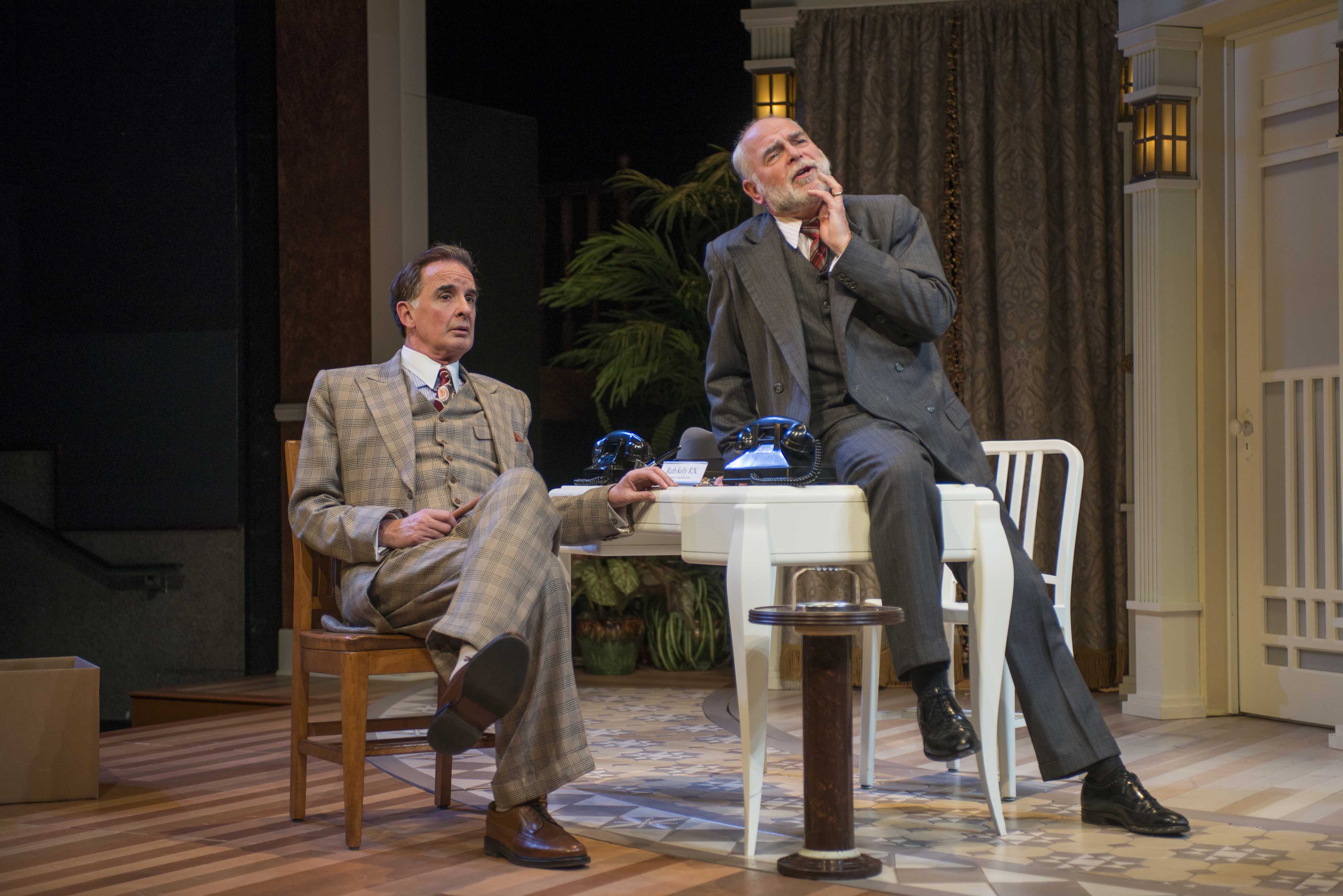
There are plenty of world events today feeding our urge to escape reality, but the main reason to see Harvey at the Milwaukee Repertory Theatre can be summed up in three words: Jonathan Gillard Daly.
I don’t mean to discount the fine work of director KJ Sanchez and the terrific ensemble cast she has assembled for this production (standouts include Kelley Faulkner, James Pickering, Deborah Staples, Laura  Gordon and Justin Brill, who plays the orderly, Duane, with the kind of pop that Preston Sturges would appreciate). Nor for the handsome period design work by Daniel Conway (scenery) and Rachel Anne Healy (costumes). But Daly’s performance is an understated triumph, a perfect fusion of natural personality and actorly skill that is a joy to watch.
It’s more of a challenge than it looks. The temptation with Elwood–as with any theatrical “eccentrics”–is to put him, so to speak, in italics, or in “air quotes,” to be sure the audience knows that you, the actor, knows how cute and daffy this character is. But Dowd lives most beautifully when his humanity is allowed to shine through, direct and unadorned. That’s exactly what Daly achieves. When he is onstage, particularly in Act Two, when the play’s dramatic tension ramps up, Daly’s Elwood is the still eye of a maelstrom. But he’s also an unassuming fall guy to the other characters’ desires for order and social acceptance.
As you might guess, he never does fall. But Chase’s sweet comedy–and Daly’s very truthful performance–offers a beautiful vision of the power of human kindness, even in a world where kindness seems in too short supply.