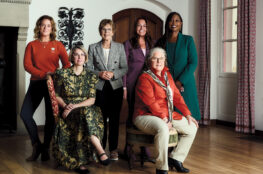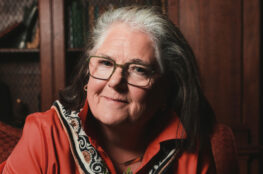

photos by Peter DiAntoni
Kathy Mykleby’s small size shocks strangers on the street. The Channel 12 news anchor seems large on TV, wearing three-inch heels and standing on a platform that together add a half-foot to her height. And her voice has a husky resonance, suggesting she is a hefty woman. In fact, she is a mere 5 foot 3. And quite trim, her size 5 physique honed by relentless exercise. Mykleby graciously accepts the inevitable backhanded compliments at how petite she is. “I lose 10 pounds every day – when I leave the studio,” she jokes.
The issue, of course, is not small in an industry that’s obsessed with appearances – all the more so for women. Even more ironic, Mykleby has never been about appearances. For decades, she single-mindedly pursued the news, improving her journalism skills and ignoring how she looked. Now, she’s perfected both. When we meet for the first time, she wears an impeccably tailored tweed suit; her hair in a youthful bob. “I’m not getting any younger and everyone else around me is,” she says. “You have to do what you can.”
Mykleby’s authenticity stands out in a profession that breeds superficiality. The Kathy Mykleby you see on the nightly news is the one you get in person – energetic, upbeat, smart, witty and down-to-earth – and as committed to bringing viewers real news as she was 27 years ago when former WISN-TV news anchor Jerry Taff first spotted her bounding out of the sports department and asked “Who’s the cheerleader?”
The cheerleader slowly rose to make her mark on Milwaukee TV news. For decades, her competitor, WTMJ-TV Channel 4, was “the news leader” in Southeastern Wisconsin; now, WISN-TV Channel 12 is the region’s top-rated news station – in no small part due to Mykleby.
“She may have been the best newsroom hire by any station in Milwaukee – ever,” says Taff, now retired and living in Texas. “Kathy’s the central pillar, the heart, the soul and the conscience of WISN-TV news.”
Mykleby’s career has spanned a generation of change in broadcast news, from technological innovations like live remote satellite feeds to the role of women. When she began in the 1970s, “men were men, and women were aliens in TV newsrooms,” says Jill Geisler, who became Milwaukee’s first female TV news director in 1978 and now heads the Florida-based Poynter Institute’s broadcast leadership program.
“Mykleby was a pioneer woman journalist as a hard-nosed reporter, and again as an anchor. She’s not just some pretty face,” says former WISN-TV assistant news director MaryAnn Lazarski, now on the UW-Milwaukee journalism faculty.
Old-fashioned reporting has become less important as TV news has moved inexorably in the direction foreshadowed by the 1987 film Broadcast News, with show-biz hyperbole and scare tactics trumping hard news. In Milwaukee, WITI-TV Channel 6 news begins with the latest developments from the network’s current reality show. At WTMJ, there’s breathless Breaking News Now obsessed with sex crimes and shootings and a tease about a scoop on the sexual predator living next door – “details at 10.”
But Mykleby has somehow stayed the course; a substantial journalist in an ever-less substantial field, a short woman who casts a long professional shadow. Former WTMJ anchor Mike Gousha, who pulled the plug on his own distinguished career in the wake of the dumbing down of TV news, says, “Kathy Mykleby is an old-school journalist who grew up like I did – with the story being bigger than we are.”
Mykleby is at the peak of her career, anchoring the city’s top-rated news station, but at age 53, she wonders how many more years she’ll have in an industry where the standard for news anchors seems to have become size 2, blond, twentysomething anchors whose knowledge of the news is just as thin. Mykleby has survived much, but how long can she maintain her position?
***
She was named Kathleen Inga Wold and grew up in the north shore Chicago suburb of Glenview, Ill., the oldest child of an advertising executive and his wife. Kathleen was no cheerleader as a child. “Unless Kathy becomes more outgoing and responsive in class, she’ll never amount to much,” her second-grade teacher warned.
Kathy’s mother wouldn’t stand for it, says Kathy’s husband, Geoff Mykleby, describing his mother-in-law Edie Wold. An outspoken registered nurse, sometime artist and substitute teacher who took college enrichment courses well into her 70s, Edie survived childhood polio and being orphaned at 13. She wasn’t about to raise a shrinking violet. “She put Kathy into social situations that made her outgoing,” Geoff says.
In a rare moment in fourth grade, Kathy did speak up. When her teacher scolded her for dawdling in the hallway, Kathy announced she’d run into another teacher who was sobbing. The teacher had told her President Kennedy had been shot.
The news stopped the class, Kathy recalls. Her memory of it is indelible. “I was only 9 years old, but it was my first broadcast.”
Kathy’s relationship with her mother was complicated. Edie never stopped pushing her daughter and Kathy felt a pressure to live up to those expectations. In seventh grade, as Kathy reluctantly prepared to perform in the school talent show with two friends, the girls ditched her. Her mother secretly recruited two new girls, devised costumes and built go-go dancer cages for them. The night before the competition, she told Kathy she was going on as Nancy Sinatra, lip-syncing and dancing to “These Boots Are Made for Walking.” Edie had choreographed the whole thing, right down to when Kathy would point at her boots. “Those girls are relying on you,” Edie told her daughter.
The next day, as Kathy summoned all of her courage, Dick Wold watched his daughter’s evolution. “By gosh, she had no stage fright at all,” he says. “Kathy had great confidence after that. It changed her.”
The new, more outgoing Kathy went on to Glenbrook South High School. When she failed to make the cheerleading squad, she became a “mat maid” for the wrestling team. “She went around in a letter sweater with a clipboard,” her father says. “Her confidence was sky high.” She dated the school’s Olympic-caliber wrestler and served as the school’s prom queen.
After graduation, Kathy followed her boyfriend to the University of Iowa. “That’s where she really came into her own,” her father says. She joined the Delta Delta Delta sorority, broke up with her boyfriend, and won “a tough political battle” to become the sorority’s president, he notes.
Watergate had made journalism an appealing profession, even more so for someone who grew up in a household that debated current affairs. When Kathy discovered journalism wasn’t an accredited major at Iowa, she worked with faculty and other students to help craft a curriculum for a communications studies major and earned a bachelor’s degree in that in 1976.
After college, Kathy applied for jobs at several advertising agencies in Chicago without getting a nibble. “She was a little depressed,” her father recalls. But her fortunes were about to change.
On the last day of college, at a party with 100 people crammed into a two-bedroom condo, Kathy had tried to dodge a male student who’d pursued her for years. She stepped on a stranger’s foot hoping he’d talk to her and scare off the unwanted admirer. The stranger was Geoff Mykleby. The strategy worked.
Their first date was a bingo game at the local Catholic high school – all he could afford at the time, Geoff says. Afterward, they ran into a DJ from the local radio station, KRNA-FM, who’d just quit his job.
“When Kathy heard that,” Geoff Mykleby recalls, “She blurted out, ‘Well then, they’ll need someone for your job.’ ”
She landed a job there the next day – but only scheduling the station’s commercials. But with her smoky voice, she was soon doing newscasts. The tiny 3,000-watt FM station was so ill-equipped that when Kathy wanted to interview a source, she had to pry the heavy reel-to-reel tape deck out of the console and lug it with her to the interview.
On New Year’s Eve 1977, just 18 months after they met, KRNA news director Kathy Wold married Geoff Mykleby. At the rehearsal dinner, Kathy’s kid brother Casey offered a startling toast. “Thank God,” he said. “She’s finally going through with it. She’s been engaged three times.” Kathy’s father watched the jaws of her future in-laws drop. She had been engaged to her high school sweetheart and to another boy at college, her father notes. No one had told Geoff’s parents, but they recovered, and the wedding went off smoothly.
When Geoff finished dental school, the newlyweds moved to Oklahoma City for his postgraduate work. Kathy waited tables and sold ads for a local newspaper before landing a job at WKY-AM radio. It was a news reporter’s paradise, she says, and Mykleby got to cover the state house, but she spent just under a year at the station.
Geoff finished his residency in the fall of 1979, and it was time to move. The Myklebys settled on Milwaukee. It was near enough to both of their hometowns (Geoff’s family lives in Cedar Rapids, Iowa), and Geoff had landed a job in Wauwatosa.
WKY’s management had promised to get Kathy a job with the company’s sister station in Milwaukee, WVTV-TV Channel 18. But the station didn’t actually have a news operation – just a station manager who wanted one. So Kathy became the entire department – writer, reporter, producer and anchor – delivering two-minute news updates at 9:30 and 10:30 p.m. The 25-year-old Mykleby built, stained and varnished her own set, a rolling desk on wheels.
“I just sort of fell into TV,” she says. “It wasn’t something I planned.”
During her first newscast, Mykleby’s hands shook so badly from nerves that she later joked they were practically flapping. “I could have flown out of the studio.”
Within a month of starting the job, she was introduced to the dark side of TV celebrity. A stranger called one night and asked for Mykleby. “‘I’m going to blow your head off when you walk out of the building,” the caller warned her.
“I’m thinking, ‘Shit, I left the safe world of radio and newspapers for this?’ ” Police officers escorted Mykleby to her car every night for a week.
Mykleby received a much better phone call a few weeks later. Milwaukee Journal writer Damien Jacques wanted to profile her for the Sunday paper. The March 1980 piece described Mykleby as “intense and often funny … with a cool competence.” Her first love was reporting, Jacques wrote, and she liked the anonymity of radio, “where the only important thing is what you are saying – not how you look.”
The media took notice. Within weeks, Mykleby had two job offers. She accepted a reporting job with WISN-TV 12. It was a huge step up, and Mykleby’s inexperience was evident. On her first assignment, covering the controversial, middle-of-the-night demolition of the historic Plankinton Mansion, it took her 100 attempts to get the taped report right.
Covering a gas station robbery, Mykleby tried to say “a plain-clothed police officer in an unmarked squad” but the words came out amusingly garbled, “an unclothed police officer in a plain-marked squad.” Attempting to recover, she looked into the camera and said, “You know what I mean.”
Her TV career was off to a rocky start.
***
When Mykleby arrived at Channel 12 in 1980, the industry had a clear bias. “Men always got the better, more serious story assignments,” says former WISN traffic reporter Anne Catalane. “From the very beginning, Kathy had to fight that.”
Mykleby gradually won some heavy-duty assignments: covering an organized crime trial and the demise of East Side drug kingpin Tony Peters. Meanwhile, she applied for anchor jobs when they opened up, only to be passed over in 1983 and again in 1985.
Mykleby did a stint as the consumer reporter and also covered City Hall. In 1986, she became a permanent weekend anchor, and by 1987, Milwaukee Mayor Henry Maier was calling her in the middle of the night. “I knew I was doing something right,” she says.
But she still worried about her job performance. When the news director invited her to coffee at Miss Katie’s Diner in 1988, she was certain she was getting fired. Instead, he asked her to do a feature called Tuesday’s Child, helping pair kids with Big Brothers and Big Sisters. “I was afraid I was going off into the land of fluffy feature reporting,” she says. But she accepted.
Mykleby was soon passionate about her Tuesday’s Child segments, and over the next 19 years, helped match 1,960 kids with mentors. “She wasn’t like other anchors, just going through the motions. You could see she really loved those kids,” says former WISN-TV anchor Jane Hampden, now host of “Lake Effect” on WUWM-FM.
Mykleby eventually took on another cause. In 1993, Channel 12 gave her a choice – attend the presidential inauguration or go to Somalia. Mykleby turned down the ball gowns and parties and flew to Somalia with the National Guard’s local 128th Air Refueling Wing. She saw “awful things,” she says, including “a baby dying in its mother’s arms.” And she came back with a mission. Convinced she could save lives imperiled by childhood illnesses like diphtheria, mumps and measles, Mykleby organized the Relief Mission for Somalia, and amassed $250,000 worth of medical supplies.
“Kathy refused to take no for an answer. She takes that obligation to change the world seriously,” says former Channel 12 news director Fred D’Ambrosi, now news director for San Diego’s KFMB-TV.
Mykleby had a reputation for staying with a story, even if it meant working long hours. “Kathy would be darned if anyone was going to take her story – ever,” says WISN-TV managing editor Renee Raffaelli. During the state legislature’s contentious vote on funding Miller Park’s construction, Mykleby stayed all night. So Raffaelli did, too.
“She was the best reporter we ever had. And such a stickler,” Raffaelli says. “I would try to get every answer to every possible question so I’d have it if Kathy asked me. It made me a better producer.”
While other would-be anchors primped, Mykleby would come back to the station “with her hair pulled back and she was a mess,” recalls Raffaelli. Mykleby’s wiry salt-and-pepper bouffant made her look like the 101 Dalmations’ character Cruella De Vil.
“Kathy isn’t afraid to cover a fire all day and get soot all over her,” D’Ambrosi says.
In 1993, Mykleby won an Emmy for her reporting on mass murderer Jeffrey Dahmer. The recognition did not speed her ascent. If her look – or lack of it – was a liability in getting a prime-time anchor job, so, ironically, was her great reporting. “The station didn’t want to lose her as a reporter,” says a former colleague.
There was also the matter of Mykleby’s incessant talking. When she finally did get the nod for a weekend anchor job, her co-anchor, Mike Anderson, found Mykleby a challenge. “She took some getting used to,” he confesses. “She talks through commercials, through videos. I had to have one ear on her and one on the producer.”
Female co-anchors didn’t seem to mind Mykleby’s animated storytelling, but male anchors did, says Anderson. They took to calling her “Chatty Kathy.”
“She’d be telling me a story and then without taking a breath, she’d be reading the teleprompter,” says David Davis, who co-anchored with Mykleby for seven years. “Well, some of us guys have to concentrate a little more.”
When Davis managed to slip in his own stories, he recalls, “Kathy always had a better one.” (Davis now works at KUSI-TV in San Diego.)
Anderson found Mykleby’s narrative one-upsmanship demoralizing. “I don’t think Kathy realizes how it affects people,” he says. Fortunately, he adds, “she has a sweetness about her, so people didn’t hate her for it.”
Mykleby worked as a weekend anchor for eight years. “There are not many left like her,” says Raffaelli, who was mentored by Mykleby as an intern and later became her weekend producer. Young anchors today would say “‘OK, I did six months of your weekends; I’ve earned a better position.’ ”
Raffaelli was one of many neophytes that Mykleby mentored. “Unlike most anchors, she was approachable,” says former WISN-TV reporter Diana Reed, now a producer for WSVN-TV in Miami. When Reed began doing on-air segments, she went to Mykleby “for honest feedback,” she says. “I’d ask her “ ‘Does this blazer work?’ And she’d say, ‘No, it makes you look fat.’”
Even as an anchor, Mykleby invariably wore a pencil behind her ear, just in case she needed to track down a story detail. “That was the kind of journalist she is, a roll-up-your-sleeves working anchor who brought up the standards for the whole station,” says Lazarski.
Mykleby developed an ability to describe scenes in a way that average viewers could understand. Reporting from Afghanistan, she described the Taliban headquarters this way: “It looked like West Allis with split-level houses.” Describing the bullet-riddled presidential palace, she said, “it was full of old furniture that looked like it was used in The King and I– for three decades.”
Though she had been passed over for anchor in 1985 in favor of Marty Burns Wolfe, Mykleby bore no resentment. “Marty deserved the job. I wasn’t ready for it,” Mykleby says, adding that she learned a lot from her, including how proper lighting could enhance her appearance on camera.
“Our working together might have been a recipe for disaster, but we had no problems,” says Wolfe, now working in real estate in Denver. “I have a great respect for Kathy. She’s a gutsy gal and a hell of a reporter.”
Finally, in January 1995 at the age of 41, Mykleby got her chance. “Essentially, Marty was demoted and Kathy was promoted,” says Catalane. Mykleby would co-anchor with longtime WISN staple Jerry Taff.
Anchors typically had their own office, while producers and others were crammed into cubicles. Yet not long after Mykleby finally got her plum post, a major remodeling did away with the anchors’ offices, putting the emphasis on the entire news team.
“Kathy was a little hurt. I think she saw it as a slap in the face,” says Tammy Elliott, later her co-anchor.
But if anyone was likely to adjust, it was Mykleby. Sharing a cubical with three others, she became the life of the newsroom. She’d slip into her Katharine Hepburn imitation, says Lazarski, “and I’d laugh so hard I’d be crying half the time.” Mykleby’s laugh, a cross between Woody Woodpecker’s cackle and the rat-a-tat-tat of a machine gun, became such a fixture that the 10 p.m. news producer perfected an imitation of it.
Taff, meanwhile, sulked over the loss of his office, says Anderson. “Jerry and Marty both wanted to be the big kahuna. TV does that to people. It makes you feel like you really are some kind of a star, but Kathy didn’t change. She’s not a prima donna.”
Mykleby can be relentless – not unlike her mother. “I don’t think I’ve ever won an argument,” says her husband of 30 years. It was the same at work. “I’d have to tell her, ‘Shut up. I got it. Now go away,’ ” says D’Ambrosi. “But you could hash things out with Kathy. She was never a pouter, and that’s rare among news anchors.”
In May of 2005, Taff signed off for good. Well before his departure, the station began pairing Mykleby and Elliott at 10 p.m. In an industry where males had dominated, it was a bold step to staff the most important news show with two female anchors. It was radical at the time, says Geisler.
Mykleby had her own reservations – about her young, blond and petite new co-host who seemed exactly the type of anchor becoming the industry standard. But to Kathy’s surprise, the twosome worked, her father says. “We could communicate without even talking,” says Elliott.
Taff’s long, six-month farewell at WISN sent the station’s Nielsen ratings to new highs. Mykleby’s pairing with Elliott pushed them even higher. But in June of 2006, Elliott returned home to Green Bay and an anchor job more conducive to raising two small children. Mykleby’s new co-anchor became Toya Washington, a no-nonsense young anchor with model-like looks and a baby on the way, a combination that helped draw even higher ratings.
“There was a time when no matter what we did, we couldn’t beat [Channel] 4,” says Anderson. Now, after decades of dominance by WTMJ, Channel 12 was on top.
As Anderson notes, WTMJ contributed to the process by cheapening its news. “In this business, they can always slide
someone in there who’s prettier, younger and cheaper,” he says. WTMJ did that. WISN capitalized on experience.
“Besides,” he adds, “Kathy’s cute, and that is more disarming than pretty. Pretty don’t last.”
***
On the day of one of the largest mass shootings in U.S. history, the massacre at Virginia Tech University, Mykleby arrives at the station at her usual 2:30 p.m. She has been monitoring the 24-hour news channels. “They have so little substance, it’s like treading water,” she complains. “It’s time to dive in and do some real reporting.”
WISN has sent its 6 p.m. co-anchor to Virginia; Mykleby will have three newscasts to anchor. Even with just two, most anchors wouldn’t do any reporting, but Mykleby joins the daily strategy session where the producers, editors and reporters discuss developing stories. Mykleby has been in the business longer than some producers have been alive. “When she talks, people listen,” says 5 p.m. news producer Tonya Simpson. She calls Mykleby “WISN’s encyclopedia.”
Mykleby is like a yo-yo at the news meeting, in and out. She has to do her hair and makeup – the part of the job she hates most is trying to get a “consistent look,” she says – then she’ll tape the 5 p.m. promo and teasers for the 6 and 10 p.m. shows.
When she emerges from the dressing room, Mykleby is perfectly coiffed and wearing a rich purple blouse open at the neck to reveal a silver necklace – necklaces, her image consultants say, lengthen the appearance of her short neck.
Her wire-haired Cruella De Vil days came before she was “image consultant worthy,” Mykleby says. Back then, “she hated her hair,” says Elliott.
Now, she has as many as three such consults in one day, and her hair is styled in the neat bob she first saw on a woman in a Paris café. She described it to her hair stylist and together, she says, they found her “look” – dyed brown hair with strong blond streaks. Barely a week passes without someone calling to ask who cuts her hair. Mykleby returns the calls herself.
Mykleby was always more interested in reporting, but might never have succeeded as an anchor had she not addressed her image. And so she has to make the minutes count, attending to her appearance even as she does the reporting she loves. She checks e-mail, retrieves voice messages, returns a call, Googles for info that might connect Virginia Tech to Wisconsin, then phones a station salesman asking: “Where did your wife go to college again? Virginia Tech? I thought so.” Mykleby reaches the wife and gets the lay of the land on campus.
“Kathy feels it’s very important for people to know she knows her stuff,” says former co-anchor Elliott, too young to have worked when a female journalist’s knowledge was routinely questioned on hard news topics.
Between promos, Mykleby jumps on a tip from a viewer. She calls a former Port Washington teen, now a student in the dorm where the shootings began, and interviews him on tape. “What are the kids saying that the media doesn’t know?” In a flash, she’s back in the news meeting, asking, “Do we have a picture of this kid?” Mykleby has a practiced eye when it comes to using visuals to tell a story. A week earlier, she had previewed a script that began with reporters stationed all over town covering a spring blizzard. Start with snow falling and cars in ditches, she told her producer. Simpson made the change. “I love it that I’m working with her because she really knows her stuff,” says the 25-year-old.
With Mykleby anchoring, a fantastic California car chase won’t make the news just because it’s good footage. “She’s always asking, ‘How is this relevant to people in Milwaukee?’ ” says Simpson.
Not every anchor previews copy. “And not everyone who does knows enough to be able to correct things. With Kathy, you know she’ll get it right,” says Hampden, who anchored in several cities.
Previewing copy for the 5 p.m. broadcast, Mykleby corrects then-U.S. Attorney General Gonzales’ name, replacing “Roberto” with “Alberto.” In a description from the Brendan Dassey murder trial, she changes a reference to the teen’s “Uncle Steve” to the more accurate “his uncle, convicted murderer Steven Avery.”
Across the country, notes Geisler, “sensational, gotcha and overly scary stories” have become increasingly common. She sees Mykleby as a force opposing the trend. When the Department of Homeland Security advised citizens to stock up on duct tape in case of a terrorist attack, Geisler says, Mykleby sent her an e-mail asking: “ ‘How do we convey the government’s advice without scaring people?’ ” This type of question is normally handled by the news director, not an anchor. Geisler ended up using the anecdote in a story she wrote on “lessons in leadership” for the Poynter Institute.
Mykleby, of course, is only one member of a team that features veterans like Anderson, Raffaelli, Kent Wainscott, Colleen Henry and others, but she’s the unquestioned leader. “I can’t imagine what this station would be like without Kathy. She gives us our identity,” says managing editor Raffaelli.
Watching Mykleby do election coverage last fall, Anderson realized just how good his former co-anchor has become. “Before,” he says, “she was learning to swim. There was a lot of beating the water. It takes years of getting comfortable with yourself. But now, she doesn’t have to try to be the big anchor lady. She isthe big anchor lady.”
One month after the Virginia Tech slayings, Channel 12 placed first in every news slot – for the first time since overnight Nielsen ratings began.
***
For decades, the hard-driving Mykleby was a smoker. Colleagues would often see smoke wafting from a cigarette at her desk, but she had darted off in pursuit of a story. Then, in 1996, WISN-TV saleswoman Mo Lloyd asked Mykleby to undergo a series of medical tests to bring attention to women’s heart health.
A routine chest X-ray found a spot on Mykleby’s lung. “I figured I had done this horrible thing, and was getting my payback,” says Mykleby, who was convinced smoking had given her cancer.
Surgery found the growth wasn’t cancerous, but six months later, it was back. Within 96 hours, Mykleby was on the operating table. The diagnosis was sarcoidosis, the auto-immune disease that contributed to the death of former Packer Reggie White.
Mykleby quit smoking cold turkey. Working out with an almost religious zeal, she got her lung capacity back to 100 percent. “Somehow, I beat it, but without Mo and those tests,” she says, “I’d never have known anything was wrong. She saved my life.”
It changed Mykleby’s life, says her father. “It scared her. She was never a great exerciser, never as driven as she became.”
Before that, Mykleby admits, she often lamented the great times she missed with family and friends because she worked nights and weekends. Spending time mourning those lost opportunities “was my greatest failure,” she says.
After her surgery, Mykleby says she vowed to “inject more laughter” into her life. She became game for just about anything, says best friend, Channel 12 reporter Henry, who recalls Mykleby agreeing to dress up as Marilyn Monroe and sing “Happy Birthday” when Henry’s husband turned 50.
Most evening anchors sleep in, but Mykleby is up before 7 a.m., having her hair color touched up, exercising, running errands, lunching with a friend. Mykleby’s personal trainer and marathon-walking partner Anne Tremel calls her “the Energizer Bunny.”
Mykleby could write the book on time management. Take her “Rule of 100s” approach to yard care: “Picking up a stick in the yard counts one, and so does pulling a weed,” she says. “You do 100 things a day, and within a couple of weeks, everything is done.”
Kathy and Geoff Mykleby found their dream house – four blocks from home – while walking their dogs along the Menomonee River Parkway in Wauwatosa in 1991. They’d been considering a move to Brookfield or Mequon, but Kathy had admired the 1939 Italianate Lannon stone home overlooking the parkway for years.
She decorated it with dramatic flair and bright colors, draping fabrics and hand-painting her own unique faux wallpaper. Her mother’s response was double-edged: “I’m so proud of you,” Kathy recalls her saying. “I thought you were so beige.”
Beige it isn’t. “Her house is almost like wearable art – in a strange sort of way,” says friend Lee Crombie, an artist herself. Mykleby transformed the massive living room with its high ceiling and stone fireplace into a dining room seating 14 with a comfy chaise in the corner for reading. “Now, it’s so civilized, no one wants to get up after dinner,” she quips.
Mykleby has befriended the little girl next door, 11-year-old Katie, who has become her partner in artistic endeavors. Kathy would walk her to school and they’d stop and talk about the things they liked about this house or that, sometimes getting so carried away, Katie says, that she “wasn’t always on time.” On another occasion, they worked on a wild redesign of one room in Mykleby’s house. “We stapled Mexican flags onto the ceiling of the awful pink spare bedroom,” Katie recalls. “It’s always like a party over here. There’s always something going on.”
If Mykleby lacks confidence anywhere, it is in the kitchen, where she had a French poster-style mural of a damsel in distress painted over the stove. “I get by with cooking and catering,” she says, though she is famous for her entertaining. She hosts 30 for a Thanksgiving dinner so involved that each place setting includes five glasses.
Her cooking snafus have been memorable. On one occasion, she baked a nephew’s birthday cake, only to have it burst into flames in the oven. She had to be at work in an hour, she says, but she remembered her mother’s warning: “We’re prone to fire, for God’s sake.” (Her parents’ home twice had a fire due to electrical problems.) So Mykleby called the fire department’s nonemergency number. “I just wanted to hear someone (from the fire department) say, ‘You did everything you possibly could,’ ” she says. Instead, she heard sirens and the fire chief came walking up the driveway.
It was a “Mykleby moment,” says Reed, her former colleague. “If something weird is going to happen,” she says, “it will happen when Kathy’s there.” Reed recounts how Mykleby convinced her to buy a 6-foot-tall, 3-foot-wide candelabra – the one item she said Reed needed to complete her décor. “The next thing you knew, Kathy was on the roof of my little Honda Civic finagling it out of the sun roof,” Reed recalls, “and we drove down Ventura Boulevard with that thing sticking out of the roof like a mast, laughing hysterically, with people on the street waving at us.”
These “Kathy Calamities,” as another friend calls them, have been going on a long time. Mykleby met U.S. Sen. Ted Kennedy in a stairwell of an Oklahoma hotel in 1979 when he came upon her – with her shoulder strap and television cable tangled hopelessly in the stair’s railing.
***
The one topic Mykleby’s closest friends say they never discuss is her lack of children. Mykleby’s father calls it a “sensitive subject.” Kathy’s brother, he says, “Keeps bringing it up, worried that “someday, she will wake up all alone.”
It wasn’t much of an issue when Geoff and Kathy got married. “The only things Kathy wanted were a house with a fenced yard and a dog,” Geoff says.
Still, some wondered if they’d last. “Geoff would have loved children, but Kathy was driven to have that career,” says an old acquaintance. “And in those days, you didn’t see pregnant women on the TV news.”
Mykleby seems relaxed when asked about it. “We never decided not to have children,” she says. “We just didn’t have them. We don’t consider it a failure; just a fact.” Once, filming a segment in the office of a fertility doctor, she says, she thought about making an appointment, but she never did. “After a while, it was too late.”
So the Myklebys’ dogs, Max and Speedo, have become like children. There is even art hung knee-high for their benefit. When Chewy, the Myklebys’ older dog, died last year, Geoff was too upset to work. Later, he celebrated the couple’s new puppy, Speedo, with a welcome worthy of a new baby. He rescheduled his appointments so his staff could play with the new pup.
The Myklebys’ dogs are always cocker spaniels and always buff in color because that’s what Kathy had as a child, Geoff says. There are always two dogs so they have a buddy. “And one is always four years younger,” he adds, “so there’s one to keep us going when the older one dies.”
Mykleby also has a network of friends to whom she is tremendously loyal. “You cannot have a better friend,” says Elliott, recalling how when the doctor ordered bed rest during her pregnancies, Mykleby “got this whole array of her friends – people I didn’t even know – to make me food.”
After Tremel – Mykleby’s personal trainer – was widowed, she had to sell her Brookfield home, but couldn’t afford the updating the Realtor said it needed. So while Tremel was out of town, Mykleby and two others took over the task. “They basically did a whole house makeover,” Tremel says.
When a fall paralyzed WISN-TV investigative reporter Scott Feldmeyer, “a lot of people abandoned Scott – he was drinking a lot and difficult to be around – but not Kathy,” says Catalane. Mykleby would tell Feldmeyer not to drink around her because then he wouldn’t be the Scottie she knew.
“He always tried to be at his best around me,” Mykleby recalls. “I was on my way to visit Scottie the day he died. He was … saying goodbye to everyone, and they thought that if I came in, he’d try to revive himself,” she says, tears welling. But he was ready to die, “so they asked me not to come.”
In June 2001, five years after Mykleby’s health scare, her mother’s health faltered. Geoff phoned his wife in the south of France, where he had planned to meet her.
Alarmed by the news and struggling to get home, Kathy discovered she was on the wrong train and “she nearly swooned,” says her traveling companion, Trish Haudricourt, executive director of Boerner Botanical Gardens. Even in a foreign language, she says, “Kathy’s so warm and larger than life, strangers rallied to help her.”
But Edie died before her daughter could reach her. “Kathy was just devastated,” says Dick Wold. “Everyone sees Edie in Kathy. She was a sparkplug and a wit. They’re very much the same. It’s almost eerie.”
Today, the mention of her mother’s death still brings tears to Mykleby’s eyes. On Mother’s Day, she released a helium-filled balloon into the sky, a personal tribute to the determined woman who brought her out of her shell with a song and a pair of boots.
Four years after her mother’s death, Nancy Sinatra was scheduled to perform at Festa Italiana. Mykleby convinced Raffaelli to let her do an interview. Her cameraman balked. “Who cares about Nancy Sinatra?” he said. But Mykleby persisted, as she always does, and was waiting when Sinatra stepped off the elevator and into the hotel lounge. “She had great big hair, great big sunglasses, boots, and she’s real little,” Mykleby recalls, sitting in her basement in front of a big-screen TV.
She cues up her Sinatra interview, and pulls out the old black-and-white photo of her own rendition of “These Boots Are Made for Walking” all those years ago, the same photo she’d shown to Sinatra. Then the tape rolls showing Mykleby asking Sinatra if they could sing “Boots” together.
“You go first,” Sinatra said, and Mykleby did; her strong smoky voice barely carrying the tune. The 64-year-old Sinatra wasn’t a dazzling singer either, but she told Mykleby she was doing it for her daughter, who’d urged her to get back on stage. “That sounded like what my mom did for me,” Mykleby says. “In a way, my life had come full circle.”
In recent months, the Myklebys have been discussing “what Kathy will do next,” Geoff says. She’s pondered a list of second career options: painting, stand-up comedy, teaching, a TV decorating show or talk radio program, or “something in public service – without being elected,” he says, “because Kathy’s a blurter; she says what she thinks. Politics would never work.” Still, Kathy needs to be where the action is, he adds. She needs to make a difference.
“If I didn’t love what I’m doing, I’d be crazy to do it this long,” she says. “I’ve got 27 years with 12 – 30 sounds like a
nice number.”
But three years more won’t be enough for Kathy, her father says. Mykleby’s career has, in many ways, defied the conventional wisdom, but in a business that remains enamored with pretty young faces, how much longer can she expect to be an anchor? Perhaps unaware of how fitting the metaphor is, her father offers this prediction: The only way Kathy will leave Channel 12, he says, is “with her boots on.”
Mary Van de Kamp Nohl is a senior editor at Milwaukee Magazine. Write to her at mary.nohl@milwaukeemagazine.com.