

READ MORE FROM OUR 2025 KWIK TRIP FEATURE HERE.
There are gas stations. There are convenience stores. There are fast food joints. There are supermarkets. And then there’s Kwik Trip.
Kwik Trip is something else. Yes, it’s all those things in a way, but the Wisconsin chain also possesses an additional alchemy, something that makes people in this state go just a little bit nuts.
What other gas station has a Facebook fan group with over 150,000 followers posting their love of the place hourly? Do people write songs about BP? Take wedding photos at Speedway? Sport Mobil merch?
Kwik Trip, with over 500 locations in Wisconsin and almost 400 more elsewhere in the Upper Midwest, has amassed a following whose devotion borders on the fanatical.
Celebrate this year’s winners of the Betty Awards!
“In a class, I asked the students how they would summarize Wisconsin culture,” says Steven Michael, a professor at UW-Milwaukee’s Lubar College of Business. “The students said: the Packers, bratwurst, beer, cheese and Kwik Trip.”
And while Kwik Trip is very much a phenomenon, it also is a gas station, one that over the past 60 years turned low margins on fuel and declining cigarette sales into profits that, though hidden from public view, are enough to fund an enviable annual expansion rate of over 30 new locations. It’s a business model that you could argue is gradually turning Wisconsin into a territory of the Kwik Kingdom.
This leads us to a question. If you’re a member of the Church of Latter-Day Kwik, the answer might seem so obvious as to merit an eye roll. But if you’re new to Wisconsin, or if you reject purveyors of the fast and mass-produced, it’s a question you may have already asked yourself:
What’s the big deal with Kwik Trip?
DON ZIETLOW WAS SLINGING FROZEN MEAT. The year was 1958, and the 24-year-old was working long, exhausting hours as a delivery driver. Born in Chaseburg, a village of under 200 people about 10 miles southeast of La Crosse, Zietlow grew up on a farm with dreams of becoming a minister. But a stutter (which he’d have until he was 32) put an end to his hopes of preaching – and then marriage and a baby on the way meant it was high time to start making money.
Zietlow started working at Gateway Foods, a La Crosse-based wholesale grocer, and eventually rose through the company’s ranks to president. On June 16, 1965, while Zietlow was building his career as a grocer, John Hansen and his wife, Donna, opened a small grocery store in Eau Claire, partnering with Gateway Foods owner D.B. Reinhart.

grocery stores in Eau Claire, like the one pictured above on Tower Drive, in the late 1960s.
The store’s name? You guessed it. Kwik Trip.
The term “convenience store” wasn’t yet commonplace, but Kwik Trip was one of several small stores across the country paving a new lane somewhere between corner newsstand and full-scale grocery store. There was no gas for sale at the first Kwik Trip, which instead advertised itself as a place for fast, easy food purchases. The idea was successful enough to merit opening four more nearby locations.
Then, in 1971, Zietlow found himself standing in front of a conference room full of grocery store owners. He was giving a presentation on an emerging trend: convenience stores. He boldly claimed that if these local grocers didn’t go big, they’d need to shrink their stores in order to survive, a la Gateway’s nascent Kwik Trip.
This prompted one indignant La Crosse grocer to challenge him, saying, “Look, if you’re so smart, buy my store,” according to John McHugh, vice president of external relations at Kwik Trip. “And then Don said, ‘OK, you just sold it.’ He went home that night and told his wife he bought a grocery store.”
The sudden purchase prompted Zietlow to team up with Hansen and Reinhart to add his new store to Kwik Trip’s existing five. They hammered out a plan, each taking one-third ownership of the six locations.
At this point the name was there, but the local chain wasn’t really the Kwik Trip we know today – and it certainly wasn’t inspiring any wedding photos. During its first two decades, Kwik Trip started installing pumps and shifted its model from small grocery store to gas station. By 1983, it had grown to 50 locations, largely in western Wisconsin, with a corporate office in La Crosse. By 1986, it was up to 100.

A turning point for the chain came in 1989. With the era of shoulder pads and neon palettes on the outs and grunge lurking in the wings, Zietlow and Hansen bought Reinhardt out of Kwik Trip. Zietlow took the majority of shares, and with that introduced a new plan to decimate company profits – or at least that’s what it sounded like to some.
He wanted to take 40% of the company’s pre-tax profits and give them back to employees. At the end of the year, everyone who worked at Kwik Trip would get a bonus of 8%-12% based on their gross annual wages.
When he pitched the scheme, Zietlow harkened back to his days as a truck driver when he felt underpaid, overworked and underappreciated, like he was busting his hump just to line the pockets of an owner. He didn’t want Kwik Trip workers to feel like that. But this wasn’t an act of charity – it was a bet that employees who felt the company was investing in them would, in turn, invest more of themselves into the company.
Despite skepticism at the time, the scheme worked – and still hasn’t been replicated elsewhere in the industry. “I am not aware of any other profit-sharing plan like that in retailing,” says Michael, the UWM business professor.
“Already, back in 1989,” says McHugh, “we had the kernels of our Kwik Trip culture.”
Over 500 Kwik Trips are in Wisconsin. Over 900 are in the Midwest.
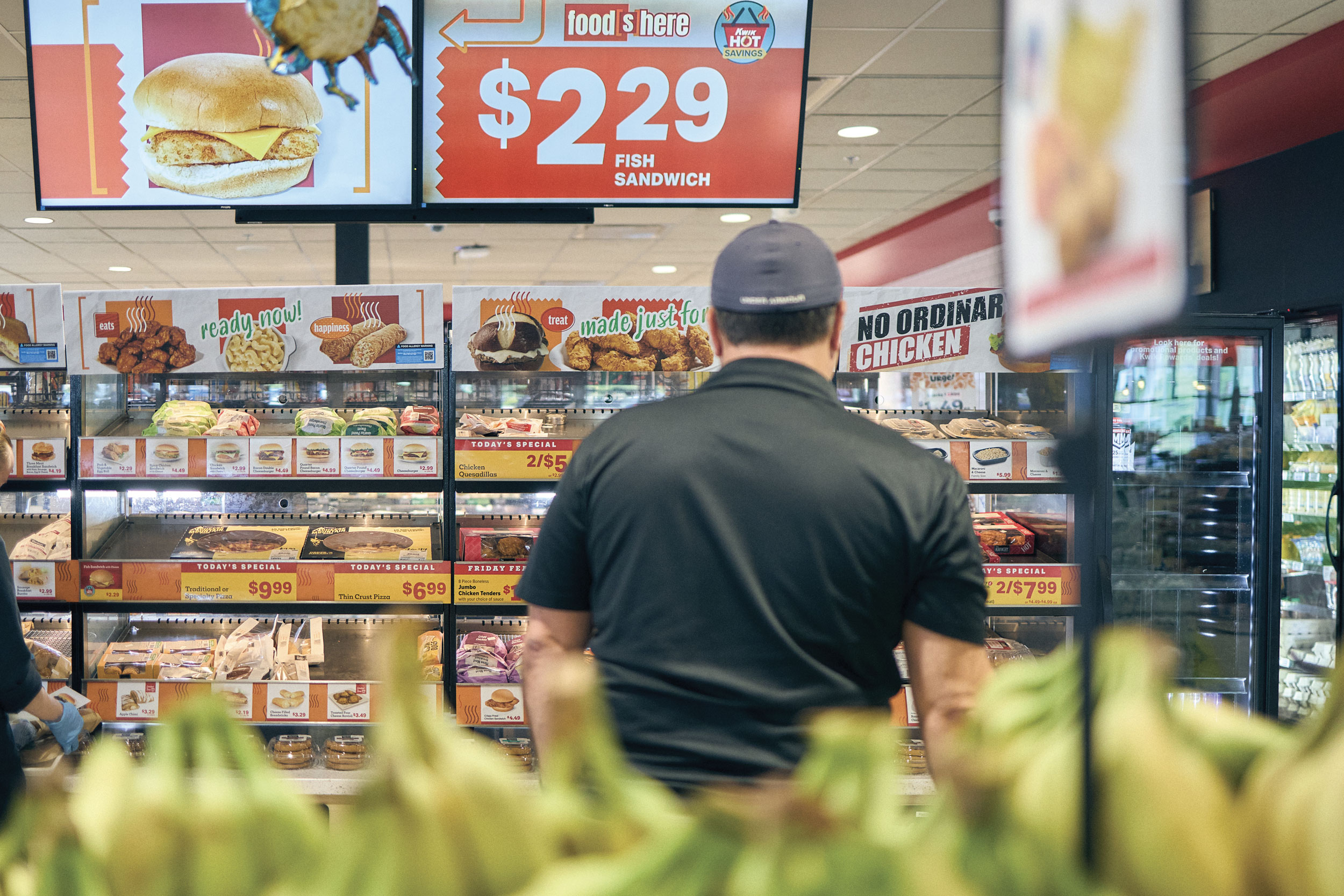
WHAT EXACTLY IS THE KWIK TRIP EXPERIENCE? First, it’s more than a gas station. We don’t mean that in some starry-eyed, fanboy sense – we mean it’s literally got more stuff. Alongside regular gas station fare, you’ll find an impressive lineup of hot sandwiches, fresh-made doughnuts, pizza (ready to eat or take-and-bake), eggs, bananas and other produce, fried chicken. It’s not unheard of for people to do their grocery shopping at Kwik Trip.
In rural markets, most notably in Iowa, the company’s stores are sometimes the nearest source of produce for miles. And to accommodate the wares and the kitchens used to cook up much of the prepared foods, Kwik Trip’s buildings themselves are bigger than a typical gas station.
In Iowa, you might drive by a big gas station with bright red lettering in a familiar font, Glazers for sale, chicken tenders and Pothole pizza on the shelves. But the sign outside will say “Kwik Star.” No, this isn’t a rip-off. Kwik Star is Kwik Trip. When the chain opened its first Iowa location in 1993, Don Zietlow didn’t want his store confused with the Oklahoma-based, Iowa-heavy chain QuikTrip and decided on a location-based name change.
Second, Kwik Trip has more than the single employee you see at many gas stations – usually far more to handle all that food.
Third, those people are all going to be nice to you. Kwik Trip employees (or as the company refers to them, “co-workers”) are widely known for a helpful demeanor so aggressively friendly that it might baffle a visitor from New York. Most noticeable, as you head out the door, they call out a phrase they’re trained to say: “See you next time!”
“It’s such a friendly atmosphere,” says Pati Holschbach, a lifelong Wisconsinite and Kwik Trip fan. “I’ve never had a bad experience.”
That is by design.

In 2000, the Zietlow family became sole owners of Kwik Trip when the Hansens sold their stake. With full Zietlow ownership, the turn of the century saw a shift in Kwik Trip’s business model and company culture.
McHugh remembers a conversation with Don Zietlow when he was hired in 2004. The CEO wanted his company to stand out from all the chains popping up across Wisconsin.
“Back then, Southwest Airlines was known for customer service. Don told me he wanted to create that for the convenience store industry,” McHugh says. “So we started making a concerted effort to make sure everybody at all levels in the organization knew our mission. We’re not here just to sell gasoline and hot dogs. We’re here to take care of our guests.”
How are you supposed to measure that? McHugh says in 2004, the company received 21 unsolicited guest compliment letters. That’s about .068 letters per location. In 2024, it received 2,660, nearly three per location.
After 36 years, Zietlow’s profit-sharing program remains a cornerstone incentive to keep those employees earning compliments. “If you treat the customer well, and that customer comes back again, that’s more profits and more money in your pocket,” McHugh says.
Another reason for the chipper reputation of KT employees is a surprisingly intense hiring process aimed at weeding out the less friendly. He says every Kwik Trip interview for every position starts by asking the potential employee to share “the last random act of kindness you did for someone. And if you can’t answer that question, we know you won’t fit the culture. … I can teach you how to run the register and how to make a cheeseburger. I can’t teach you how to be nice.”
Apparently, the chain can afford to be picky. McHugh noted that in August, Kwik Trip was hiring for a new distribution center in DeForest, near Madison, and already had received so many applications that statistically you’d be more likely to get into Harvard (a 3.5% acceptance rate) than land a job there.
Look at a heat map of Kwik Trip locations in Wisconsin, and there’s a big, obvious, glaring dead zone. The chain doesn’t have a single location in Milwaukee. The nearest Kwik Trip to Downtown is on Lapham Street at Highway 100 in West Allis, about 7 miles away.
John McHugh, the VP of external relations at Kwik Trip, says the chain’s food program and its resulting lot size requirements make a Milwaukee location unrealistic. “We need at least a 3-acre site minimum,” he says. “To find one at a reasonable price in a major metropolitan area is almost impossible. We can’t spend millions and millions on a site and have it take so many years to get a return on the investment. That’s why you won’t see us in Milwaukee.”
Another potential factor? Milwaukee prohibits gas stations from selling alcohol, which many Kwik Trips stock.
Occasionally contentious online discussions have speculated on the business’s politically right-leaning leadership or employee safety concerns as factors. But Kwik Trip says it remains open to Milwaukee. “We’re always looking,” McHugh says. “If any of your readers have a 3-acre site that’s reasonably priced, let us know.”
KWIK TRIP DOESN’T CEDE POWER. And that’s one reason all 900 locations feel essentially the same.
Kwik Trip is a privately owned company that doesn’t franchise, while other prominent chains, like BP or Shell, lend their brand to independent owners who operate individual locations, or groups of them. That means you could walk into one franchised store in Cudahy and find it clean and well-stocked, with a friendly clerk behind the counter. And then you could walk into another from the same brand in, say, Cedarburg, and find a filthy bathroom, half-empty shelves, and a scowling guy working the register who seems furious that you dared ask if they sell aspirin. Depends on the franchise owner and how they run it.
Every Kwik Trip is run by the Kwik Trip company, and its leaders are, for lack of a better term, control freaks. Nowhere is that clearer than Kwik Trip’s vertical integration, the business term for a company controlling the production, distribution and sale of goods, top-to-bottom.

That’s easier to understand if you think about the journey of a single Glazer doughnut. It and thousands like it are made every day at Kwik Trip production facilities, boxed by Kwik Trip employees, loaded into Kwik Trip trucks, transported by Kwik Trip drivers, and delivered to Kwik Trip stores to be sold to Kwik Trip customers. The same can be said for much of what’s on shelves at Kwik Trip stores, most notably its hot food but also its Kwik Trip-brand milk, coffee, potato chips.
“By designing it all, they’re able to control the quality better. You have the full range of management tools – supervision, inspection, motivation of people in the plant – rather than trying to contract for that with third parties,” Michael says. “They probably pay more to do that, but they obviously think it’s worth it.”
Kwik Trip, which operates a dairy and bakeries in La Crosse, doesn’t just care about food quality for its own sake – the food is where the money is nowadays. Where did it used to be?
Cigarettes.
Kwik Trip launched its “fresh food program” in 2005, in the midst of the country’s decades-long decline in tobacco use. What was once a staple of American consumer habits was becoming a niche addiction, and of course, the places where many smokers bought their packs, gas stations, were getting hammered.
“The traditional convenience store had two sources of income, fuel and tobacco, and we realized that tobacco sales were declining substantially every year,” says McHugh. “We knew that we had to change our business model. That’s when we really started to get into the food business.”
It’s no secret: Don Zietlow is a major Republican donor. Among many examples, the former CEO of Kwik Trip donated hundreds of thousands to the political action committee Trump Victory, maxed out contributions to Brad Schimel’s failed Wisconsin Supreme Court bid this spring and boosted Scott Walker’s gubernatorial campaigns. His financial contributions to both state and national GOP representatives have totaled over $1 million. The political activity has rubbed folks of the opposite persuasion the wrong way, and the company distances itself from it.
“That was Don’s personal decision and was never done on behalf of Kwik Trip. It was his personal money,” says John McHugh, VP of external relations. “Obviously we can’t dictate what he’s going to do with his personal money. … As a company, we try to remain neutral. We support both sides of the aisle.”
The company historically has given money to both Democrats and the GOP, but the scale tilts right. From 2016 to 2024, for example, it gave $196,000 to state Republican legislative campaign committees and $45,000 to the Democratic ones.
The company’s current president and CEO, Zietlow’s son Scott, “doesn’t participate” in political donations, McHugh notes.
One personal Zietlow family decision that you will see reflected in every store is the decision to not sell contraceptives, including condoms, or pornographic magazines, like you can often find (or once could, at least) in many other convenience stores. “We just don’t want to be the space for that,” McHugh says. “We [don’t want] a parent to be in a situation where they would have to explain something that’s not age-appropriate to their kid. … That’s a family ownership decision – has been, always will be.”
Now, convenience stores like Kwik Trip make significantly more money, with wider profit margins, on the products inside the stores than on gasoline. “You walk into a Kwik Trip, a coffee is going to be about $2.50. That’s more than what you pay at McDonald’s,” says Tarun Kushwaha, a marketing professor at UW-Madison. “For Kwik Trip to be able to charge premium prices, they need to provide customers with bells and whistles. The customer is no longer thinking, ‘Why am I paying $2.50 for coffee?’ They’re not. They’re paying $2.50 for gourmet coffee in an extremely clean, well-lit store where they know they can get in and out in less than two minutes.”
Kwik Trip isn’t primarily trying to compete with gas stations anymore, McHugh says – it’s carving business from big-box stores. “We think that the average family does their major grocery shopping every two weeks. But in between that two-week grocery visit, they’re going to run out of the basic commodities – eggs, milk, butter, bananas – and if we can be your destination in between your major grocery visits, that’s our niche. That’s our business model.”
FOR ALL THE BUSINESS CONCERNS of Kwik Trip, the company’s story is also very much a marketing one. Michael describes the store’s brand as “neighbors serving neighbors,” while Kushwaha says they want customers to see them as a “mom-and-pop store – [somewhere] you know the cashier, you know the person stocking the shelf. You feel welcome.”
That “mom-and-pop” perception carries some irony for a company pushing 1,000 locations – one that has been accused of diverting business from actual mom-and-pops in small communities – but despite the obvious clash, the company has been enviably successful in branding itself as something particularly Wisconsin, with a Midwestern, small-business spirit.
“There are multiple measures of success – sales growth, profitability – but I think one of the best measures of success for a retail store is how loyal its customer base is. On that dimension, I put Kwik Trip right at the very top of the list,” says Kushwaha.
In 2019, Mike Testa, a Wisconsinite, made a joke on Facebook that he was going to start a “Wisconsin Kwik Trip Enthusiast Club.”
“Within like 10 minutes it had 100 likes,” he says. “People were commenting, ‘Build it and they will come.’”
He did, and they did. His Facebook group started slow, with about 1,000 members, until one enthusiast posted that his girlfriend had agreed to get married at Kwik Trip if his post got 10,000 likes. The post went viral, and the next day, Testa had about 30,000 more members and counting. “He definitely got his 10,000 likes,” says Testa. “I think his wife rescinded her offer, though.”
Today, the Enthusiast Club has over 150,000 members postings idea pitches (a Kwik Trip fish fry “complete with potato pancakes”), photos of majestic sunsets behind stores, and mini product reviews (“Why is the chicken and rice soup so salty now? Was perfect the way it was.”), among many more psalms to the glory of Kwik Trip.
Testa says he reached out to Kwik Trip shortly after founding the group about collaborating and found the company reticent, though now he works with them frequently on posts. Kwik Trip has not just fully embraced its social media reputation, but now works extensively to drum it up. Through paid brand ambassadors and creator partnerships, such as with Milwaukee comedian Charlie Berens, the company invests in its own legend. Influencers rave about the food, sport the merch and engage in social media feats to attract publicity, such as visiting every single KT location.
“I think most companies would die for our kind of organic social media platform,” McHugh says.
Kwik Trip serves 11.5 million customers per week.
IN 2022, DON ZIETLOW RETIRED at the age of 88. He left the company in the hands of a former Mayo Clinic trauma surgeon, which might seem like an odd decision if that surgeon wasn’t his son – Scott Zietlow, who worked at Mayo since the early 1990s. Kwik Trip’s growth has continued unabated in the two years since. In 2025, it’s set to open 33 new locations.
What’s next for Kwik Trip? Is Wisconsin’s constantly expanding chain on its way to becoming the next 7-Eleven, a nationwide convenience juggernaut? That answer, McHugh says, is straightforward.
Nope.
Upper Midwest only, he says. “You won’t ever see us on the East Coast or the West Coast.” Expanding any further would mean compromising food quality. “Our freshness model is contingent on us being contained in the region.”
Kwik Trip’s ambitions might end at the borders of the Midwest, but after 60 years in Wisconsin, the chain has undeniably made a name for itself in our state – and its evangelists are determined to keep converting disciples to its gospel of fried foods, clean bathrooms and friendly faces.
See you next time.