

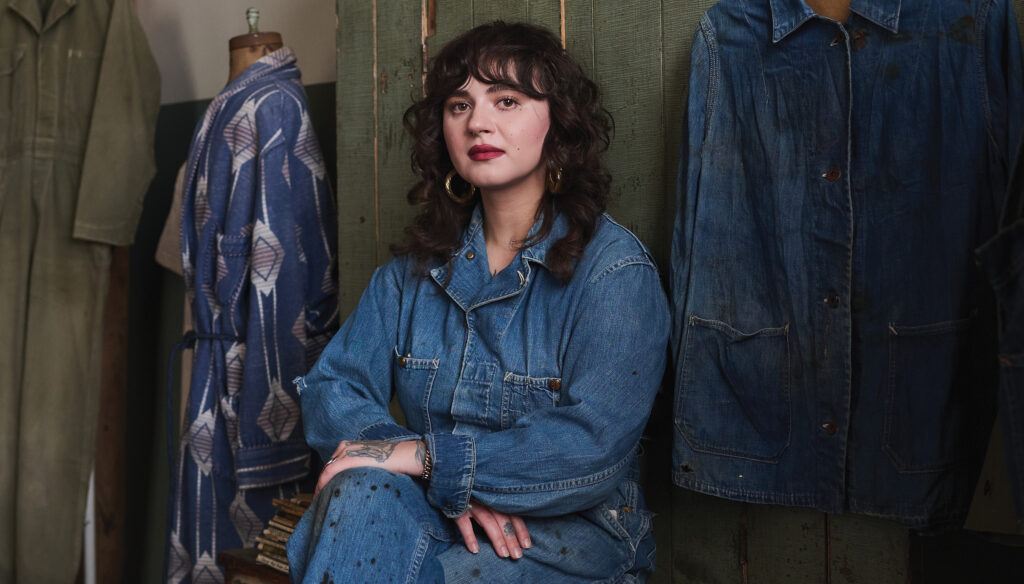
Coveralls with paint splatters. Denim dresses with sewn-on patches. The pre-1950s clothes that Noelie Ronczka collects for her shop, The Brass Lady, aren’t pristine, but they’ve survived to tell a story. “You can’t help but wonder about what the person’s life was like who owned this,” she says.
Ronczka is inspired by the blue-collar history and make-do mentality that comes from vintage workwear. She and her partner wander across rural Wisconsin to find these treasures, knocking on doors to gain entry to attics that might be packed with old clothes. She repairs and restores everything by hand but keeps the signs of wear that ooze character.
“I buy high to sell high,” Ronczka says of her prices – usually $150-$650 but sometimes touching four figures. That’s to ensure whoever buys an item values it like its original owner did. “What would make me happiest at the end of my life is knowing that I had a small hand in keeping these things around for another 100 years.”

Celebrate this year’s winners of the Betty Awards!
How would you describe your aesthetic?
I sell pre-1950s American workwear and antiques. As far as the antiques go, I have a specific taste. It’s changed throughout the years, but I mainly am drawn to things that are handmade, things with character. … People used what they had to get by.
If you’re a farmer back in the 1930s when the Great Depression hit, you only had one pair of overalls. If you needed to go out in the field and work the next day and you busted a hole in your only pair, you had to rely on yourself and your skill set to repair those. It was very utilitarian.
These pieces have a history, and you’re drawn by what stories they may have to tell. Why is that?
This ties into part of the reason why I got into vintage clothing in the first place. … Some of my earliest memories are sitting on my grandma’s lap after she had pulled a literal drawer down from this old armoire in our attic, stuffed to the gills with antique photographs, family snapshots, photo albums. I don’t know if you’ve ever seen the show “Golden Girls,” but she calls herself the Sophia Petrillo of the family – she had a story for every single photograph. As I’ve gotten older, I’ve picked up on more details from those stories and learned to appreciate them a little bit more … I’ve learned from a young age to appreciate a good story.
Another reason you collect these pieces seems to be because they’re made to last.
That ties back to the fact that people had to use what they had. Think about it this way: You go into a big-box store nowadays and you buy a pair of jeans and they’re 20 bucks. You’re not going to appreciate them or care for them as you would something that you spent a lot of time saving up for.
Something that’s important to note is my father died when I was very young. I was 8 years old, and my mother and my grandparents joined efforts and raised my younger sister and me. We were from a long line of factory and farmer workers – you know, blue-collar workers. When you’re raised in an environment like that, where you have to work hard to save up for the things that you want, you learn to appreciate quality and that things are meant to last a long time.
How do you source these items?
Estate sales, flea markets. There are so many memories of [my partner] Chris and I driving overnight to get to an estate sale and ensure like that we’re first in line, many cold nights in church parking lots. When you’re a small woman covered in tattoos and you’re wearing bib overalls, it’s very jarring and confusing for a lot of these farmers [when knocking on their doors], because they think you’re trying to sell them something, or you’re cosplaying. You can only say so much to someone when they’re in the process of shutting the door in your face.
But for however many times we get told no, it makes it worth it for that one time that we do knock on someone’s door and they’re like, “Yes, you can come in and look and buy my family’s items. Anytime you get permission to go into a place and see someone’s untouched history, it’s like a true treasure trove.
How do you even find these houses?
Driving. A lot of back roads, a lot of going off the beaten path and taking those old highways in the country. We used to do a lot of mapping before we would go out; we would zoom in on small towns and say, “I think that’s an old house. Maybe we can try and leave our contact information.”
But it’s kind of just word of mouth sometimes. When we’re picking in small towns, it’s a lot of times a very uncomfortable situation walking into a townie bar and you see all these people who look at you upside down like you surely don’t belong here. But we’ll sit down, have a beer and chat with the locals and say, “This is what we do, and we pay well for it.” And sometimes it leads us to places.
When it comes to repairing items, how do you decide what needs fixing and what should stay because it adds character?
At the end of the day, I will try and repair every single little thing that I can because ultimately, a fully fixed or restored item is going to sell for a little bit more. But for my own personal wardrobe, I will wear things with holes in it and stains. As a blue-collar worker myself, I will wear true vintage to the cafe that I work at. It’s a conversation piece, because someone’s going to look at, for instance, my 1940s Headlight brand coveralls – the denim has the original paint splatters and oil stains all over the legs. And someone’s like, “I can’t help but ask…”
How do you price your clothes?
My thing is, I buy high to sell high. Sometimes that means an object will sit on my website for months. I, of course, come down, or I always entertain offers as well on pieces, especially if it’s going to someone who you know will wear it and will appreciate it. But the sentiment remains that if I’m not looking to get top dollar all the time on things, I just want to see them sell for a price that someone will want to care for it and will appreciate it. There’s this trend I’ve noticed in the reselling community where people will buy a lot for really cheap and sell it for really cheap – the same eras that we’re selling – and I don’t know. I feel like somebody buying a pair of 1930s pants for $100 will not make someone see the intrinsic value of it.
Let’s say I pay a couple $100 for a pair of overalls, and they are in pretty worse-for-wear condition. I’m hand repairing a lot of these pieces. I don’t even use a sewing machine, which is a little crazy. I like the steady, slow and controlled motions of hand sewing. At the end of the day, if I’m repairing something, I want to sell it for what it’s worth, at a bare minimum, plus pay myself. And I want it to be something that someone will treasure, so someone has to invest in it.
Tell me a bit about your Bay View warehouse showroom space.
Three months into renting the space in that 1880s warehouse, my grandma was telling stories, as she does. She was telling me that my great, great – possibly three great – grandfather worked there when it was a machine shop. When she told me that we have a family history there, people who worked in that factory space, and now we’re having our showroom space there – it’s like, “Oh, this makes sense.” It just felt right. Kismet, almost.