
Northern Wisconsin
Quince Mountain was packed. Eighteen Alaskan huskies. Nearly a ton of food, including 300 chicken legs. His ax, his parka. He had said goodbye to his wife and their toddler twins and set off from their home on a 3,000-mile road trip to Alaska, with a goal of finishing the Iditarod, this time.
Mountain, who also goes by “Q,” knew he wasn’t the fastest racer. He just wanted to make it to the finish line in Nome. “It’s guaranteed to be an adventure, no matter what,” he said.
The 47-year-old had decided to enter the Iditarod in November 2024. At the time, while his writer-adventurer wife, Blair Braverman, was in Antarctica, he was home training dogs and taking care of the babies. He was unsure when he would have another chance to take on the monumental challenge of the Iditarod, which starts with training a dog team, completing qualifying races and raising around $70,000.

Check It Out!
Braverman and Mountain are the two parts of BraverMountain Mushing, a team based in the small town of Mountain, Wisconsin, and in Michigan’s Upper Peninsula. They’ve gained a social media following by personifying their dogs with humor and countering their haters with wit. Their fans are known as “Ugly Dogs,” inspired by a Twitter troll. Braverman finished the Iditarod in 2019, while Mountain’s first attempt in 2020 was cut short by the COVID-19 pandemic.
“I’m not out there trying to win,” Mountain said. “I just want to have a successful race with a happy team of dogs and learn a lot together.”
Joe Redington Sr. founded “The Last Great Race” in 1973 to preserve the Alaskan husky breed and the tradition of using dog teams and sleds to traverse Alaska’s vast wilderness. “Everybody thought he was crazy,” said his son, Raymie Redington. The Iditarod meanders for about 1,000 miles along old mail routes between remote villages, many of which are hundreds of miles from the nearest road. The 2024 winner finished in just over nine days; the last musher to finish was three days behind.
This year, Mountain drove his Ford F-150 for five days with his dogs and supplies to arrive in Alaska on Feb. 13. He handed over 57 drop bags to planes that would freight his essentials – all that food, hundreds of booties to protect 72 paws – to 20 checkpoints.
He was ready.
Back home, Braverman and the twins were staying with family to help with child care. Mountain’s mother was back in a nursing home near Chicago after she’d fought and recovered from a virus. During a long battle with memory loss, she struggled to recognize family members, but for the holidays, she’d sent a gift to each of the family’s 21 dogs, writing each dog’s name on their own envelope and tucking a dollar bill inside each one.
About one week before the race, Mountain went into town, in Fairbanks. His phone rang. It was his wife. His mother had died.
Fairbanks
ON HIS NEXT RUN with the dogsled team, just a few miles from their dog yard, Mountain felt something he’d never experienced on the trail: terror. He’d always found refuge in the outdoors, a child who struggled to fit in as he grew up in Chicago and later northern Wisconsin. But now, he was overcome with a crippling fear that if something went wrong, he couldn’t handle it.
A musher must be fully present and attuned with his dogs on the trail – to immediately notice if they were changing direction, or if they saw danger ahead. These things that had always been subconscious for Mountain were now requiring effort. He cut the run short after just 12 miles.
He took a few days off and spent his time talking with family. Mountain was dealing with a sense of regret on top of the loss. Even though he knew her health challenges made it unrealistic, he wished he had been able to care for his mother in his own home. “It is what it is,” he said. “What’s done is done. I can’t have this idea that I might restore or repair. It’s not gonna happen.”
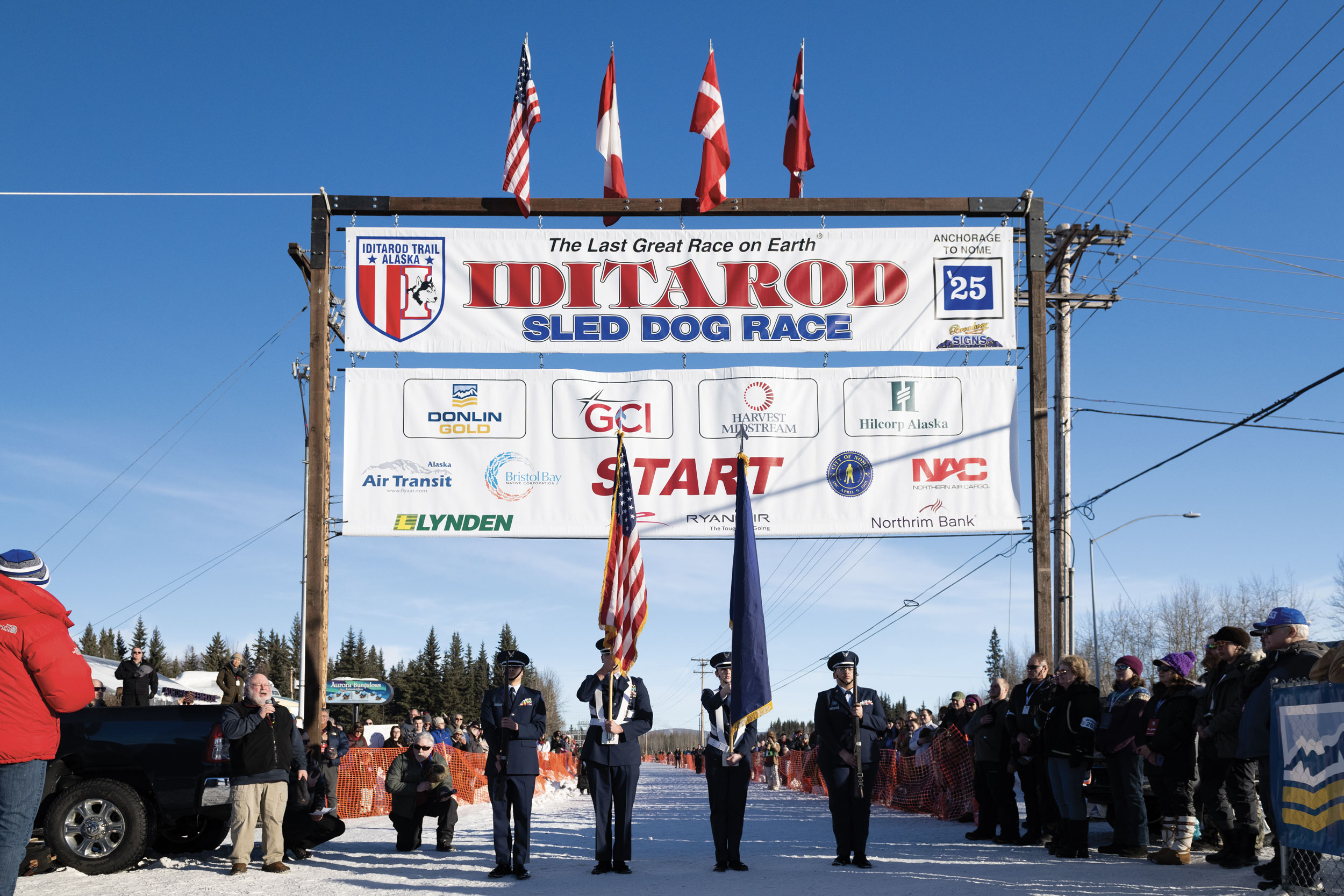
While he was processing the early stages of his grief, other racers were on daily runs, reviewing strategies and navigating a complicated change to the route. Just two weeks before the Iditarod began, a lack of snow in south-central Alaska forced race officials to move the start from Willow to Fairbanks. That 360-mile drive north is roughly equivalent to that from St. Louis to Milwaukee.
That was the easiest part of the logistical complication. Mushers had their drop bags carefully packed weeks earlier with supplies sufficient to travel the distance between drops, filling giant burlap sacks marked “Skwentna” or “Rainy Pass,” checkpoints along the trail that were no longer on the route. The bags would be at the new locations, but the supplies would not match the new distances between villages.
The 2025 race would end up being the longest and warmest in Iditarod history. Temperatures on the trail often climbed above 0; dogs prefer temperatures around 10 below. And the new route added about 130 total miles to the race – about a full day’s racing at the average speed of 8 mph.
Anchorage
ON MARCH 1, two days before the actual race began, the ceremonial start in Alaska’s biggest city was a chance for the mushers to be the rock stars they are to Iditarod fans. Crowds lined downtown streets to watch them make a symbolic first leg of the journey – this time, with snow imported from farther north – and the mushers met adoring and curious fans.
Mountain, who’s 5-foot-7, stocky and bearded, emerged from his trailer, wearing fleece pants and a bright-blue hoodie that matched his eyes. He tended to his dogs, moving meticulously, and came to life when he addressed his fans with his warmth and self-deprecating humor.
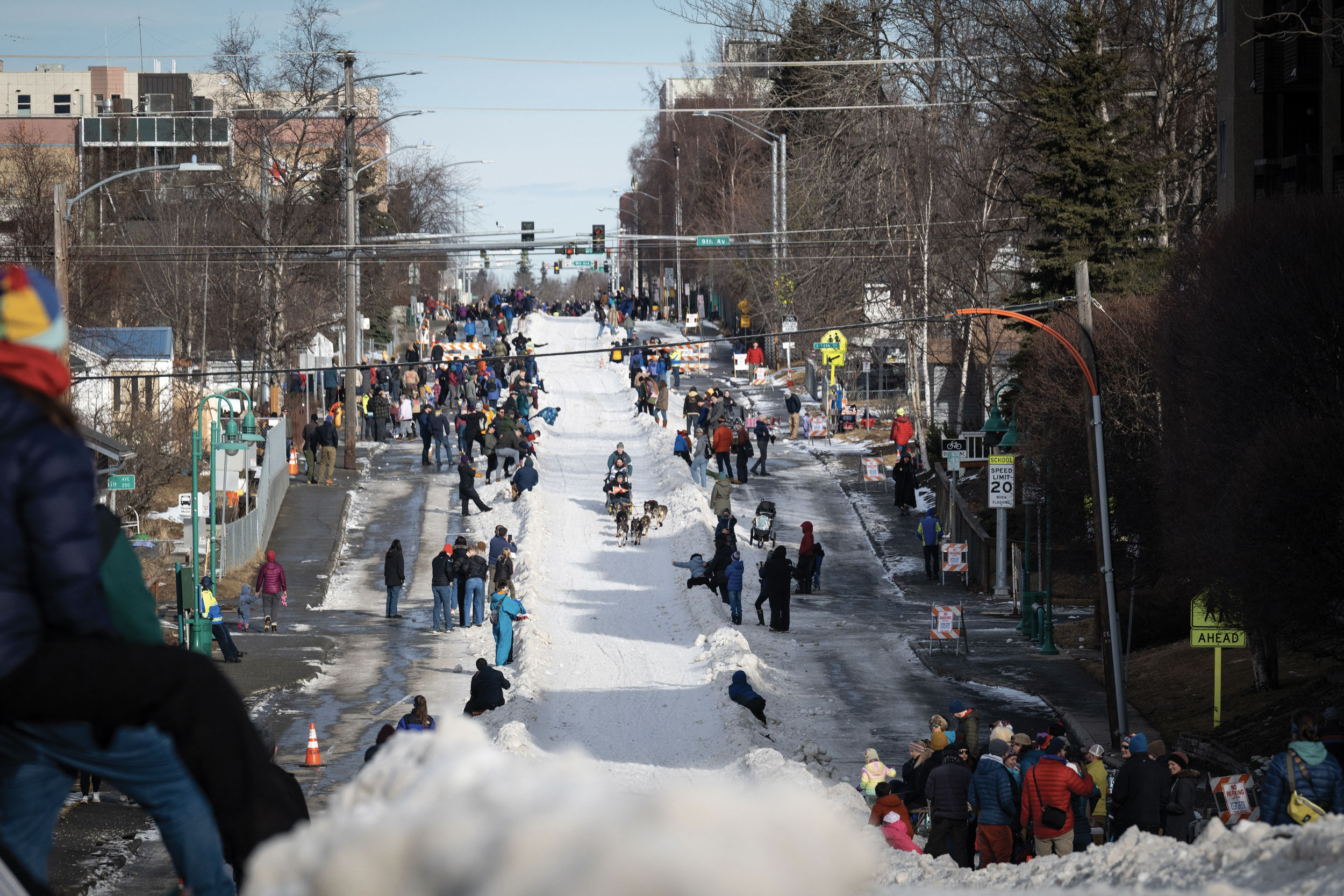
While Mountain was a relative newcomer to the Iditarod, he could barely go a minute without being recognized by strangers. Gerty Flagg, a math teacher who came all the way from Grinnell Elementary School in Derry, New Hampshire, handed Mountain a waterproof envelope bulging with letters from her students. Iditarod Insider, a crew that posts updates on the Iditarod website throughout the race, filmed Mountain as he read a few of the letters.
One asked what his favorite part of the race is. “This!” he said. “Hundreds of people come out to volunteer to make this race happen. It’s incredible.” How much do the dogs eat? “A lot!” he said – the dogs burn 10,000 calories every day on the trail. “Which is like a guy my weight eating like 45 Big Macs a day.” “I hope you win,” another letter said. Mountain laughed.
“I’m not going to win. I’m sorry,” he said. “A lot would have to go wrong to other people for me to win, and I don’t want that to happen.”
The spectators included about two dozen Ugly Dogs who traveled from across the Lower 48 to Alaska and gathered near Mountain’s trailer to see him start his Iditarod journey.
Each year since Braverman’s run in 2019, the Ugly Dogs have raised money for rural communities along the Iditarod trail, calling their fundraiser “Igivearod.” It started when a fan learned about a school in Nikolai whose students were struggling to fund a trip. The fan sent out a tweet to the Ugly Dogs, and the trip was funded in less than a day. The momentum continued as the group identified more school fundraisers along the Iditarod trail and funded them all. (During the 2025 race, Igivearod raised a record-breaking $138,646.)
“It’s proof positive that for all the toxicity that you can have on social media – and God knows it’s out there – people can connect in a way that they never could have [otherwise], and I think that’s a pretty beautiful and amazing thing,” said Erica Phillips of Boise, Idaho, who joined the group in 2018.
The group supports one another both on- and offline. Among the Ugly Dogs was Daniel Lent, a longtime volunteer with the Iditarod Trail Committee, and his wife, Kristie. When Lent contracted MRSA, an infection resistant to antibiotics, affecting his heart, the group raised more than $40,000 to support them. Mountain visited him in the hospital in Seattle.
“I felt such energy and presence, and I was so reluctant to leave,” Mountain said. “‘Happy trails’ – that’s the last thing he said to me, and I thought, ‘Oh, he’s thinking maybe he’s not going to make it.’”
Lent died Oct. 11, 2023, at age 40.
Before the ceremonial start, one of the Ugly Dogs reached across the temporary fence to Mountain, handing him a small pill bottle of Lent’s ashes. “I told him he’s gonna get spread under the arch,” she said, referring to the finish line in Nome.
“OK, is that what we’re doing? Now I’ve really got to get there,” Mountain said, disrupting the melancholy with humor. “If I don’t make it, I’ll say, ‘Well, Daniel, we made it to Tanana,” the third checkpoint, about 10% of the way through the race, he said as he mimed scattering the ashes with a look of resignation on his face. The group dissolved into laughter. “He’d probably love that.”
Fairbanks
THE ONLY ROAD connecting Anchorage and Fairbanks is the two-lane Parks Highway, which cuts through the 600-mile Alaska Range and offers panoramic mountain views, including of Denali on clear days. Headed north, about 80 miles from Fairbanks, the landscape abruptly shifts to sweeping valleys of boreal forest and then the vast tundra of Alaska’s Interior. The few signs of civilization come as a lonely gas station every 100 miles or so. As the mushers made their way north, the highway was lined with towering piles of snow that melted into the road and refroze under their trailers filled with dogs.
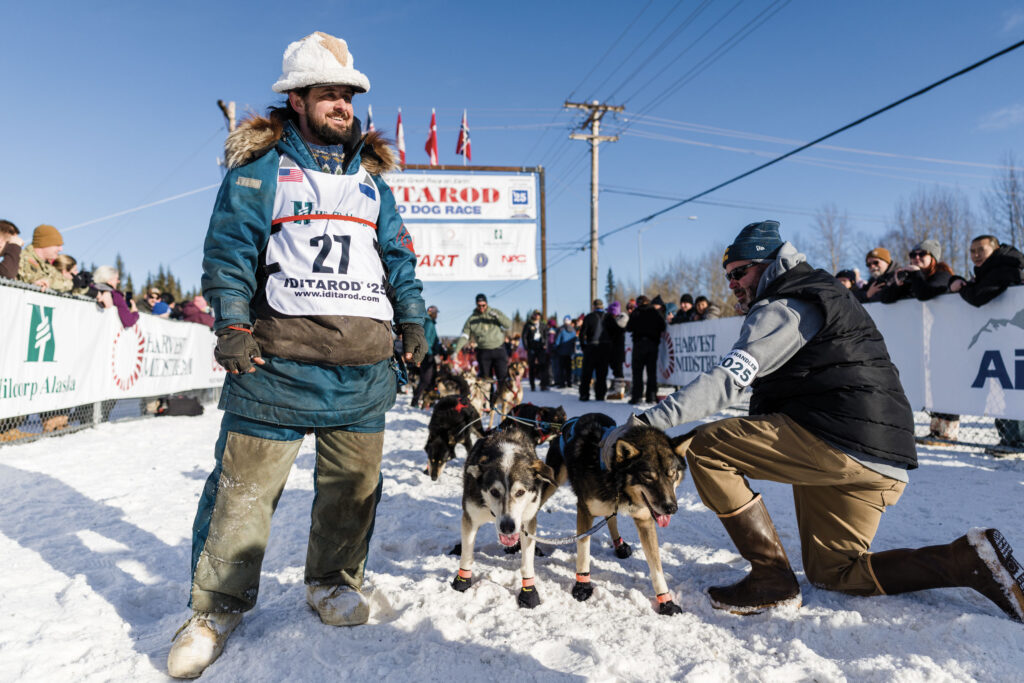
At the starting line, hundreds of people lined each side of the starting chute flanking the Chena River, one of many frozen waterways that Alaskans have used as winter highways for thousands of years. “Once you pull the hook and the race starts,” said Mountain, wearing bib No. 27, “you’ve done everything you’re gonna do to be prepared. The dog team is what it is. You can’t change anything out, and you just go.”
Quince Mountain, the first openly transgender Iditarod musher, said he encountered more positive than negative responses related to his identity, including “nothing but support” from his fellow mushers. When he does encounter negativity, he remembers that he had to get over his own internalized transphobia. “Then why would I expect that somebody who just met me along the trail for three minutes would be totally over my transness?” he said. “It’s an unusual thing for a lot of people, and I get that they might be chewing on the whole idea for a while.”
From the starting line, mushers leave the road system and enter the wilderness, crossing the tundra from Fairbanks westward to the shore of the Bering Sea. Checkpoints in Alaska Native villages are manned by volunteers, including veterinarians who monitor the health of the dogs. After the vet check, mushers can choose to rest at the checkpoint or simply pick up their supply bags and fresh bales of straw (bedding for the dogs), and continue racing. But they must take three mandated rests; one of 24 hours and two of eight hours. They take shorter breaks throughout the race, often resting during the day and running during the long nights, when the temperatures are most favorable for the dogs. Between checkpoints, mushers’ only contact with the outside world is a GPS equipped with an emergency beacon.
Fifty miles down the trail at the first checkpoint in Nenana, a lanky teenager was awaiting the mushers’ arrivals, stirring an enormous pot of moose soup over a wood fire. This bridge town is named for its intersection of mountains and rivers in a valley at the foot of the Alaska Range. Local children decorated the tribal hall with drawings and notes to the mushers, and a spread of food was laid out for visitors. The floor was lined with sleeping bags for volunteers who would stay up late into the night until the last musher came through.
Iditarod legends were monitoring the race at the checkpoint. Raymie Redington, who ran in the first Iditarod, was keeping tabs on the group of mushers that included his son, Ryan Redington. In the 1970s, snowmobiles, or as Alaskans call them, “snow machines started coming and people were getting rid of dogs,” Raymie said. “My dad wanted to make sure that dogs kept racing.”
Today, he said, the cost to maintain a racing dog team is increasingly prohibitive as food and transportation costs soar, especially for Alaska Natives whose supplies must be flown from remote villages.
Nenana is among the larger Native villages and one of a few that is accessible by road year-round. It has a population of about “350 on a good day,” said Village Chief Donald Charlie. The Iditarod boosts Nenana’s economy and gives the young people a chance to show visitors their Native Athabascan values of humor, hard work, friendliness and generosity. “It’s often said that when somebody comes to visit you, they don’t leave the house hungry,” Charlie said.
The teens brought hot coffee and soup to the mushers as they arrived at the checkpoint, where dogsled teams paused for their veterinarian checks and to collect their drop bags. Some stopped for a short rest.
At about 8:30 p.m., Mountain checked in to Nenana, pausing for a brief rest in the quiet just ahead of the checkpoint. Ahead of him were 29 mushers; trailing him, only three.
Manley Hot Springs
AFTER ANOTHER 85 MILES and nearly 24 additional hours on the trail, Mountain pulled his team into the second checkpoint at about 7 p.m. in a stupor. He had slept perhaps a few hours in three days, since the night before he drove the team up to Fairbanks. Before his own rest, he painstakingly laid out straw for each of the dogs.
Six other teams were quietly resting at the checkpoint, fanned out from tow lines on their sleds, each dog nested in its own bed of straw.
A volunteer coaxed one of Mountain’s dogs, Deshka, from her place on the line. “There will be more hay where I’m taking you,” she said in a baby voice. “Come on. There’ll be boys there! There’ll be boys there, too!”
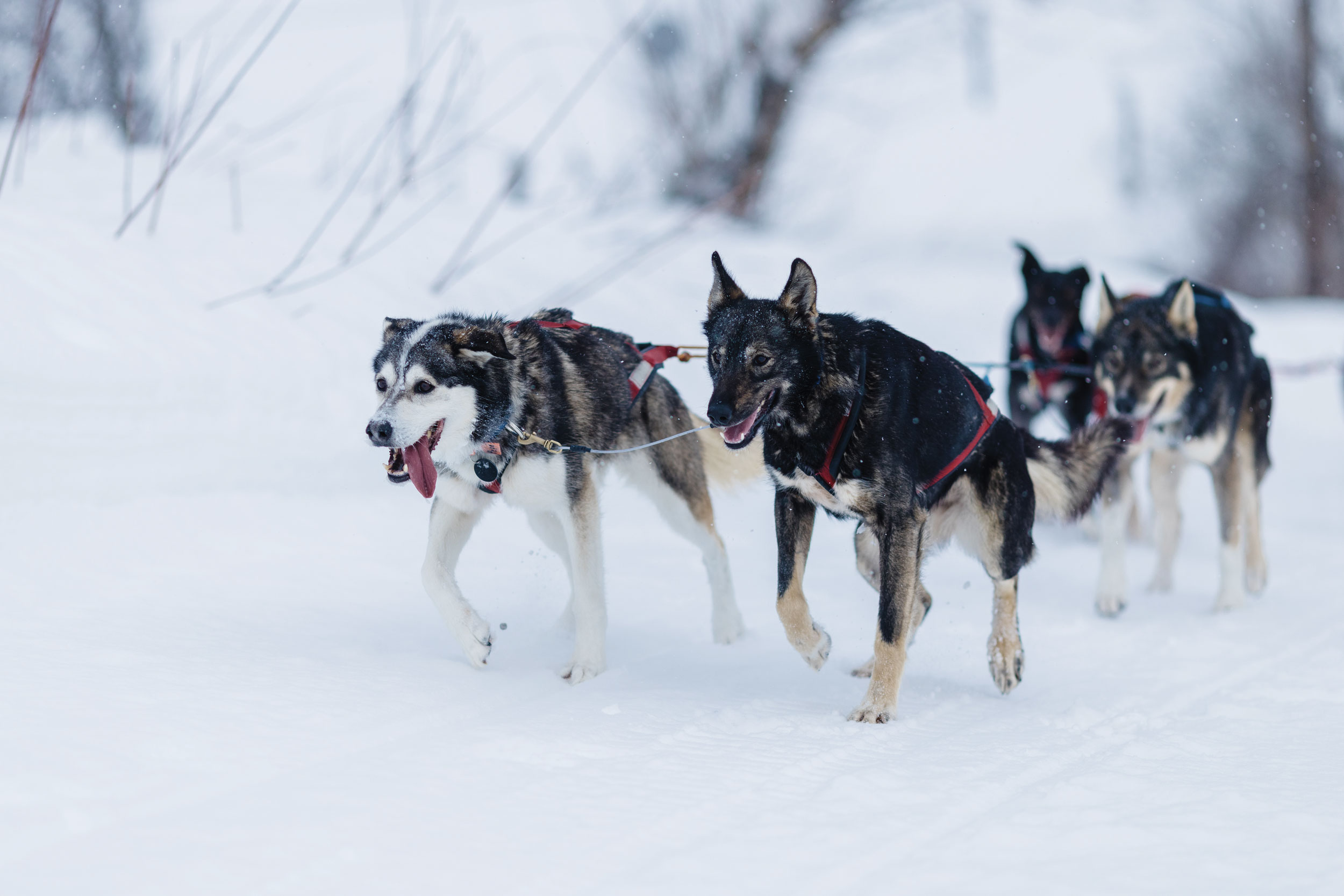
Deshka was leaving the race. She’d turned from a key member of the team to a major distraction after she unexpectedly went into heat. “The team is great, so much so that they want to make puppies,” Mountain said. Mushers have the option of leaving dogs in the temporary care of veterinarians at checkpoints, as long as they keep a team of at least five dogs.
After the dogs were settled in, Mountain sprawled out on a snowbank. “If I fall asleep during this interview, you have to wake me up in an hour and a half,” he said. He told slap-happy stories of minor mishaps on the trail, like tossing a bottle of orange juice to a fellow musher and losing it in a snowbank.
He fed the dogs chicken quarters and fish before looking in his sled for some food for himself. There were mashed potatoes, but he didn’t want to eat those cold. He was excited to come across some caffeinated chocolate, setting it aside to eat after his nap. Along the trail, he had treated himself to a frozen gummy bear for every mile that his team crossed.
Mountain curled up in his sled, pulled a parka over himself and took out a kitchen timer, set it for 80 minutes and quickly drifted into a brief sleep. At about 2:15 a.m., he left the checkpoint in last place, more than three hours behind the next musher.
Kaltag
MOUNTAIN WAS MAKING HIS WAY DOWN the trail at a halting pace. The death of his mother was a heavy weight he had not planned to carry across 1,000 miles of frozen wilderness. And Braverman and the twins were always on his mind. He encountered tough love with Iditarod veteran Jessie Royer at the first checkpoint in Grayling. He realized he was worrying too much about the team, projecting his own anxieties onto the dogs and taking unnecessary breaks. His dogs weren’t the fastest, but they had the endurance to keep moving, and they were losing momentum every time they stopped.
“It was a projection of my own stuff that was going on at the time,” he said. “I started to let the dogs just run their run and get out of the way.”
His team’s average speed increased from about 4 mph to over 7. On March 9, six days after leaving Fairbanks, Mountain arrived in Kaltag, about 65 miles from the Bering Sea. He was roughly 40% through the race.
While resting at that checkpoint, in an interview with Iditarod Insider, he told the public for the first time about the death of his mother. He said it had taken his head out of the race, and for the first few legs of the journey, he knew he was falling farther and farther behind. “I was like, ‘How could I possibly do this race? Why am I here?’ It was really hard, and then something happened,” he said. “I couldn’t imagine how I’d finish the race. But then I was trying to imagine ending my race, and not doing it, and I realized I couldn’t imagine that at all.
“It’s like a switch flipped,” he continued. “I need to just focus on being here and being present. I don’t know exactly what it means, but that’s my job right now. It’s what I need in my life, ’cause I couldn’t sit with that reality of not finishing, or at least not giving it my best.”
Grayling
THREE DAYS LATER, after a course loop to the south, Mountain checked back into Grayling, the 12th checkpoint of the race. There, his Iditarod suddenly came to an end.
The race officials told him he needed to stop. It was time to quit.
While the Iditarod does not have predetermined cut-off times, officials exercise Rule 36 when they determine a musher has fallen too far behind. Mountain was pulled, along with musher Sydnie Bahl, who was about six hours ahead of him. It was a controversial decision. “This is one of the dirtiest tricks ever pulled by the Iditarod,” longtime Iditarod veteran Vern Halter said in a post on Facebook cited by the Anchorage Daily News. “Something is seriously wrong with the Iditarod mentality of not helping and encouraging finishers – no matter where they are or in what position.”
Race Director Mark Nordman said that with the massive infrastructure that goes into supporting mushers, with volunteers from all over the world at checkpoints, there is a time when race officials must make a tough logistical decision to consolidate checkpoints and send the trailing mushers home. When Mountain was pulled, eventual winner Jessie Holmes was about 170 miles from the finish line. Mountain had 468 miles left. “Quince put in a valiant effort,” Nordman said. “It’s heartfelt. It’s hard to pull somebody from a race.”
Mountain’s fans heard little else after the Iditarod’s announcement. The next day, Braverman posted on Patreon: “My apologies for this extremely short note, as a lot is happening right now, but I just wanted to let you know that Q and dogs are doing well and getting lots of food and rest.”
The cryptic message held a note of finality to the fans who knew Mountain had been pulled from the race. But Braverman left some things unsaid.
A few days later, Mountain’s dog handler still had not heard from him either and was waiting for an update on when to drive his truck and trailer down to Anchorage to meet him after his flight out of the race. “I’m trying to give him space,” she said in a text to me. “I imagine he’s processing a lot.”
Several more days passed without public word. His followers were becoming worried. They expected he would be home by now, or, at least in a place with cell service.
He broke a week of silence on March 20, replying to a text I’d sent him six days earlier, commiserating after he was pulled from the race.
“You know what tho?” he wrote. “After I was withdrawn, I mushed the dogs up the coast to Nome. :))))”
Nome
MOUNTAIN HAD DECIDED TO FINISH the Iditarod anyway. He gave up his tracker and trouble button. The remaining checkpoints, with their two veterinarians, supporting volunteers, awaiting drop bags, and sometimes food and hot coffee, were closed. Instead, Mountain packed everything he could onto a smaller sled and pared down his team to six dogs. He had his satellite phone, and a friend with a snow machine was on call for rescue.
Mountain and his dog team approached Nome on March 19, 18 days since the race’s start in Fairbanks. News from locals about his pending arrival traveled up the trail. A fire truck was waiting to escort him down Front Street to the burled arch, where a group of residents was waiting to cheer him across the finish line.
Mountain’s lead dog, Pepé, was 11 years old when she crossed the Iditarod finish line for the second time. Pepé was also the lead dog that brought Braverman across the finish line in 2019.
Mountain said that like many older people, Pepé is a bit slower, but she has incredible endurance and deep experience. “She knew where we were going. She mushed to Nome before. She just wasn’t too stressed out about it,” Mountain said. After Pepé’s Iditarod finish, she was retired from racing.
“They fucking did it,” Braverman told the Ugly Dogs and the rest of the world on social media. “They mushed to Nome.”
Mountain didn’t begrudge the race officials and understood the logistical reasons for pulling him. But he said it would have felt strange to end the race with the dogs packed onto an airplane, when the team was healthy and ready to continue. “You didn’t end it knowing it would end,” he said.
He consulted with race officials and flew with the dogs to Unalakleet, two checkpoints ahead of Grayling. He rested for about two days, allowing the last remaining mushers to move ahead of him so he wouldn’t interfere.
He decided he would mush at least to Blueberry Hills, a spot with a shelter cabin where he’d planned to pay tribute to his late friend Lent. “I scattered his ashes right by the dog team, where they were bedded down,” Mountain said. “Countless Iditarod dog teams have and will bed down in the same spot, and I know Daniel would love that.”
After a rest in the cabin, Mountain woke up and decided to keep going. “It felt clear to me that I was doing what I needed to do,” he said.
The race became a spiritual journey for him: “I’m not the same before and after this.” On the trail, he began to process his grief and learned life-changing lessons from his dogs.
The final stretch’s more relaxed pace gave him the time to connect with people on the trail. Mountain described villagers bringing him rags and clothing for the dogs’ beds, in place of the straw. A little girl whispered messages in the dogs’ ears while they rested.
A woman gave him a coffee can of grocery-store-grade food for the dogs – athletes that typically eat $80 bags of food. One dog had been losing her appetite on the trail and suddenly regained it. “Those dogs were so excited to have something new and different. Maybe it’s their version of being an Olympic athlete in training and now someone hands them a Big Mac,” he said. “It ended up being this gift I was so grateful for. Sometimes you don’t even know what you’re gonna need.”
Later, he encountered a young man snowmobiling on the trail. They struck up a conversation that eventually turned deep, and the young man told Mountain he was battling suicidal thoughts. He asked Mountain how he kept pressing on through the challenges he was facing.
Mountain told the man that while he was struggling, the dogs kept moving forward, pointing forward, no matter what. When they encountered a mountain, they were focused solely on finding their way up and over it without wasting a fleeting thought on giving up. “They don’t think about just turning around. That’s not how these dogs are wired,” he said. “It’s like they don’t even seem to know it’s an option.”
Mountain had been feeling a pull toward home and wrestling an insistent thought of why he was there on the trail instead of with his mother when she died. Later, when the young man’s mother texted Mountain to say she was grateful for their conversation, he found a reason.
“Maybe this is what it was all about, being here for this person at this moment,” Mountain said. “Who knows? But there’s bigger stuff that happens.”
Alyssa Choiniere is a freelance journalist and flight medic based in southwestern Pennsylvania. This is her first story for Milwaukee Magazine.