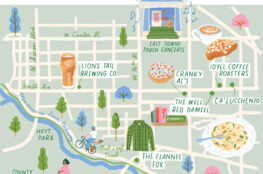


Map of Clarke Square Points of Interest

History
As ethnically diverse Walker’s Point residents began moving west in the late 1800s, a new neighborhood emerged around a little park that was eventually named Clarke Square after the original purchasers of the land decades before. German, Irish and Scandinavian immigrants (both working class and wealthy) created homes, businesses and churches. In the 1920s, Mexican immigrants moving to Milwaukee for tannery jobs began forming a Latino community that now comprises over 60% of Clarke Square. Later, after 1968 when Open Housing laws were finally passed, small portions of the city’s African American population moved to the south side and in the 1980s, immigrants from southeast Asia found a new home there, joining Native American and white residents — making Clarke Square one of Milwaukee’s most diverse neighborhoods.
The quality of life in Clarke Square and neighboring Muskego Way is maintained and constantly improved by the work of organizations such as the Clarke Square Neighborhood Initiative and the Cesar Chavez Business Improvement District, decades-old institutions like Journey House (1969) and the Milwaukee Christian Center (1921), with its Building Neighborhood Capacities Program.
Explore the Arts
→ CLARKE SQUARE ARTIST-IN-RESIDENCE: Ck LEDESMA

Erick (Ck) Ledesma is Clarke Square’s first Artist-in-Residence, a position made possible by the Cesar Chavez BID’s Farm Project initiative. Born, raised and educated in Puerto Rico, Ledesma moved to Milwaukee in 2007 and graduated from UWM’s Peck School of Art with his BFA. He is a working artist who divides his time between Milwaukee and San Juan, Puerto Rico. During his four-month residency (through November), he will create his own art pieces (his main mediums are colorful acrylics and spray paint) and engage local residents in creating pieces, including masks, that explore personal and community identities.


→ CESAR CHAVEZ STATUE (2016)
Where: 916 S. Cesar E. Chavez Dr.
The only likeness of the prominent leader of the United Farm Workers in the Midwest, this statue was erected outside El Rey in 2016 by the Farm Project.

→ CESAR CHAVEZ MURAL (2009)
Where: 1037 S. Cesar E. Chavez Dr.
Created by Eliot Patterson of TRUE Skool and local youth, businesses and residents, this massive mural was part of the Cesar Chavez Business Improvement District’s Adopt a Community project and depicts Chavez and other Latino community leaders, the Aztec calendar and local businesses.


→ 5X3 HAYES BILINGUAL MURAL (JULY 2016)
Where: 1000 S. Cesar E. Chavez Dr.
Created by Anja Sieger, Terry Spears, and youth from the Hayes Bilingual Boys & Girls Club in conjunction with Artists Working in Education (A.W.E.), this mural made up of tessellations (or repeating geometric patterns) seeks to “make people smile and feel good when they see it.”

→ HEALTH EQUITY MURAL (AUGUST 2016)
Where: 1200 S. Cesar E. Chavez Dr.
Created by John Kowalczyk, Isabel Castro, and youth from La Luz Del Mundo church and Journey House in collaboration with A.W.E., the Clarke Square Neighborhood Initiative, and the Milwaukee Diabetes and Oral Health Art Gallery, this mural supports quality health care for all.

→ AZTEC INK MURAL (2013)
Where: 1230 S. Cesar E. Chavez Dr.
Created by Tia Richardson, Jeanette Martin, and eight STITCH Milwaukee muralists, Aztec Ink is one half of a larger mural that emerged out of a series of talking circles about living in a Milwaukee with so many challenges. The left half resides at Alice’s Garden on 20th & Garfield Avenue on the north side.

→ THE HANDALA (JULY 2017)
Where: 2433 W. National Ave.
Created by Jennifer “Kya” Espenscheid, this newest National Avenue mural is an intricate, mirrored mandala inspired by expressive photos of local residents’ hands.


→ THE HUMMINGBIRDS (MAY 2014)
Where: 22nd Street & W. National Ave.
Created by Ramiro Sandoval Arguta, owner of Rebel Ink tattoo shop, this striking spray-painted mural depicts aspects of life and connectivity through the hummingbirds, a beating heart and a woman (inspired by Arguta’s mother).


→ FREEDOM MURAL (MAY 2014)
Where: 2000 W. National Ave.
Also created by Arguta, this mural encourages freedom through its imagery of, again, a woman, as well as animals and dragonflies.

→ CannedBeatz ART SPACE
Where: 2435 W. National Ave.
Equal parts gallery, community gathering space and event venue, CannedBeatz opened early this fall and has already seen exhibits, paint parties, birthday parties and a fall beverage tasting with sweets pairings. The Art Space promises to become a vital destination community creativity.

Explore the Food
Supermarkets
→ EL REY
Where: 916 S. Cesar E. Chavez Dr.
This location opened in 2007, but brothers Ernesto and Heriberto Villarreal opened the first El Rey in 1978 with their spouses Olivia and Criselda. Since then, this and El Rey’s other three locations have been providing authentic Latino products, experiences and education to Milwaukee’s south side community.
→ PETE’S FRUIT MARKET
Where: 1400 S. Union St.
Established as an open-air market in 1992, Pete’s Fruit Market has long since expanded into a bright and vibrant store offering a diverse selection of fresh produce, meats and other products. Their new location in Bronzeville now serves up the same quality on the north side.


Food Trucks
→ BERTA’S TAMALES FOOD TRUCK
Where: 1023 S. Cesar E. Chavez Dr.
Berta’s Tamales will greet you at the 16th Street entrance into Clarke Square. The tamales hit the spot, but also try the elote (corn on the cob spread with mayo and chili powder) or elote embaso (with the corn cut off the cob).

Restaurants
→ JALISCO RESTAURANT
Where: 1035 S. Cesar E. Chavez Dr.
Try Jalisco‘s juicy barbacoa taco or the ribeye steak with avocado, which has a mild pot roast flavor — although, according to their sign, you should also try the “famous” burritos. Here, the salsa is bright and salty.


→ EL TSUNAMI
Where: 1232 S. Cesar E. Chavez Dr.
Try the ceviche or one of the caldos (broths) filled to the brim with shrimp at El Tsunami, well-known for their seafood offerings.


→ TAQUERIA LOS COMALES
Where: 1306 S. Cesar E. Chavez Dr.
Try the tender flank steak taco or the cercina, with a sweet, diced beef. And don’t pass up Chicago-based Los Comales‘ escabeche with pickled carrots, cauliflower and jalapeños reminiscent of Italian giardiniera (which I ate jarfuls of when I was a kid).


→ PHAN’S GARDEN
Where: 1923 W. National Ave.
Representing the cuisines of Vietnam and China, Phan’s Garden has an extensive menu — but people keep saying, “Go for the pho!” Currently, it appears that the long Buddhist temple mural on this oldest Vietnamese restaurant in Milwaukee is being refurbished.

→ EL CAÑAVERAL
Where: 2501 W. Greenfield Ave.
The quesadillas at El Cañaveral are folded, not sandwiched, and come with your choice of meat, plus ingredients like flor de calabaza (squash blossoms), huitlachoche (otherwise known as the “Mexican truffle”) or rajas (roasted poblano chiles).


Ice Cream
→ LA MICHOACANA
Where: 1224 S. Cesar E. Chavez Dr.
Scan the rainbow rows of icy, neon paletas and the buckets of ice cream and try to pick just one in this long, spacious ice cream shop.


Bakeries
→ LAS REYNAS BAKERY & ICE CREAM
Where: 1242 S. Cesar E. Chavez Dr.
Las Reynas creates intricate cake designs and carries a plethora of celebration decorations for events small and large: birthday parties and communions, quinceañeras and weddings.


→ GLORIA’S CAKE SHOP & CAFE
Where: 2531 W. National Ave.
Owner Gloria DeAngelo and her associates at Gloria’s Cake Shop & Cafe design beautiful cakes for every occasion (including my wedding last December) as well as an assortment of other sweets like cakes, pastries, tarts.


→ EL FLAMBOYAN
Where: 2131 S. Muskego Ave.
The first Puerto Rican bakery in Milwaukee, El Flamboyan (in adjacent Muskego Way) serves up traditional and contemporary breads, pastries and cakes as well as a tasty selection of sandwiches with jamon (ham), pernil (roast pork) and pastrami. The flamboyan is a prolific tree in Puerto Rico with “flamboyant” red flowers. Also known as the Royal Poinciana, Flame Tree, or Peacock Flower, the iconic flamboyan is often depicted in local art, as seen in the bakery’s sign.