

The clearest takeaway from Milwaukee Ballet’s MKE MIX – its latest contemporary program that just capped two weekends at the Baumgartner Center for Dance – is how strong this company has become. Now firmly established in their Third Ward studios, the Ballet has an effortlessness to presenting more intimate, contemporary programing to finally ease audiences into the 21st century.
That’s not to say they weren’t doing contemporary work before. The annual “Genesis” competition has brought some of the best and brightest emerging choreographers through Milwaukee Ballet’s doors. MKE MIX is a more recent effort to champion new voices from within the company’s ranks with a homegrown showcase. In this case, those voices are company dancers Amanda Lewis, Garrett Glassman and Eric Figueredo, whose three works ran Feb. 7-16 and fully exploited their colleagues’ talent and versatility.

Check It Out!
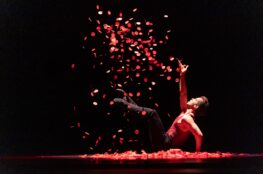
Lewis’ This Little Life opened the program, inspired by a quote from the 1989 film Dead Poets Society. Like the characters in the film, all of Lewis’ 13 dancers are uniformly dressed, sky blue bodices and flowing chiffon skirts replacing boarding school suits. The metaphor is more water than sky. Garrett Glassman is the Todd Anderson of This Little Life, breaking from the group’s undulations to take them in while evidently undergoing a transformation of his own. Most impactful are a few strategic pauses installed throughout the piece, the dancers spilling into a series of fleeting tableau or a kind of fermata in which to bask at each other, or to reflect on the vast endlessness of a rumbling sea – likely both.
Lewis is a promising voice with a lot to say. And at this stage of her career, she appears to be trying to say all of it in one piece. Moments of demonstrated restraint and dogged determination to a single idea are when she best shows that promise. Efforts to overtly communicate what the piece is about by shedding layers of costume, for example, or swapping footwear no less than four times, will likely feel less compulsory in future opportunities – and there should be many.

Figueredo’s Interlace is a bit like the yang to Lewis’ yin. Simple, striking black rehearsal clothes and a dark, moody atmosphere (made more tantalizing through its varied musical score placing contemporary ballet mainstays like Nils Frahm, Ezio Basso and Philip Glass against electronica by Caio Cesar). Both choreographers appear to be tapping into the essence of human-to-human connection, though Figueredo is less wholly committed to the idea. That’s not a bad thing, necessarily. Rather, Interlace comes across like a sketchbook of choreographed scribblings, tangling steps and bodies between and around one another with extraordinary intricacy. When the dancers finish an idea, even in the case of a protracted, exquisite duet for Josiah Cook and Marie Harrison-Collins mid-way through, they simply walk away from it and move onto the next.
Tucked between these two premieres is a revival of Glassman’s I Do, Don’t I?, created five years ago for Milwaukee Ballet’s 2020 tribute to the Ballets Russes. That program similarly featured company dancers-turned-choreographers and served as a kind of precursor to MKE MIX, which hopefully becomes an annual tradition. Glassman used Bronislava Nijinska’s Les Noces as a jumping-off point, discarding all but the very core of that iconic work to make this one. Les Noces is seen by some as a feminist counterpoint to a work by her brother, Vaslav Nijinsky. Nijinsky’s Rite of Spring depicts the ritual sacrifice of a virginal woman; Les Noces conversely draws from wedding rites and centers the women.

I Do, Don’t I? homes in on one particular wedding ritual: the bachelor party. Despite appearances, the piece is thus deeply layered with meaning – even as Barry Molina emerges from behind a mustard-hued sofa, pantsless and apparently nauseous, bottles of beer duct-taped to his hands. Indeed, in this more intimate setting than when it first premiered at The Pabst Theater, I Do, Don’t I? is made even funnier by our proximity to it, which reveals Glassman and these dancers’ keen ability to stick the landing on nearly every joke.
It’s not wholly devoid of virtuosity, either; each of the men occasionally step away from their slapstick, pedestrian milieu to perform a triple pirouette, for example, or an abundance of leaps. The chef’s kiss is a magnificent slow-motion tableau as this goofy mid-century wedding party takes its final shots of the night, the most raucous strains of Stravinsky’s Pulcinella hilariously swelling all around them.