

There has never been a morning better than the morning, any morning, when you find yourself hurtling forward through parts of Wisconsin on a bicycle.
Just such a morning as this. It began at 6:30 a.m., three minutes past sunrise, at a trailhead parking lot in West Bend on the southern outskirts of town, an otherwise unexceptional locus between rural and industrial zones. The Eisenbahn State Trail starts here, at Rusco Road, and continues north about 25 miles through Kewaskum and Campbellsport until concluding at an even less exceptional endpoint in the community of Eden. Paved for the first few miles and then mostly hard-packed dirt and gravel, the Eisenbahn is a rail trail, on right of way that formerly accommodated trains. A cyclist can depend on it for a mostly flat and mostly straight ride.
On this morning, I had it in my mind to ride the entire thing. Twice.
Wisconsin has 44 designated state trails, many of them built on former rail beds. Cyclists share them with runners, hikers, walkers, dog walkers, snowmobilers, ATVers, horseback riders, cross-country skiers, in-line skaters, unicyclers, cartwheelers, interpretive dancers, long-distance brooders and any other breed of active Wisconsinite you can imagine – though, of course, not all at the same time or on the same trail. (Check usage restrictions in advance.) Even within the cycling community, there are many reasons to experience a rail trail: the commute, the family ride, the workout, the nature sampler. Alyssa Hallgren, co-owner of Fond du Lac Cyclery, says a rail trail is a great way to get out of your head for a while – or to go in the other direction, deeper into your head, depending on your mood.

Check It Out!
A critical benefit: You don’t need to worry as much about a car side-swiping you and landing you first on the ground and then in the hospital. “Any time cars are a factor, the danger increases,” Hallgren told me when I gave her a call to learn more about the local cycling scene. On a rail trail, the cyclist’s thoughts are free to burrow inward or launch outward, feeding on the passing scenery, as you pedal, pedal, pedal.
“There’s a real peacefulness to it,” Hallgren said.
I’ve cycled on parts of the Eisenbahn before, though never the full thing. Now, on a chilly but tolerable morning in early April, I mounted my Jamis Aurora bike and pointed the front tire north, bundled up for the 37-degree dawn.
“True solitude is found in the wild places, where one is without human obligation,” Wendell Berry, America’s farmer-poet, wrote.
I was eager to escape human obligation for at least one morning but still far from the truly wild places. The Eisenbahn begins as a snug corridor shielded by trees and shrubbery, opening occasionally to reveal fields and streams. Elevated above the surrounding terrain, its sides sloping steeply down, the trail transitions quickly into an industrial zone and residential neighborhoods, with views of the backs of warehouses, trailside parks, playgrounds and neighbors back yards.
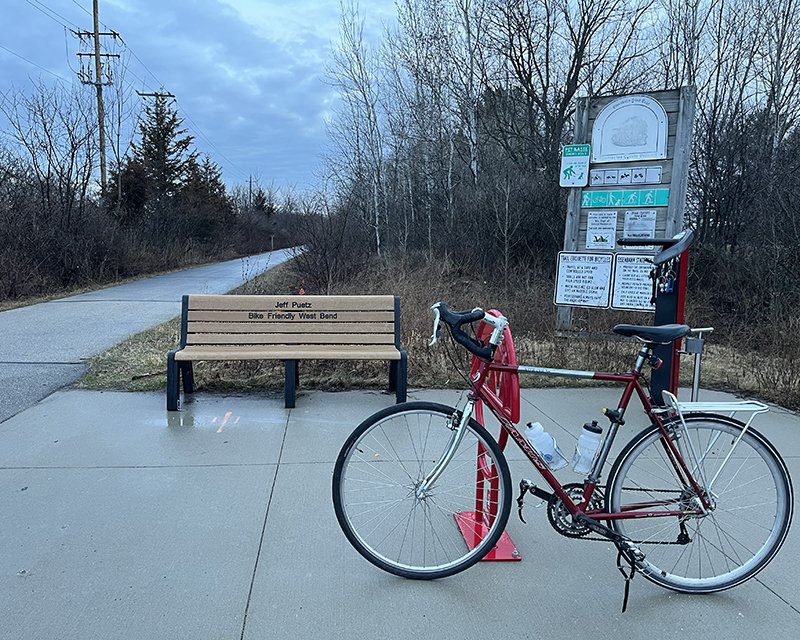
While the Wisconsin Department of Natural Resources oversees the state trail system and maintains many of its trails, some trails, like the Eisenbahn, are tended by local partnerships. Washington and Fond du Lac counties are jointly responsible for these 25 miles, with support from organizations like Bike Friendly West Bend.
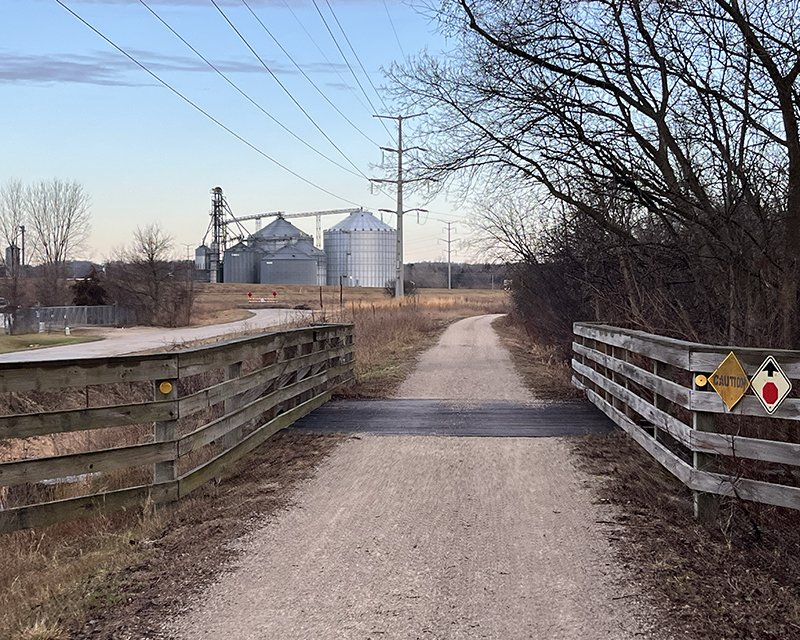
West Bend is a fun cycling town, and the Eisenbahn is a big reason. Within a few miles, the trail reaches downtown, crossing the Milwaukee River on one of the trail’s many wood-plank bridges. It rolls past a historic former railroad depot just south of Washington Street, the city’s primary east-west corridor.
A speedy cyclist passed on the left and gave an obligatory tip-of-the-helmet. I did the same, then paused and shouted, “Hi, Mark!”
Recognition. It was Mark Ramsey, the owner of West Bend’s Pedal Moraine Cycle & Fitness (a perfect local bike shop name), whom I had met two days before while researching the Eisenbahn Trail. I think he recognized me back,
“Enjoy your ride!” he hollered.
Ramsey can’t take credit for the name. Pedal Moraine, a play on the Kettle Moraine State Forest and the hills the region is known for, dates to the shop’s former owner. When Ramsey bought the business in 2002, the name stayed. It’s located on a commercial strip of West Bend’s Main Street south of downtown. More importantly, a bike connection to the Eisenbahn State Trail is less than a mile away.
“The Eisenbahn is great because it caters to all capability of riders,” Ramsey told me when I stopped by to chat with him on a lunch break.
Ramsey’s use of the Eisenbahn tends to be purposeful, as in the winter, when he can roll out his fat tire bike on the snow. In the warmer months, he takes the trail to meet fellow riders, with coffee for the goal, as was the case this Saturday when he passed me.
North of downtown West Bend, the Eisenbahn squeezes between Barton Pond on the left and Lac Lawrann Conservancy on the right. The paved trail turned to dirt near West Bend’s city limits. A long bridge carries the trail back over the Milwaukee River. I wasn’t quite to the wild places, but I was getting closer.
After passing the bulky steel landmark of West Bend Elevator, the Eisenbahn curves to the right and hugs Highway 45 for about 5 miles, through the other side of Kewaskum, population 4,400. Traffic on that parallel highway won’t side-swipe you, but it won’t leave you at peace either, as you pass Sunburst Ski Area on the left and cross the Ice Age Trail just south of Highway H.
If you live in Kewaskum, the Eisenbahn is an easy go-to route for a short walk, run or ride. Nearly all of the people I saw on my trip were within a couple miles of one of the four communities that make up the trail’s linear constellation.
On the other side of Kewaskum, I was alone again. The increasingly wild landscape produced the steady miles of agricultural fields and wetlands that make up a mostly unpopulated Wisconsin terrain once bisected by locomotives.
The future of rail trails is on the incline
A train has its limits. It can climb, but only up hills so steep. It can turn, but only around turns so sharp. And in a nation of hills, valleys and and other natural obstacles, that topography can bedevil the railroad designer. But humans have obligations. Trains need to chug, chug, chug along, so that landscape must be carved and threaded so the trains can get through.
And what happens when a railroad dies? More than 25,000 miles of carefully designed railroad beds are now multiuse trails offering outdoor adventure for runners, cyclists, cartwheelers, etc., in more than 2,400 locations nationwide and counting. Wisconsin alone has more than 100 rail trails, both state-owned and local, according to the Rails to Trail Conservancy, founded in 1986 when the movement to create such trails in the United States was chugging away.
The public’s enjoyment of those trails continues to gain steam today.
“The future of trails, not only in the state but in the country is on the rise, big time,” Missy VanLanduyt told me by phone before my Eisenbahn ride. She heads the recreational partnerships section of the Wisconsin DNR’s Bureau of Parks and Recreation Management. VanLanduyt explained that the barriers to enjoy most state trails, especially rail trails, are very low, usually just some hiking boots or running shoes, or in my case a working bicycle. “Many more people, especially since the pandemic, are getting outdoors and on our trails.”
VanLanduyt noted that the Eisenbahn is one of the shorter trails in the state network, which spans more than 2,000 miles. Eighteen other trails are 30 miles or longer, and six are at least 75 miles. Even so, a trail like the Eisenbahn’s is open to a range of uses and connects several communities.
The trail, which takes its name from the German word for “railway,” was built on the former route of the Milwaukee and Fond du Lac Airline, a branch of the Milwaukee and Superior Railroad. The original rail line opened in 1850 and remained an active until its closure in 1999, according to a Rails to Trails Conservancy guidebook. It was redeveloped and reopened as the Eisenbahn State Trail in 2006.
Morning trail ride, powered by brat
When I arrived In Eden, my straight path ended in confusion. Google Maps had told me the Eisenbahn continued to Main Street. Instead, I was approaching what initially appeared to be a dead end. The only option was a sharp right turn onto an extended, raised boardwalk, which ended at the Eden Community Center.
Strangely, no sign indicated this was the end of the Eisenbahn. To the west, I found Google’s imaginary endpoint. The trail there had transformed back into an active rail line, where it crossed Main Street. There was no bicycle access here. Don’t trust everything you read online.
In Eden, population 900, the Eisenbahn’s proper trailhead is located at the end of a short connector trail, with parking at Eden Community Park. I figured that would be my best way back, but first I stopped at the gas station next to the Eden Cafe and picked up a coffee, which was not very strong but only cost $1.
It was 9 a.m., and outside in the parking lot, the Ruff Riders Snowmobile Club had fired up the grill for its semi-annual Brat Fry. I couldn’t resist handing over $5 and taking a brat from Dan, a man clad in a Ski-Doo riding jacket. Dan told me was the first brat of the day, and the club expected to sell 250 by midafternoon, as well as 250 burgers.
Snowmobiling is an authorized use of this end of the Eisenbahn, though another club is responsible for maintaining the state trail in the winter. The Ruff Riders take care of other trails north of the Eisenbahn.
I asked Dan how the past season had been for snowmobiling. Just six days, he said, “and that’s double last year.”
Back in the saddle, I found my way to Eden Community Park and stopped to pose the bike for a photo in front of the Eisenbahn State Trail sign. Another sign, on the trail heading south, indicated the estimated mileage to Rusco Road: 24.6 miles. Now benefiting from a tailwind and a gradual downward ride back to West Bend, I was feeling a new boost of energy. However wild or solitary, there are no hard miles on a morning like this.
David Paulsen writes about outdoor adventures at The Sconnist. The following is excerpted from his April column about the state’s rail trails and a ride on the Eisenbahn State Trail, which can be found here.